
抑郁症中酰基肉碱的代谢:与荷兰抑郁与焦虑研究队列中的诊断状态、抑郁严重程度及症状特征的关联
Acylcarnitines metabolism in depression: association with diagnostic status, depression severity and symptom profile in the NESDA cohort.
作者信息
Montanari Silvia, Jansen Rick, Schranner Daniela, Kastenmüller Gabi, Arnold Matthias, Janiri Delfina, Sani Gabriele, Bhattacharyya Sudeepa, Mahmoudian Dehkordi Siamak, Dunlop Boadie W, Rush A John, Penninx Brenda W H J, Kaddurah-Daouk Rima, Milaneschi Yuri
机构信息
Department of Neuroscience, Section of Psychiatry, Università Cattolica del Sacro Cuore, Rome, Italy.
Department of Psychiatry, Amsterdam UMC, Vrije Universiteit Amsterdam, Amsterdam, The Netherlands.
出版信息
Transl Psychiatry. 2025 Feb 23;15(1):65. doi: 10.1038/s41398-025-03274-x.
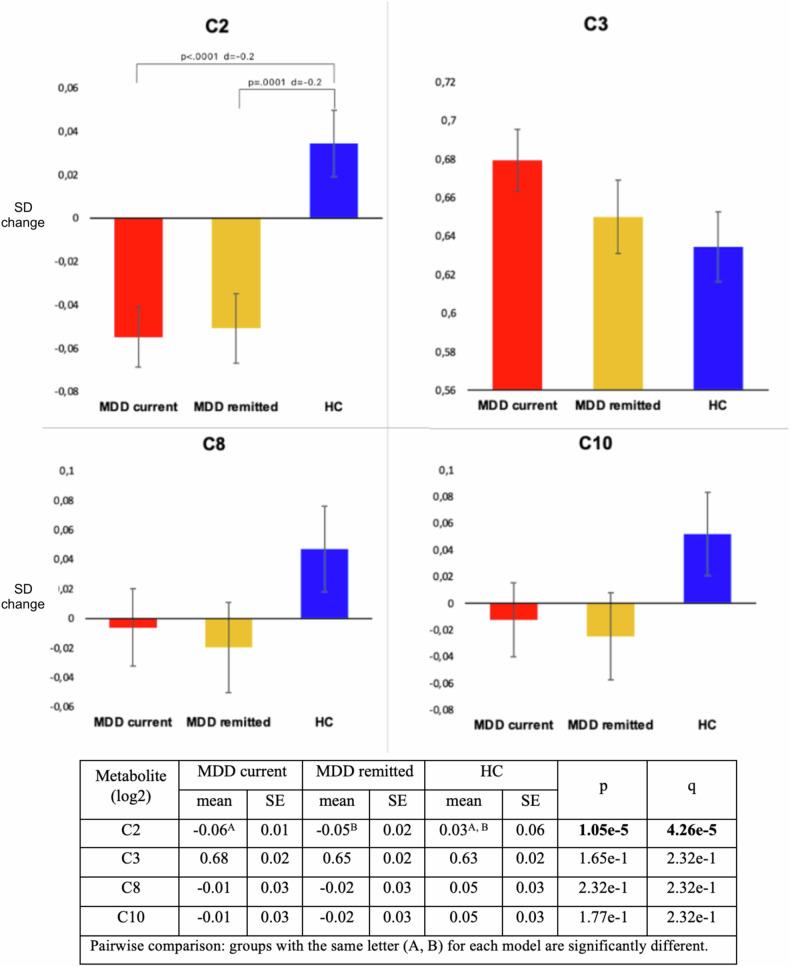
Acylcarnitines (ACs) are involved in bioenergetics processes that may play a role in the pathophysiology of depression. Previous genomic evidence identified four ACs potentially linked to depression risk. We carried forward these ACs and tested the association of their circulating levels with Major Depressive Disorder (MDD) diagnosis, overall depression severity and specific symptom profiles. The sample from the Netherlands Study of Depression and Anxiety included participants with current (n = 1035) or remitted (n = 739) MDD and healthy controls (n = 800). Plasma levels of four ACs (short-chain: acetylcarnitine C2 and propionylcarnitine C3; medium-chain: octanoylcarnitine C8 and decanoylcarnitine C10) were measured. Overall depression severity as well as atypical/energy-related (AES), anhedonic and melancholic symptom profiles were derived from the Inventory of Depressive Symptomatology. As compared to healthy controls, subjects with current or remitted MDD presented similarly lower mean C2 levels (Cohen's d = 0.2, p ≤ 1e-4). Higher overall depression severity was significantly associated with higher C3 levels (ß = 0.06, SE = 0.02, p = 1.21e-3). No associations were found for C8 and C10. Focusing on symptom profiles, only higher AES scores were linked to lower C2 (ß = -0.05, SE = 0.02, p = 1.85e-2) and higher C3 (ß = 0.08, SE = 0.02, p = 3.41e-5) levels. Results were confirmed in analyses pooling data with an additional internal replication sample from the same subjects measured at 6-year follow-up (totaling 4141 observations). Small alterations in levels of short-chain acylcarnitine levels were related to the presence and severity of depression, especially for symptoms reflecting altered energy homeostasis. Cellular metabolic dysfunctions may represent a key pathway in depression pathophysiology potentially accessible through AC metabolism.
酰基肉碱(ACs)参与生物能量学过程,这可能在抑郁症的病理生理学中发挥作用。先前的基因组证据确定了四种可能与抑郁症风险相关的ACs。我们进一步研究了这些ACs,并测试了它们的循环水平与重度抑郁症(MDD)诊断、总体抑郁严重程度和特定症状特征之间的关联。荷兰抑郁症和焦虑症研究的样本包括当前患有MDD(n = 1035)或已缓解MDD(n = 739)的参与者以及健康对照者(n = 800)。测量了四种ACs的血浆水平(短链:乙酰肉碱C2和丙酰肉碱C3;中链:辛酰肉碱C8和癸酰肉碱C10)。总体抑郁严重程度以及非典型/能量相关(AES)、快感缺失和抑郁症状特征来自抑郁症状量表。与健康对照者相比,当前患有或已缓解MDD的受试者的平均C2水平同样较低(科恩d值 = 0.2,p ≤ 1e - 4)。总体抑郁严重程度越高,与C3水平越高显著相关(β = 0.06,标准误 = 0.02,p = 1.21e - 3)。未发现C8和C10有相关性。关注症状特征,只有较高的AES评分与较低的C2(β = -0.05,标准误 = 0.02,p = 1.85e - 2)和较高的C3(β = 0.08,标准误 = 0.02,p = 3.41e - 5)水平相关。在将数据与来自同一受试者的6年随访时测量的数据合并的分析中(总共4141次观察),结果得到了证实。短链酰基肉碱水平的微小变化与抑郁症的存在和严重程度有关,特别是对于反映能量稳态改变的症状。细胞代谢功能障碍可能代表抑郁症病理生理学中的一个关键途径,可能通过AC代谢来调节。


 Zotero 插件