
一项关于生酮饮食治疗双相情感障碍的初步研究:临床、代谢及磁共振波谱分析结果
A pilot study of a ketogenic diet in bipolar disorder: clinical, metabolic and magnetic resonance spectroscopy findings.
作者信息
Campbell Iain H, Needham Nicole, Grossi Helen, Kamenska Ivana, Luz Saturnino, Sheehan Shane, Thompson Gerard, Thrippleton Michael J, Gibbs Melissa C, Leitao Joana, Moses Tessa, Burgess Karl, Rigby Benjamin P, Simpson Sharon A, McIntosh Emma, Brown Rachel, Meadowcroft Ben, Creasy Frances, Mitchell-Grigorjeva Maja, Norrie John, McLellan Ailsa, Fisher Cheryl, Zieliński Tomasz, Gaggioni Giulia, Campbell Harry, Smith Daniel J
机构信息
Division of Psychiatry, Centre for Clinical Brain Sciences, University of Edinburgh, UK.
Department of Nutrition and Dietetics, Royal Hospital for Children and Young People, NHS Lothian, Edinburgh, UK.
出版信息
BJPsych Open. 2025 Feb 25;11(2):e34. doi: 10.1192/bjo.2024.841.
BACKGROUND
Preliminary evidence suggests that a ketogenic diet may be effective for bipolar disorder.
AIMS
To assess the impact of a ketogenic diet in bipolar disorder on clinical, metabolic and magnetic resonance spectroscopy outcomes.
METHOD
Euthymic individuals with bipolar disorder ( = 27) were recruited to a 6- to 8-week single-arm open pilot study of a modified ketogenic diet. Clinical, metabolic and MRS measures were assessed before and after the intervention.
RESULTS
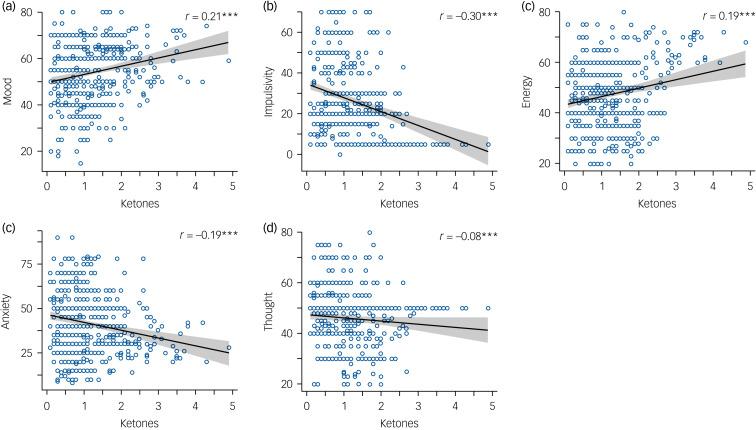
Of 27 recruited participants, 26 began and 20 completed the ketogenic diet. For participants completing the intervention, mean body weight fell by 4.2 kg ( < 0.001), mean body mass index fell by 1.5 kg/m ( < 0.001) and mean systolic blood pressure fell by 7.4 mmHg ( < 0.041). The euthymic participants had average baseline and follow-up assessments consistent with them being in the euthymic range with no statistically significant changes in Affective Lability Scale-18, Beck Depression Inventory and Young Mania Rating Scale. In participants providing reliable daily ecological momentary assessment data ( = 14), there was a positive correlation between daily ketone levels and self-rated mood ( = 0.21, < 0.001) and energy ( = 0.19 < 0.001), and an inverse correlation between ketone levels and both impulsivity ( = -0.30, < 0.001) and anxiety ( = -0.19, < 0.001). From the MRS measurements, brain glutamate plus glutamine concentration decreased by 11.6% in the anterior cingulate cortex ( = 0.025) and fell by 13.6% in the posterior cingulate cortex ( = <0.001).
CONCLUSIONS
These findings suggest that a ketogenic diet may be clinically useful in bipolar disorder, for both mental health and metabolic outcomes. Replication and randomised controlled trials are now warranted.
背景
初步证据表明生酮饮食可能对双相情感障碍有效。
目的
评估双相情感障碍患者采用生酮饮食对临床、代谢及磁共振波谱结果的影响。
方法
招募了27名双相情感障碍缓解期患者,进行一项为期6至8周的改良生酮饮食单臂开放性初步研究。在干预前后评估临床、代谢及磁共振波谱测量指标。
结果
在招募的27名参与者中,26人开始采用生酮饮食,20人完成该饮食方案。完成干预的参与者平均体重下降4.2千克(P<0.001),平均体重指数下降1.5千克/平方米(P<0.001),平均收缩压下降7.4毫米汞柱(P<0.041)。缓解期参与者的平均基线和随访评估结果表明他们处于缓解期范围内,在情感不稳定量表-18、贝克抑郁量表和杨氏躁狂评定量表中无统计学显著变化。在提供可靠的每日生态瞬时评估数据的参与者(n = 14)中,每日酮水平与自评情绪(r = 0.21,P<0.001)和能量(r = 0.19,P<0.001)呈正相关,与冲动性(r = -0.30,P<0.001)和焦虑(r = -0.19,P<0.001)呈负相关。根据磁共振波谱测量结果,前扣带回皮质的脑谷氨酸加谷氨酰胺浓度下降了11.6%(P = 0.025),后扣带回皮质下降了13.6%(P<0.001)。
结论
这些发现表明,生酮饮食在双相情感障碍的心理健康和代谢结果方面可能具有临床应用价值。现在有必要进行重复试验和随机对照试验。
 Zotero 插件