
以纳米氧化锌为光催化剂处理的原油废水的毒性:一项生化与生理研究
Toxicity of Crude Oil Wastewater Treated with Nano-ZnO as a Photocatalyst on : A Biochemical and Physiological Investigation.
作者信息
Mousaviyon Zahra, Pourkhabbaz Hamid Reza, Banaee Mahdi, Khodadoust Saeid, Pourkhabbaz Ali Reza, Trivedi Abha, Faggio Caterina, Multisanti Cristiana Roberta
机构信息
Environmental Department, Faculty of Natural Resources, Behbahan Khatam Alanbia University of Technology, Behbahan 1417614411, Iran.
Aquaculture Department, Faculty of Natural Resources, Behbahan Khatam Alanbia University of Technology, Behbahan 6361647189, Iran.
出版信息
J Xenobiot. 2025 Feb 2;15(1):25. doi: 10.3390/jox15010025.
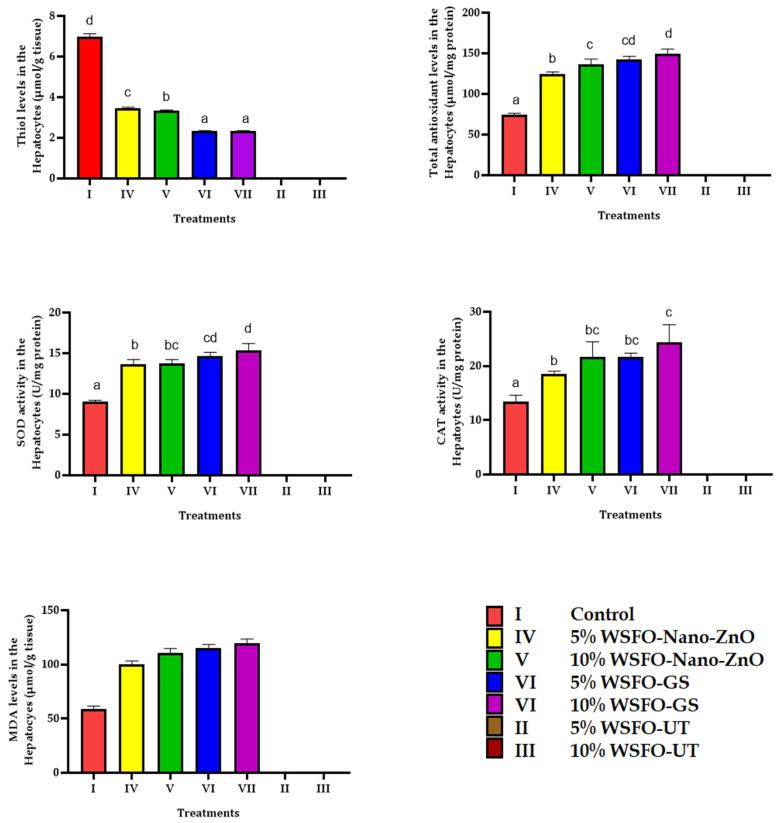
This study aimed to evaluate the effects of the water-soluble fraction of crude oil (WSFO) on Indian carp () with and without treatment with zinc oxide nanoparticles (Nano-ZnO). A total of 225 fish were randomly assigned to five groups in triplicate for 21 days. Group I served as the control group. Groups II and III were exposed to 0.5% and 1% untreated WSFO, respectively. Groups IV and V received 5% and 10% WSFO treated with Nano-ZnO, while Groups VI and VII received 5% and 10% WSFO treated without Nano-ZnO. No blood samples were obtained from fish exposed to untreated WSFO, due to increased hemolysis. Exposure to treated WSFO increased creatine phosphokinase, alkaline phosphatase, aspartate aminotransferase, lactate dehydrogenase, and gamma-glutamyl transferase activities, while alanine aminotransferase activity decreased. Although a significant decrease was observed in total protein, globulin, and triglyceride levels, albumin and cholesterol increased. Thiol groups and glutathione peroxidase activity significantly decreased, while superoxide dismutase, catalase, total antioxidant capacity, and malondialdehyde levels increased. The findings showed that exposure to WSFO, whether treated or untreated, induces significant biochemical and oxidative stress responses in . Although WSFO treated with Nano-ZnO mitigated hemolysis, it was unable to prevent enzyme and antioxidant imbalances, indicating persistent physiological stress.
本研究旨在评估原油水溶性馏分(WSFO)对印度鲤鱼()的影响,以及氧化锌纳米颗粒(纳米氧化锌)处理与否的作用。总共225条鱼被随机分为五组,每组重复三次,为期21天。第一组作为对照组。第二组和第三组分别暴露于0.5%和1%未处理的WSFO中。第四组和第五组接受5%和10%经纳米氧化锌处理的WSFO,而第六组和第七组接受5%和10%未经纳米氧化锌处理的WSFO。由于溶血增加,未从不暴露于未处理WSFO的鱼身上采集血样。暴露于经处理的WSFO会增加肌酸磷酸激酶、碱性磷酸酶、天冬氨酸转氨酶、乳酸脱氢酶和γ-谷氨酰转移酶的活性,而丙氨酸转氨酶活性降低。尽管总蛋白、球蛋白和甘油三酯水平显著下降,但白蛋白和胆固醇增加。巯基和谷胱甘肽过氧化物酶活性显著降低,而超氧化物歧化酶、过氧化氢酶、总抗氧化能力和丙二醛水平增加。研究结果表明,暴露于WSFO,无论是否经过处理,都会在印度鲤鱼中引发显著的生化和氧化应激反应。尽管经纳米氧化锌处理的WSFO减轻了溶血,但它无法防止酶和抗氧化剂失衡,表明存在持续的生理应激。

 Zotero 插件