
成熟青蛙体内的端粒动态在不同器官间存在差异。
Telomere dynamics in maturing frogs vary among organs.
作者信息
Burraco Pablo, Metcalfe Neil B, Monaghan Pat
机构信息
Doñana Biological Station (CSIC), Seville 41092, Spain.
School of Biodiversity, One Health and Veterinary Medicine, College of Medical, Veterinary and Life Sciences, University of Glasgow, Glasgow G12 8QQ, UK.
出版信息
Biol Lett. 2025 Feb;21(2):20240626. doi: 10.1098/rsbl.2024.0626. Epub 2025 Feb 26.
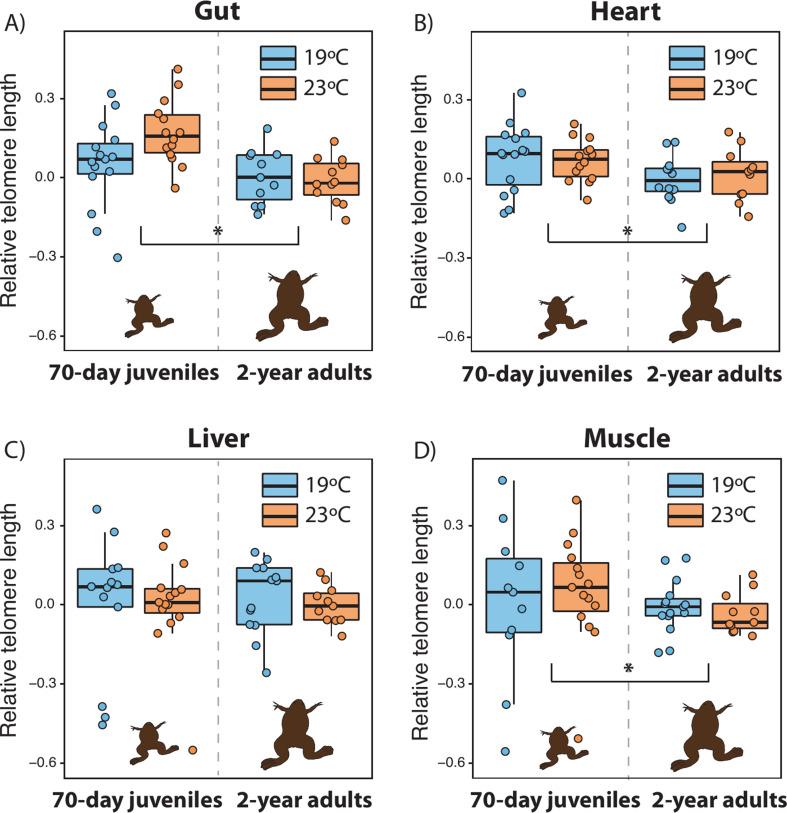
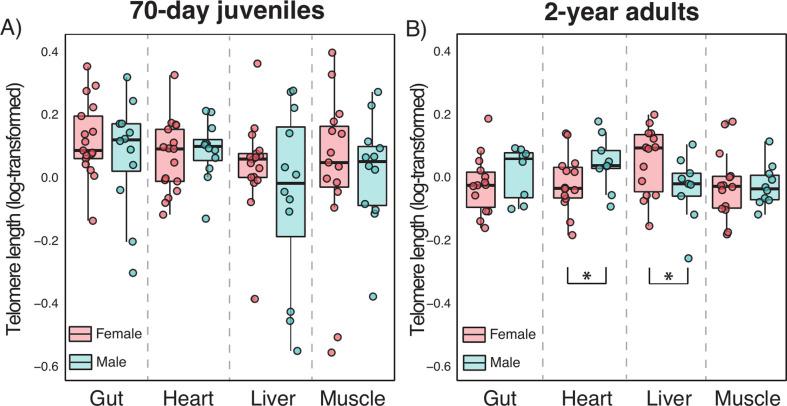
It is important to know whether organs age at the same rate and are equally affected by developmental conditions as this provides insights into causes of ageing. However, data on organ-specific telomere dynamics remain scant. In a previous study of the early life of the amphibian , we detected changes in telomere lengths in gut cells, while liver, heart and muscle telomeres were unchanged; larval rearing temperature had minimal effects. Here, we extend that study to examine telomere dynamics in the same four organs and larval temperature treatments from 70-day post-metamorphic juvenile through to sexually mature (2-year-old) adults. Telomeres shortened from juvenile to adult in the gut, heart and hindlimb muscle. In contrast, liver telomere lengths did not change with age but were shorter if the early life temperature was warm. Organ telomere lengths were influenced by sex only in adults. Warmer larval temperatures were also associated with longer gut telomeres in juveniles. Hence, pre-metamorphic conditions can influence post-metamorphic telomere dynamics, and telomere loss between juvenile and adult life stages occurs in different organs from those affected earlier in life. These findings indicate the existence of organ-dependent ageing rates across lifetimes, potentially related to developmental and environmental history.
了解器官是否以相同的速率衰老以及是否同样受到发育条件的影响非常重要,因为这有助于深入了解衰老的原因。然而,关于器官特异性端粒动态的数据仍然很少。在之前对两栖动物早期生活的研究中,我们检测到肠道细胞中端粒长度的变化,而肝脏、心脏和肌肉的端粒则没有变化;幼体饲养温度的影响很小。在这里,我们扩展了该研究,以检查从变态后70天的幼体到性成熟(2岁)成体的相同四个器官以及幼体温度处理下的端粒动态。在肠道、心脏和后肢肌肉中,端粒从幼体到成体缩短。相比之下,肝脏端粒长度不会随年龄变化,但如果早期生活温度较高则会较短。器官端粒长度仅在成体中受到性别影响。较高的幼体温度也与幼体肠道端粒较长有关。因此,变态前的条件可以影响变态后的端粒动态,并且幼体和成体生命阶段之间的端粒丢失发生在与生命早期受影响的器官不同的器官中。这些发现表明一生中存在器官依赖性衰老速率,这可能与发育和环境历史有关。

 Zotero 插件