
评估次生代谢产物在抗生素诱导的菌群失调中的疗效:临床前研究的叙述性综述
Evaluating the Efficacy of Secondary Metabolites in Antibiotic-Induced Dysbiosis: A Narrative Review of Preclinical Studies.
作者信息
Andrei Corina, Zanfirescu Anca, Ormeneanu Victor-Pierre, Negreș Simona
机构信息
Faculty of Pharmacy, "Carol Davila" University of Medicine and Pharmacy, Traian Vuia 6, 020956 Bucharest, Romania.
出版信息
Antibiotics (Basel). 2025 Feb 1;14(2):138. doi: 10.3390/antibiotics14020138.
BACKGROUND/OBJECTIVES: Drug-induced dysbiosis, particularly from antibiotics, has emerged as a significant contributor to chronic diseases by disrupting gut microbiota composition and function. Plant-derived secondary metabolites, such as polysaccharides, polyphenols, alkaloids, and saponins, show potential in mitigating antibiotic-induced dysbiosis. This review aims to consolidate evidence from preclinical studies on the therapeutic effects of secondary metabolites in restoring gut microbial balance, emphasizing their mechanisms and efficacy.
METHODS
A narrative review was conducted using PubMed, Scopus, and Web of Science. Studies were selected based on specific inclusion criteria, focusing on animal models treated with secondary metabolites for antibiotic-induced dysbiosis. The search terms included "gut microbiota", "antibiotics", and "secondary metabolites". Data extraction focused on microbial alterations, metabolite-specific effects, and mechanisms of action. Relevant findings were systematically analyzed and summarized.
RESULTS
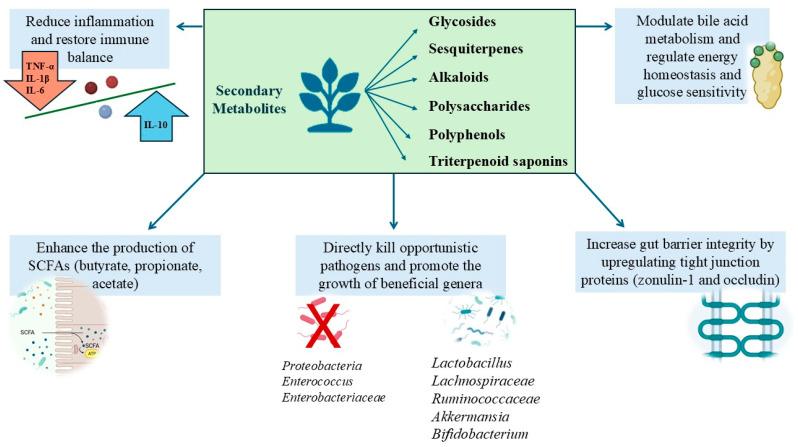
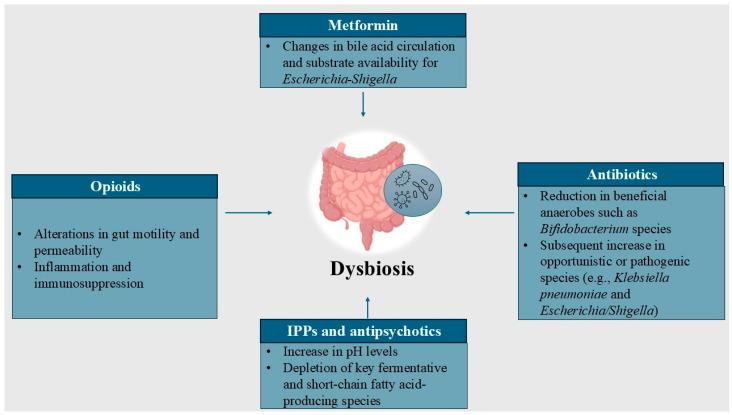
Secondary metabolites demonstrated diverse effects in mitigating the impact of dysbiosis by modulating gut microbial composition, reducing inflammation, and supporting host biological markers. Polysaccharides and polyphenols restored the ratio, increased beneficial taxa such as and , and suppressed pathogenic bacteria like . Metabolites such as triterpenoid saponins enhanced gut barrier integrity by upregulating tight junction proteins, while alkaloids reduced inflammation by modulating proinflammatory cytokines (e.g., TNF-α, IL-1β). These metabolites also improved short-chain fatty acid production, which is crucial for gut and systemic health. While antibiotic-induced dysbiosis was the primary focus, other drug classes (e.g., PPIs, metformin) require further investigation.
CONCLUSIONS
Plant-derived secondary metabolites show promise in managing antibiotic-induced dysbiosis by restoring microbial balance, reducing inflammation, and improving gut barrier function. Future research should explore their applicability to other types of drug-induced dysbiosis and validate findings in human studies to enhance clinical relevance.
背景/目的:药物诱导的微生物群失调,尤其是抗生素导致的失调,已成为扰乱肠道微生物群组成和功能从而引发慢性疾病的一个重要因素。植物源次生代谢产物,如多糖、多酚、生物碱和皂苷,在减轻抗生素诱导的微生物群失调方面显示出潜力。本综述旨在整合临床前研究中关于次生代谢产物恢复肠道微生物平衡的治疗效果的证据,重点阐述其作用机制和疗效。
方法
使用PubMed、Scopus和Web of Science进行叙述性综述。根据特定的纳入标准选择研究,重点关注用次生代谢产物治疗抗生素诱导的微生物群失调的动物模型。检索词包括“肠道微生物群”、“抗生素”和“次生代谢产物”。数据提取集中在微生物变化、代谢产物特异性效应和作用机制上。对相关研究结果进行系统分析和总结。
结果
次生代谢产物通过调节肠道微生物组成、减轻炎症和支持宿主生物学标志物,在减轻微生物群失调的影响方面表现出多种作用。多糖和多酚恢复了[具体比例],增加了有益菌属如[菌属名称1]和[菌属名称2],并抑制了如[病原菌名称]等病原菌。三萜皂苷等代谢产物通过上调紧密连接蛋白增强肠道屏障完整性,而生物碱通过调节促炎细胞因子(如TNF-α、IL-1β)减轻炎症。这些代谢产物还改善了短链脂肪酸的产生,这对肠道和全身健康至关重要。虽然抗生素诱导的微生物群失调是主要关注点,但其他药物类别(如质子泵抑制剂、二甲双胍)需要进一步研究。
结论
植物源次生代谢产物在通过恢复微生物平衡、减轻炎症和改善肠道屏障功能来管理抗生素诱导的微生物群失调方面显示出前景。未来的研究应探索它们在其他类型药物诱导的微生物群失调中的适用性,并在人体研究中验证研究结果,以提高临床相关性。
 Zotero 插件