
住院癌症患者的新冠后状况预测:一种基于机器学习的方法。
Post-COVID-19 Condition Prediction in Hospitalised Cancer Patients: A Machine Learning-Based Approach.
作者信息
Mahvash Mohammadi Sara, Rumyantsev Mikhail, Abdeeva Elina, Baimukhambetova Dina, Bobkova Polina, El-Taravi Yasmin, Pikuza Maria, Trefilova Anastasia, Zolotarev Aleksandr, Andreeva Margarita, Iakovleva Ekaterina, Bulanov Nikolay, Avdeev Sergey, Pazukhina Ekaterina, Zaikin Alexey, Kapustina Valentina, Fomin Victor, Svistunov Andrey A, Timashev Peter, Avdeenko Nina, Ivanova Yulia, Fedorova Lyudmila, Kondrikova Elena, Turina Irina, Glybochko Petr, Butnaru Denis, Blyuss Oleg, Munblit Daniel
机构信息
Centre for Cancer Screening, Prevention and Early Detection, Wolfson Institute of Population Health, Queen Mary University of London, London EC1M 6BQ, UK.
Department of Paediatrics and Paediatric Infectious Diseases, Institute of Child's Health, Sechenov First Moscow State Medical University (Sechenov University), 119991 Moscow, Russia.
出版信息
Cancers (Basel). 2025 Feb 18;17(4):687. doi: 10.3390/cancers17040687.
BACKGROUND
The COVID-19 pandemic has led to widespread long-term complications, known as post-COVID conditions (PCC), particularly affecting vulnerable populations such as cancer patients. This study aims to predict the incidence of PCC in hospitalised cancer patients using the data from a longitudinal cohort study conducted in four major university hospitals in Moscow, Russia.
METHODS
Clinical data have been collected during the acute phase and follow-ups at 6 and 12 months post-discharge. A total of 49 clinical features were evaluated, and machine learning classifiers including logistic regression, random forest, support vector machine (SVM), k-nearest neighbours (KNN), and neural network were applied to predict PCC.
RESULTS
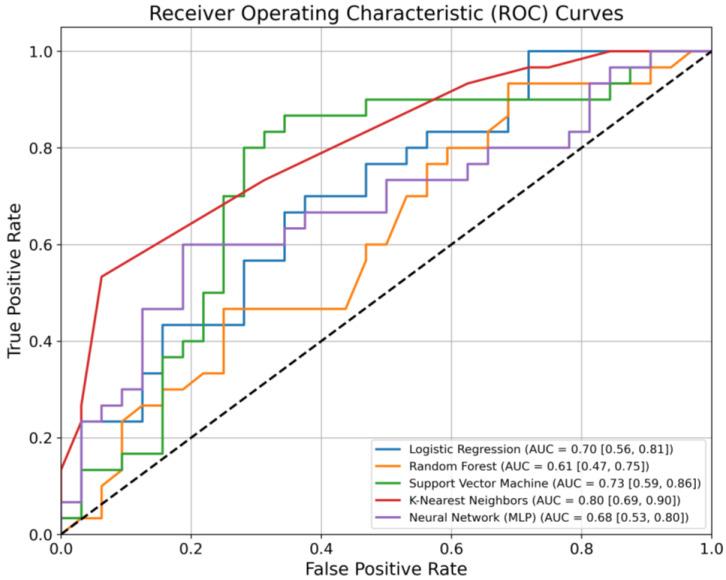
Model performance was assessed using the area under the receiver operating characteristic curve (AUC), sensitivity, and specificity. KNN demonstrated the highest predictive performance, with an AUC of 0.80, sensitivity of 0.73, and specificity of 0.69. Severe COVID-19 and pre-existing comorbidities were significant predictors of PCC.
CONCLUSIONS
Machine learning models, particularly KNN, showed some promise in predicting PCC in cancer patients, offering the potential for early intervention and personalised care. These findings emphasise the importance of long-term monitoring for cancer patients recovering from COVID-19 to mitigate PCC impact.
背景
新冠疫情导致了广泛的长期并发症,即新冠后状况(PCC),尤其影响癌症患者等弱势群体。本研究旨在利用在俄罗斯莫斯科的四家主要大学医院进行的一项纵向队列研究的数据,预测住院癌症患者发生PCC的几率。
方法
在急性期以及出院后6个月和12个月的随访期间收集临床数据。共评估了49项临床特征,并应用包括逻辑回归、随机森林、支持向量机(SVM)、k近邻(KNN)和神经网络在内的机器学习分类器来预测PCC。
结果
使用受试者工作特征曲线下面积(AUC)、敏感性和特异性评估模型性能。KNN表现出最高的预测性能,AUC为0.80,敏感性为0.73,特异性为0.69。重症新冠和既往合并症是PCC的重要预测因素。
结论
机器学习模型,尤其是KNN,在预测癌症患者的PCC方面显示出一定前景,为早期干预和个性化护理提供了可能性。这些发现强调了对从新冠中康复的癌症患者进行长期监测以减轻PCC影响的重要性。
 Zotero 插件