
运动对中风后抑郁的影响:随机对照试验的系统评价和荟萃分析
Effects of Exercise on Post-Stroke Depression: A Systematic Review and Meta-Analysis of Randomized Controlled Trials.
作者信息
Zhang Yifan, Li Gen, Zheng Wenda, Xu Ze, Lv Yuanyuan, Liu Xiaojie, Yu Laikang
机构信息
Beijing Key Laboratory of Sports Performance and Skill Assessment, Beijing Sport University, Beijing 100084, China.
Department of Strength and Conditioning Assessment and Monitoring, Beijing Sport University, Beijing 100084, China.
出版信息
Life (Basel). 2025 Feb 12;15(2):285. doi: 10.3390/life15020285.
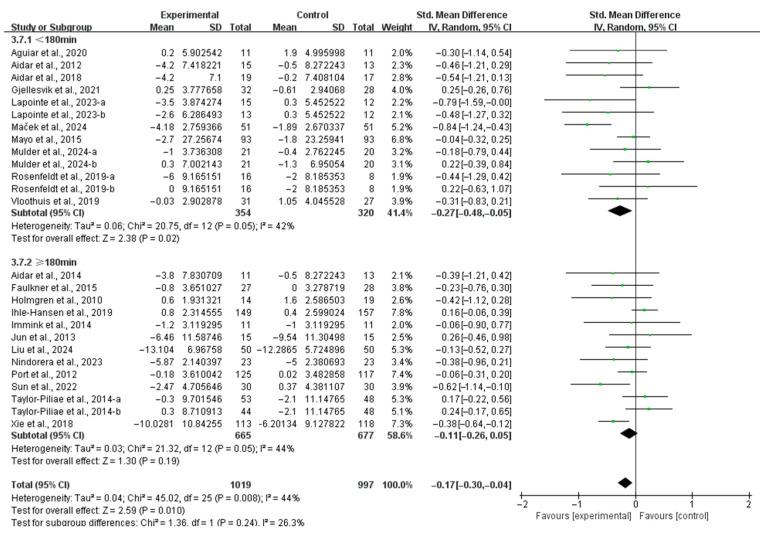
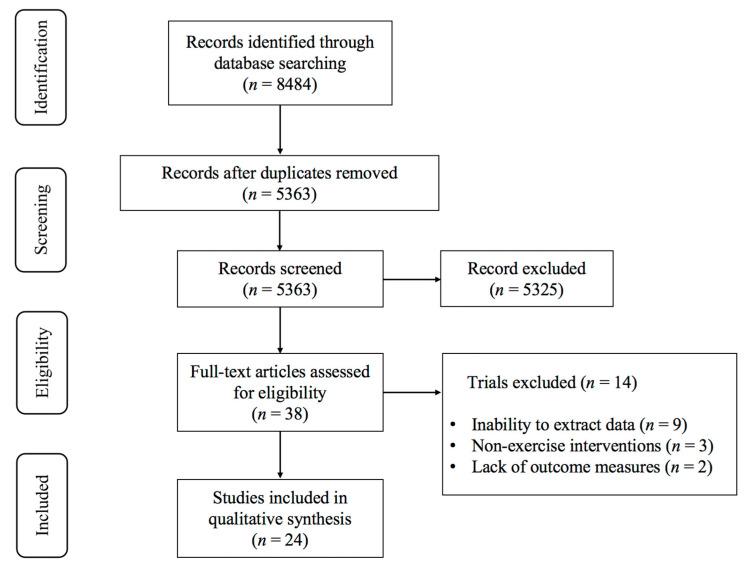
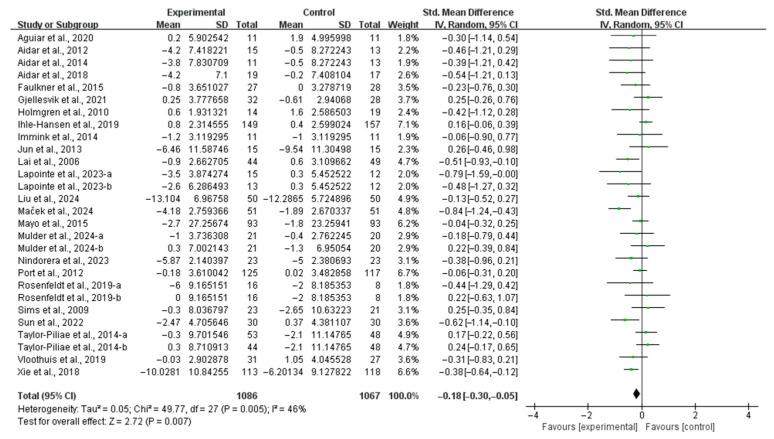
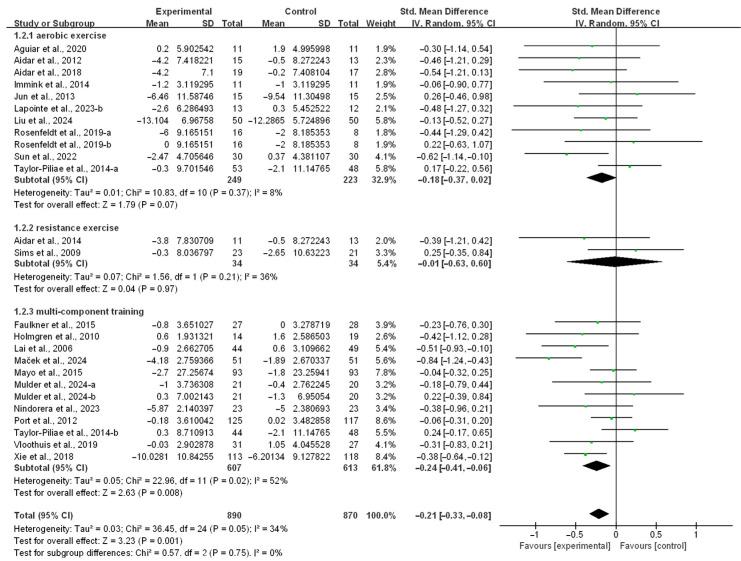
Numerous studies have investigated the effects of exercise on post-stroke depression (PSD), yet the findings remain inconclusive. This study aims to evaluate the impact of exercise on depressive symptoms in stroke patients and to identify the most effective exercise protocols for this population. A systematic review of the Embase, PubMed, Cochrane Library, Web of Science, and Scopus databases was conducted, with a search cutoff date of 13 September 2024. Quantitative synthesis was employed to assess the intervention effects, with effect sizes expressed as standardized mean differences (SMDs) and 95% confidence intervals to evaluate the efficacy of exercise in alleviating PSD. A total of 24 studies met the inclusion criteria. The results indicated that exercise significantly alleviated depressive symptoms in stroke patients (SMD = -0.18; = 0.007). Specifically, multicomponent training emerged as the most effective intervention for reducing depression (SMD = -0.24; = 0.008). Additionally, exercise programs with a duration of ≥12 weeks (SMD, -0.17; = 0.04), ≥3 sessions per week (SMD, -0.20; = 0.02), <60 min per session (SMD, -0.19; = 0.05), and <180 min per week (SMD, -0.27; = 0.02) were found to be the most effective in alleviating PSD. Exercise represents an effective strategy for managing PSD, with multicomponent training potentially serving as the optimal intervention. These findings provide evidence for clinicians, recommending that stroke patients engage in exercise at least three times weekly, with individual sessions not exceeding 60 min. By increasing the frequency of exercise, the cumulative weekly time should ideally remain below 180 min for optimal outcomes.
众多研究探讨了运动对中风后抑郁(PSD)的影响,但研究结果仍无定论。本研究旨在评估运动对中风患者抑郁症状的影响,并确定针对该人群最有效的运动方案。对Embase、PubMed、Cochrane图书馆、科学网和Scopus数据库进行了系统综述,检索截止日期为2024年9月13日。采用定量综合分析来评估干预效果,效应大小以标准化平均差(SMD)和95%置信区间表示,以评估运动缓解PSD的疗效。共有24项研究符合纳入标准。结果表明,运动显著减轻了中风患者的抑郁症状(SMD = -0.18;P = 0.007)。具体而言,多组分训练是减轻抑郁最有效的干预措施(SMD = -0.24;P = 0.008)。此外,发现持续时间≥12周(SMD,-0.17;P = 0.04)、每周≥3次训练(SMD,-0.20;P = 0.02)、每次训练<60分钟(SMD,-0.19;P = 0.05)以及每周<180分钟(SMD,-0.27;P = 0.02)的运动方案在缓解PSD方面最有效。运动是管理PSD的有效策略,多组分训练可能是最佳干预措施。这些发现为临床医生提供了证据,建议中风患者每周至少进行三次运动,每次训练不超过60分钟。通过增加运动频率,每周累计时间理想情况下应保持在180分钟以下以获得最佳效果。


 Zotero 插件