
软骨肉瘤:新的分子见解、床旁前临床建模面临的挑战及治疗方法
Chondrosarcoma: New Molecular Insights, Challenges in Near-Patient Preclinical Modeling, and Therapeutic Approaches.
作者信息
Landuzzi Lorena, Ruzzi Francesca, Lollini Pier-Luigi, Scotlandi Katia
机构信息
Experimental Oncology Laboratory, IRCCS Istituto Ortopedico Rizzoli, 40136 Bologna, Italy.
Laboratory of Immunology and Biology of Metastasis, Department of Medical and Surgical Sciences (DIMEC), University of Bologna, 40138 Bologna, Italy.
出版信息
Int J Mol Sci. 2025 Feb 12;26(4):1542. doi: 10.3390/ijms26041542.
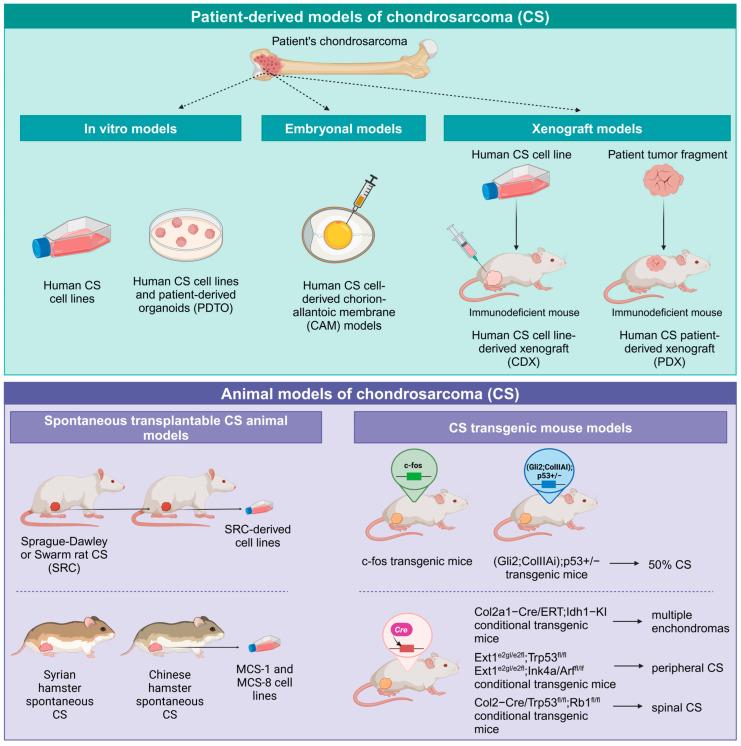
Chondrosarcoma (CS), the second most common malignant bone tumor after osteosarcoma, accounts for 20-30% of all malignant bone tumors. It mainly affects adults, middle-aged, and elderly people. The CS family includes various entities displaying peculiar biological, genetic, and epigenetic characteristics and clinical behaviors. Conventional CS is the most common subtype. High-grade, dedifferentiated, and mesenchymal CS, as well as unresectable and metastatic CS, exhibit poor prognoses due to their intrinsic resistance to radiotherapy and chemotherapy, underscoring the urgent need for novel therapeutic strategies. CS research is dealing with several challenges. Experimental studies can rely on animal and patient-derived models, but the paucity of representative near-patient preclinical models has hampered predictive drug screening research. This review describes the main clinical and molecular features of CS subtypes, discussing recent data on the genetic alterations and molecular mechanisms involved in CS pathogenesis and progression. The review provides an overview of the current in vitro and in vivo CS models, discusses their advantages and limitations, and highlights the recent efforts in the development of new targeted therapies against CS dependencies, including IDH1/2 mutations, NAD dependency, and SIRT1-HIF-2α axis, or exploring DR5 targeting, antiangiogenic therapies, epigenetic drugs, and immunological approaches. All such strategies, in combination with advanced preclinical modeling and personalized multi-omic profiling, hold promise for improving the survival of patients with advanced CS.
软骨肉瘤(CS)是仅次于骨肉瘤的第二常见恶性骨肿瘤,占所有恶性骨肿瘤的20% - 30%。它主要影响成年人、中年人和老年人。CS家族包括各种具有独特生物学、遗传学和表观遗传学特征以及临床行为的实体。传统型CS是最常见的亚型。高级别、去分化型和间充质型CS,以及不可切除和转移性CS,由于其对放疗和化疗的固有抗性,预后较差,这凸显了对新型治疗策略的迫切需求。CS研究面临着诸多挑战。实验研究可以依赖动物模型和患者来源的模型,但缺乏具有代表性的接近患者的临床前模型阻碍了预测性药物筛选研究。本综述描述了CS各亚型的主要临床和分子特征,讨论了CS发病机制和进展中涉及的基因改变和分子机制的最新数据。该综述概述了当前的CS体外和体内模型,讨论了它们的优缺点,并强调了针对CS依赖性开发新的靶向治疗的最新努力,包括异柠檬酸脱氢酶1/2(IDH1/2)突变、烟酰胺腺嘌呤二核苷酸(NAD)依赖性和沉默调节蛋白1 - 缺氧诱导因子2α(SIRT1 - HIF - 2α)轴,或探索死亡受体5(DR5)靶向、抗血管生成治疗、表观遗传药物和免疫疗法。所有这些策略,结合先进的临床前建模和个性化的多组学分析,有望提高晚期CS患者的生存率。
 Zotero 插件