
原发性纵隔大B细胞淋巴瘤靶向治疗的当前问题与未来展望
Current Issues and Future Perspectives of Targeted Therapies in Primary Mediastinal Large B-Cell Lymphoma.
作者信息
Liaskas Athanasios, Dimopoulou Maria N, Piperidou Alexia, Angelopoulou Maria K, Vassilakopoulos Theodoros P
机构信息
Department of Hematology and Bone Marrow Transplantation, Medical School, National and Kapodistrian University of Athens, General Hospital of Athens "Laikon", 11527 Athens, Greece.
出版信息
J Clin Med. 2025 Feb 11;14(4):1191. doi: 10.3390/jcm14041191.
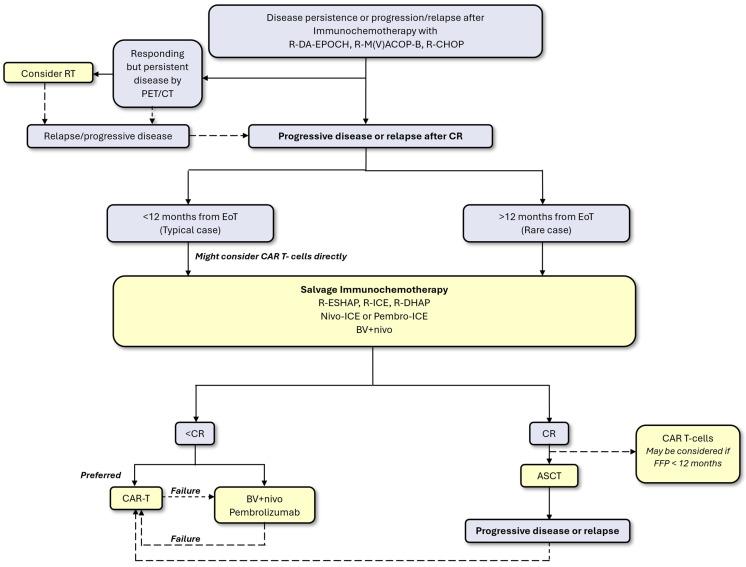
Primary mediastinal large B-cell lymphoma (PMLBCL) is a rare, aggressive B-cell lymphoma, sharing common features with diffuse large B-cell lymphoma (DLBCL) and Hodgkin lymphoma (HL). PMLBCL is usually cured with single-hit immunochemotherapy in the first-line setting. Relapses tend to be aggressive and may be unresponsive to conventional chemotherapy. Autologous stem cell transplant (ASCT) remains a viable option for chemosensitive patients; nevertheless, targeted therapies appear to be highly promising. Checkpoint inhibitors (CPIs) have already transformed the course of relapse/refractory disease, while CD-19-directed Chimeric Antigen Receptor (CAR) T-cell therapy may produce remarkably favorable outcomes. The exact position of CAR T-cells and CPIs in the treatment algorithm, along with the role of radiotherapy and ASCT, remains to be precisely determined. In the current review, we aim to present the recent research on targeted agents in PMLBCL and define their sequencing within the treatment algorithm, mainly in the relapse/refractory setting.
原发性纵隔大B细胞淋巴瘤(PMLBCL)是一种罕见的侵袭性B细胞淋巴瘤,与弥漫性大B细胞淋巴瘤(DLBCL)和霍奇金淋巴瘤(HL)具有共同特征。PMLBCL通常在一线治疗中通过单次免疫化疗治愈。复发往往具有侵袭性,可能对传统化疗无反应。自体干细胞移植(ASCT)仍然是对化疗敏感患者的可行选择;然而,靶向治疗似乎非常有前景。检查点抑制剂(CPI)已经改变了复发/难治性疾病的病程,而CD-19导向的嵌合抗原受体(CAR)T细胞疗法可能产生非常有利的结果。CAR T细胞和CPI在治疗方案中的确切位置,以及放疗和ASCT的作用,仍有待精确确定。在当前的综述中,我们旨在介绍PMLBCL靶向药物的最新研究,并确定它们在治疗方案中的顺序,主要是在复发/难治性情况下。
 Zotero 插件