
钠-葡萄糖协同转运蛋白2抑制剂:糖尿病肾病的首个内皮保护剂。
SGLT2 Inhibitors: The First Endothelial-Protector for Diabetic Nephropathy.
作者信息
Viggiano Davide, Joshi Rashmi, Borriello Gianmarco, Cacciola Giovanna, Gonnella Annalisa, Gigliotti Andrea, Nigro Michelangelo, Gigliotti Giuseppe
机构信息
Department Translational Medical Sciences, University of Campania, 80138 Naples, Italy.
Department Nephrology, Eboli Hospital, 84025 Eboli, Italy.
出版信息
J Clin Med. 2025 Feb 13;14(4):1241. doi: 10.3390/jcm14041241.
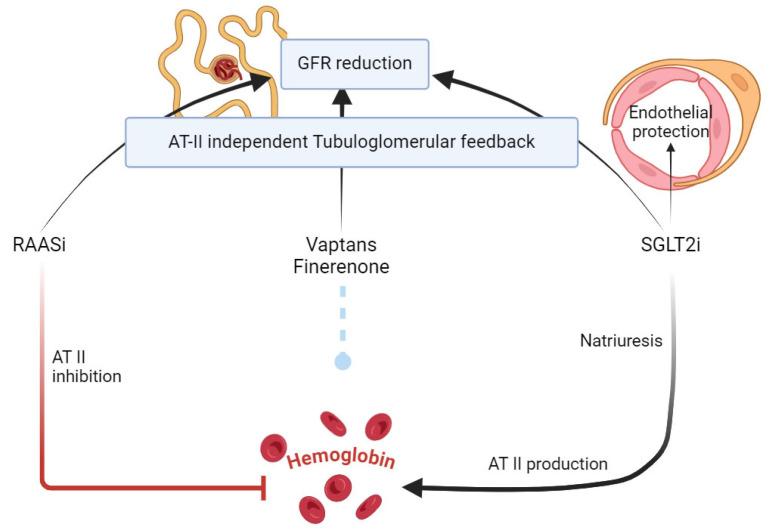
Sodium-glucose co-transporter type 2 inhibitors (SGLT2i) have emerged as a class of agents relevant for managing diabetic nephropathy and cardiopathy. In a previous report, we noticed that these drugs share, with other drugs with "nephroprotective" effects, the ability to reduce the glomerular filtration rate (GFR), thus suggesting the kidney hemodynamic effect as a proxy for optimal drug dosage. We also noticed that all known nephroprotective drugs exert cardioprotective functions, suggesting the possibility of activities not mediated by the kidney. Finally, we observe that nephroprotective drugs can be grouped according to their effects on hemoglobin levels, thus suggesting their mechanism of action. While the primary mechanism of SGLT2i involves glycosuria and natriuria, growing evidence suggests broader therapeutic effects beyond hemodynamic modulation. Specifically, the evidence that SGLT2 can be expressed in several atypical regions under pathological conditions, supports the possibility that its inhibition has several extratubular effects. Evidence supports the hypothesis that SGLT2i influence mitochondrial function in various cell types affected by diabetes, particularly in the context of diabetic nephropathy. Notably, in SGLT2i-treated patients, the extent of albumin-creatinine ratio (ACR) reduction post-treatment may be correlated with mitochondrial staining intensity in glomerular endothelial cells. This implies that the anti-proteinuric effects of SGLT2i could involve direct actions on glomerular endothelial cell. Our investigation into the role of SGLT2 inhibitors (SGLT2i) in endothelial function suggests that the aberrant expression of SGLT2 in endothelial cells in T2DM would lead to intracellular accumulation of glucose; therefore, SGLT2i are the first type of endothelial protective drugs available today, with potential implications for ageing-related kidney disease. The review reveals two major novel findings: SGLT2 inhibitors are the first known class of endothelial-protective drugs, due to their ability to prevent glucose accumulation in endothelial cells where SGLT2 is aberrantly expressed in Type 2 Diabetes. Additionally, the research demonstrates that SGLT2 inhibitors share a GFR-reducing effect with other nephroprotective drugs, suggesting both a mechanism for optimal drug dosing and potential broader applications in ageing-related kidney disease through their effects on mitochondrial function and glomerular endothelial cells.
钠-葡萄糖协同转运蛋白2抑制剂(SGLT2i)已成为一类与糖尿病肾病和心脏病管理相关的药物。在之前的一份报告中,我们注意到这些药物与其他具有“肾脏保护”作用的药物一样,具有降低肾小球滤过率(GFR)的能力,因此表明肾脏血流动力学效应可作为最佳药物剂量的替代指标。我们还注意到,所有已知的肾脏保护药物都具有心脏保护功能,这表明可能存在不由肾脏介导的活性。最后,我们观察到肾脏保护药物可根据其对血红蛋白水平的影响进行分类,从而提示其作用机制。虽然SGLT2i的主要作用机制涉及糖尿和利钠,但越来越多的证据表明其治疗作用超出了血流动力学调节范围。具体而言,有证据表明SGLT2在病理条件下可在几个非典型区域表达,这支持了其抑制作用具有多种肾小管外效应的可能性。有证据支持这样的假说,即SGLT2i会影响受糖尿病影响的各种细胞类型中的线粒体功能,特别是在糖尿病肾病的情况下。值得注意的是,在接受SGLT2i治疗的患者中,治疗后白蛋白-肌酐比值(ACR)降低的程度可能与肾小球内皮细胞中的线粒体染色强度相关。这意味着SGLT2i的抗蛋白尿作用可能涉及对肾小球内皮细胞的直接作用。我们对SGLT2抑制剂(SGLT2i)在内皮功能中的作用进行的研究表明,2型糖尿病(T2DM)患者内皮细胞中SGLT2的异常表达会导致细胞内葡萄糖积累;因此,SGLT2i是目前可用的第一类内皮保护药物,对与衰老相关的肾脏疾病可能具有潜在影响。该综述揭示了两个主要的新发现:SGLT2抑制剂是已知的第一类内皮保护药物,因为它们能够防止在2型糖尿病中SGLT2异常表达的内皮细胞中葡萄糖积累。此外,研究表明SGLT2抑制剂与其他肾脏保护药物具有相同的降低GFR的作用,这既提示了最佳药物剂量的机制,也表明通过其对线粒体功能和肾小球内皮细胞的影响,它们在与衰老相关的肾脏疾病中可能具有更广泛的应用。



 Zotero 插件