
有感染记录的母亲所生新生儿患先天性弓形虫病的风险:来自两个转诊中心的经验
Risk of Congenital Toxoplasmosis in Newborns from Mothers with Documented Infection: Experience from Two Referral Centres.
作者信息
Bonetti Alice, Comelli Agnese, Chiesa Annacarla, Spinoni Vania, Vola Ambra, Prefumo Federico, Valcamonico Adriana, Bonfanti Carlo, Caligaris Silvio, Tomasoni Lina Rachele, Baldanti Fausto, Meroni Valeria
机构信息
Microbiology and Virology Unit, Diagnostic Medicine Department, Fondazione IRCCS Policlinico San Matteo, 27100 Pavia, Italy.
PhD National Programme in One Health Approaches to Infectious Diseases and Life Science Research, Department of Public Health, Experimental and Forensic Medicine, University of Pavia, 27100 Pavia, Italy.
出版信息
Pathogens. 2025 Feb 6;14(2):157. doi: 10.3390/pathogens14020157.
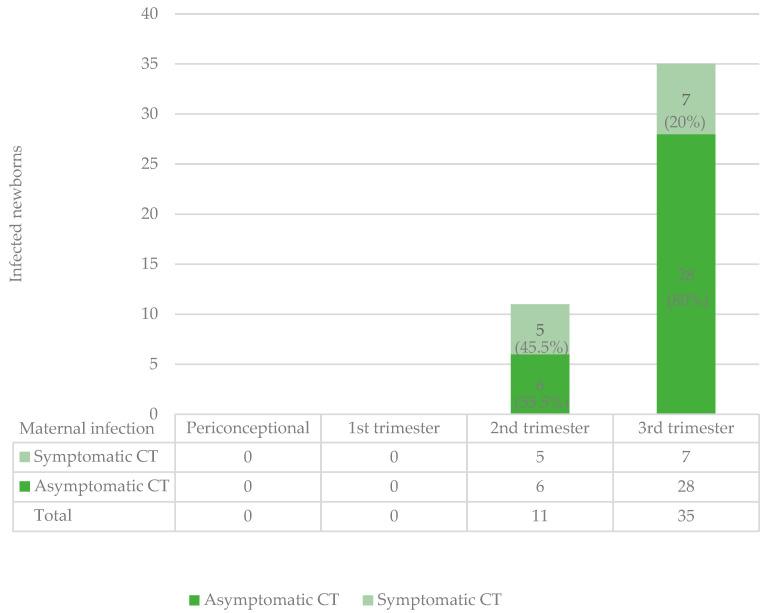
During pregnancy, primary infection can cause congenital toxoplasmosis (CT). We described the newborns' outcomes from a multicentre cohort of mothers with seroconversion (SC) at different gestational ages. This retrospective observational study (from 2007 to 2018) was conducted in two Italian referral hospitals: Fondazione IRCCS Policlinico San Matteo in Pavia and Spedali Civili in Brescia. In total, 247 pregnant women were enrolled: seroconversions were enrolled: seroconversions documented as having occurred in the two months preceding pregnancy in 12 cases (4.9%; 95% CI 2.2-7.5%), and during pregnancy in 235 cases (95.1%; 95% CI 92.5-97.8%). SC is defined as the appearance of specific anti-Toxoplasma antibodies (IgM/IgG) during pregnancy in a previously seronegative woman. A total of 56 (22.5%; 95% CI 17.3-27.7%) newborns were lost to follow-up; thus, the outcome of 193 (77.5%; 95% CI 72.3-82.7%) newborns was analyzed. The overall transmission rate of infection was 23.8% (95% CI 17.8-29.8%), 0% (95% CI 0.0-11.9%) among the 1st trimester SCs, 12.5% (95% CI 5.6-19.4%) among the 2nd trimester SCs, 53.8% (95% CI 41.7-66.0%) among the 3rd trimester ones. No CT were found in the group of periconceptional infection. Among the infected newborns, clinically manifest cases were 12 (26.1%; 95% CI 13.4-38.8%), including 1 case (2.2%; 95% CI 2.0-6.4%) of stillbirth and 11 symptomatic neonates (23.9%; 95% CI 11.6-36.2%). A total of 83 amniocentesis were performed (33.6%; 95% CI 27.7-39.5%), no complication was recorded and no false positive or false negative results were registered. The results are in line with the fetal risks reported in literature for infection during pregnancy, even if at a lower percentage probably due to a prompt treatment.
孕期初次感染可导致先天性弓形虫病(CT)。我们描述了不同孕周血清学转换(SC)的多中心队列中母亲所生新生儿的结局。这项回顾性观察研究(2007年至2018年)在意大利的两家转诊医院进行:帕维亚的圣马泰奥综合医院基金会和布雷西亚的市民医院。总共纳入了247名孕妇:其中12例(4.9%;95%CI 2.2 - 7.5%)的血清学转换记录发生在妊娠前两个月,235例(95.1%;95%CI 92.5 - 97.8%)发生在孕期。SC定义为既往血清学阴性的女性在孕期出现特异性抗弓形虫抗体(IgM/IgG)。共有56例(22.5%;95%CI 17.3 - 27.7%)新生儿失访;因此,对193例(77.5%;95%CI 72.3 - 82.7%)新生儿的结局进行了分析。总体感染传播率为23.8%(95%CI 17.8 - 29.8%),孕早期SC组为0%(95%CI 0.0 - 11.9%),孕中期SC组为12.5%(95%CI 5.6 - 19.4%),孕晚期SC组为53.8%(95%CI 41.7 - 66.0%)。在受孕前感染组未发现先天性弓形虫病病例。在感染的新生儿中,临床表现病例有12例(26.1%;95%CI 13.4 - 38.8%),包括1例死产(2.2%;95%CI 2.0 - 6.4%)和11例有症状的新生儿(23.9%;95%CI 11.6 - 36.2%)。总共进行了83次羊膜腔穿刺术(33.6%;95%CI 27.7 - 39.5%),未记录到并发症,也未出现假阳性或假阴性结果。这些结果与文献报道的孕期感染的胎儿风险一致,即使百分比较低,可能是由于及时治疗。

 Zotero 插件