
揭示内生菌和炭疽病致病属中的宿主范围与生活方式的关系
Uncovering the Host Range-Lifestyle Relationship in the Endophytic and Anthracnose Pathogenic Genus .
作者信息
Newfeld Jacy, Ujimatsu Ren, Hiruma Kei
机构信息
Department of Life Sciences, Graduate School of Arts and Sciences, The University of Tokyo, Tokyo 153-8902, Japan.
出版信息
Microorganisms. 2025 Feb 16;13(2):428. doi: 10.3390/microorganisms13020428.
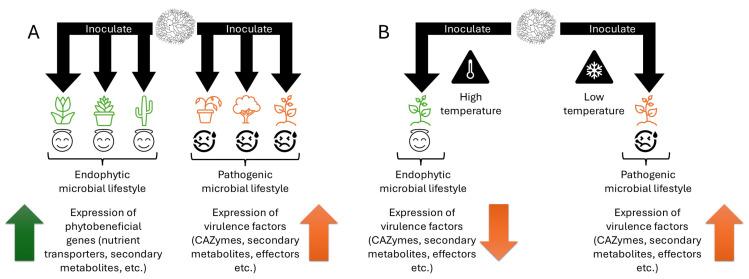
includes agriculturally and scientifically important pathogens that infect numerous plants. They can also adopt an endophytic lifestyle, refraining from causing disease and/or even promoting plant growth when inoculated on a non-susceptible host. In this manner, the host range of a fungus can shift, depending on whether it exhibits endophytic or pathogenic lifestyles. Some fungi, such as , can even shift between pathogenicity and endophytism within the same host depending on the environmental conditions. Here, we aim to disentangle the relationship between lifestyle and host range in . Specifically, we aim to demonstrate that lifestyle is dependent on the host colonized in many fungi. We discuss the ways in which pathogenic species may act endophytically on alternative hosts, how comparative genomics has uncovered candidate molecules (namely effectors, CAZymes, and secondary metabolites) underlying fungal lifestyle, and the merits of using endophytic fungi alongside pathogenic fungi in research, which facilitates the use of reverse genetics to uncover molecular determinants of lifestyle. In particular, we reference the - study system as a model for elucidating the dual roles of plant-fungus interactions, both endophytic and pathogenic, through integrative omics approaches and reverse genetics. This is because contains closely related pathogens and endophytes, making it an ideal model for identifying candidate determinants of lifestyle. This approach could identify key molecular targets for effective pathogen management in agriculture. Lastly, we propose a model in which pathogenic lifestyle occupies a different host range than the endophytic lifestyle. This will enhance our understanding of pathogenicity and endophytism in a globally significant fungal genus and lay the groundwork for future research examining molecular determinants of lifestyle in plant-associated fungi.
包括感染多种植物的具有农业和科学重要性的病原体。它们还可以采取内生生活方式,在接种到非易感宿主上时不引发疾病,甚至促进植物生长。通过这种方式,真菌的宿主范围可能会发生变化,这取决于它表现出的是内生还是致病生活方式。一些真菌,比如 ,甚至可以根据环境条件在同一宿主内的致病性和内生性之间转换。在这里,我们旨在厘清 中生活方式与宿主范围之间的关系。具体而言,我们旨在证明生活方式取决于许多 真菌所定殖的宿主。我们讨论了致病 物种可能在替代宿主上以内生方式起作用的方式、比较基因组学如何揭示了真菌生活方式背后的候选分子(即效应子、碳水化合物活性酶和次生代谢产物),以及在研究中同时使用内生真菌和致病真菌的优点,这有助于利用反向遗传学来揭示生活方式的分子决定因素。特别是,我们将 - 研究系统作为一个模型,通过综合组学方法和反向遗传学来阐明植物 - 真菌相互作用的双重作用,即内生和致病作用。这是因为 包含密切相关的病原体和内生菌,使其成为识别生活方式候选决定因素的理想模型。这种方法可以确定农业中有效病原体管理的关键分子靶点。最后,我们提出一个模型,其中致病生活方式占据与内生生活方式不同的宿主范围。这将增进我们对这个在全球具有重要意义的真菌属中的致病性和内生性的理解,并为未来研究植物相关真菌生活方式的分子决定因素奠定基础。
 Zotero 插件