
当与ELQ-316体外培养物联合使用时,丁萘醌和咪唑苯脲增强的抗巴贝斯虫功效 。 你提供的原文似乎不完整,翻译可能会不太准确,如果能补充完整原文会更好。
Enhanced Anti-Babesia Efficacy of Buparvaquone and Imidocarb When Combined with ELQ-316 In Vitro Culture of .
作者信息
Cardillo Natalia M, Villarino Nicolas F, Lacy Paul A, Doggett Joseph S, Riscoe Michael K, Suarez Carlos E, Ueti Massaro W, Chung Chungwon J
机构信息
Animal Disease Research Unit, USDA-ARS, 3003 ADBF, WSU, Pullman, WA 99163, USA.
Department of Veterinary Microbiology and Pathology, Washington State University, Pullman, WA 99164, USA.
出版信息
Pharmaceuticals (Basel). 2025 Feb 6;18(2):218. doi: 10.3390/ph18020218.
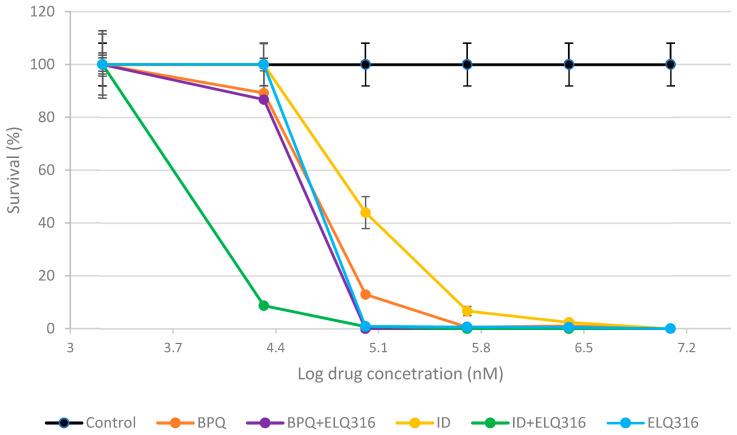
is a highly pathogenic and widely distributed tick-borne disease parasite responsible for bovine babesiosis. The development of effective and safe therapies is urgently needed for global disease control. The aim of this study is to compare the effects of endochin-like quinolone (ELQ-316), buparvaquone (BPQ), imidocarb (ID), and the combinations of ID + ELQ-316 and BPQ + ELQ-316, on in vitro survival of Parasites at a starting parasitemia level of 2%, were incubated with each single drug and a combination of drugs, ranging from 25 to 1200 nM of concentration over four consecutive days. The inhibitory concentrations, 50% (IC50%) and 99% (IC99%), were estimated. Parasitemia levels were evaluated daily using microscopic examination. Data were statistically compared using the non-parametrical Kruskall-Wallis test. All drugs tested significantly inhibited ( < 0.05) the growth of at 2% parasitemia. The combination of ID + ELQ-316 exhibited a lower mean (IC50%: 9.2; confidence interval 95%: 8.7-9.9) than ID (IC50%: 61.5; confidence interval 95%: 59.54-63.46), ELQ-316 (IC50%: 48.10; confidence interval 95%: 42.76-58.83), BPQ (IC50%: 44.66; confidence interval 95%: 43.56-45.81), and BPQ + ELQ-316 (IC50%: 27.59; confidence interval: N/A). Parasites were no longer viable in cultures treated with the BPQ + ELQ-316 combination, as well as with BPQ alone at a concentration of 1200 nM, on days 2 and 3 of treatment, respectively. BPQ and ID increase the babesiacidal effect of ELQ-316. The efficacy of these combinations deserves to be evaluated in vivo, which could lead to a promising and safer treatment option for .
是一种高致病性且广泛传播的蜱传疾病寄生虫,可引发牛巴贝斯虫病。为了全球疾病防控,迫切需要研发有效且安全的治疗方法。本研究的目的是比较内chin样喹诺酮(ELQ - 316)、丁萘脒(BPQ)、咪唑苯脲(ID)以及ID + ELQ - 316和BPQ + ELQ - 316组合对寄生虫体外存活的影响。在初始寄生虫血症水平为2%的情况下,将寄生虫与每种单一药物及药物组合一起孵育,浓度范围为25至1200 nM,连续四天。估算了50%抑制浓度(IC50%)和99%抑制浓度(IC99%)。每天通过显微镜检查评估寄生虫血症水平。使用非参数Kruskal - Wallis检验对数据进行统计学比较。所有测试药物在寄生虫血症水平为2%时均显著抑制(<0.05)寄生虫生长。ID + ELQ - 316组合的平均IC50%(9.2;95%置信区间:8.7 - 9.9)低于ID(IC50%:61.5;95%置信区间:59.54 - 63.46)、ELQ - 316(IC50%:48.10;95%置信区间:42.76 - 58.83)、BPQ(IC50%:44.66;95%置信区间:43.56 - 45.81)以及BPQ + ELQ - 316(IC50%:27.59;置信区间:无)。在治疗的第2天和第3天,用BPQ + ELQ - 316组合处理的培养物以及单独用浓度为1200 nM的BPQ处理的培养物中的寄生虫不再存活。BPQ和ID增强了ELQ - 316的杀巴贝斯虫作用。这些组合的疗效值得在体内进行评估,这可能为[疾病名称]带来一种有前景且更安全的治疗选择。 (注:原文中“Parasites at a starting parasitemia level of...”以及“Parasites were no longer viable...”处的“Parasites”指代不明,推测为牛巴贝斯虫寄生虫,但未明确,译文保留原文指代不明情况。)
 Zotero 插件