
医生对急性肾损伤(AKI)警报的检测率与医疗成本之间的非线性关联。
Non-linear association between AKI alert detection rate by physicians and medical costs.
作者信息
Ai Hai-Bo, Jiang En-Li, Wang Hai, Yang Qi, Jin Qi-Zu, Wan Li, Liu Jing-Ying, He Cheng-Qi
机构信息
Rehabilitation Medicine Center and Institute of Rehabilitation Medicine, West China Hospital, Sichuan University, Chengdu, P. R. China.
School of Rehabilitation Sciences, West China School of Medicine, Sichuan University, Chengdu, P. R. China.
出版信息
PLoS One. 2025 Feb 26;20(2):e0314907. doi: 10.1371/journal.pone.0314907. eCollection 2025.
BACKGROUND
Acute kidney injury (AKI) is associated with high mortality rates and long-term adverse outcomes and significantly increases medical costs. The AKI electronic alert system built the AKI diagnostic algorithm into the medical system, along with automated collection of key indications and generation of alerts. However, the relationship between the AKI electronic alert system and medical costs is still unknown.
METHODS
An exploratory secondary analysis of data from a double-blinded, multicenter, parallel, randomized controlled trial to investigate the association between the AKI electronic alert system and medical costs.
RESULTS
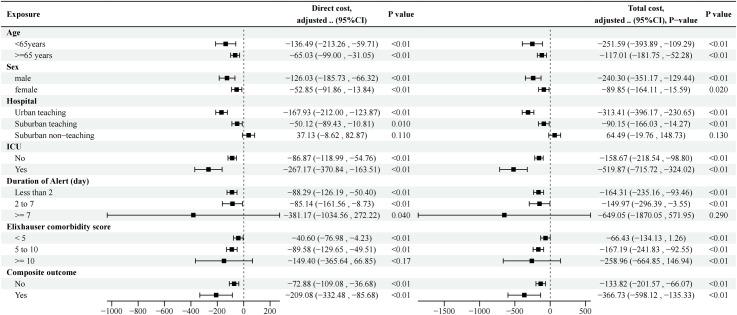
Finally, a total of 6030 patients were enrolled in this study. Multivariate logistic regression analysis revealed that the alert group was not significantly associated with medical costs (all p-values > 0.05). However, the rate of alert detection by an attending physician demonstrated a notable negative correlation with medical costs; adjusted effects for direct and total costs were -126.78$ and -236.82$, respectively. The curve fitting and threshold effect analysis revealed that when the rate of alert detection by an attending physician was between 18% and 59%, each unit increase in the rate corresponded to decreases in direct cost by 363.94 (-463.34, -264.55) $ and in total cost by 698.93 (-885.78, -512.07) $. Our subgroup analysis also found a significant relationship between the rate and medical costs.
CONCLUSION
The alert group did not significantly reduce medical costs compared to the usual care group. However, the rate of alert detection by an attending physician had a significant negative association with medical costs, and there was a threshold effect between them. When the rate was between 18% and 59%, medical costs decreased as the rate increased, and when the rate was < 18% or ≥ 59%, medical costs did not decrease as the rate increased.
背景
急性肾损伤(AKI)与高死亡率和长期不良后果相关,且显著增加医疗成本。AKI电子警报系统将AKI诊断算法植入医疗系统,同时自动收集关键指标并生成警报。然而,AKI电子警报系统与医疗成本之间的关系仍不清楚。
方法
对一项双盲、多中心、平行、随机对照试验的数据进行探索性二次分析,以研究AKI电子警报系统与医疗成本之间的关联。
结果
最终,本研究共纳入6030例患者。多因素逻辑回归分析显示,警报组与医疗成本无显著关联(所有p值>0.05)。然而,主治医师的警报检测率与医疗成本呈显著负相关;直接成本和总成本的调整效应分别为-126.78美元和-236.82美元。曲线拟合和阈值效应分析显示,当主治医师的警报检测率在18%至59%之间时,该率每增加一个单位,直接成本降低363.94(-463.34,-264.55)美元,总成本降低698.93(-885.78,-512.07)美元。我们的亚组分析也发现该率与医疗成本之间存在显著关系。
结论
与常规护理组相比,警报组并未显著降低医疗成本。然而,主治医师的警报检测率与医疗成本呈显著负相关,且二者之间存在阈值效应。当该率在18%至59%之间时,医疗成本随该率的增加而降低;当该率<18%或≥59%时,医疗成本不会随该率的增加而降低。

 Zotero 插件