
甲基叔丁基醚可能是非酒精性脂肪性肝病的潜在环境致病因素:2017 - 2020年美国国家健康与营养检查调查结果
Methyl -Butyl Ether May Be a Potential Environmental Pathogenic Factor for Nonalcoholic Fatty Liver Disease: Results from NHANES 2017-2020.
作者信息
Cui Fengtao, Wang Hanyun, Guo Mingxiao, Sun Yucheng, Xin Ye, Gao Wei, Fang Xingqiang, Chen Li, Niu Piye, Ma Junxiang
机构信息
Department of Occupational Health and Environmental Health, School of Public Health, Capital Medical University, Beijing 100069, China.
Beijing Key Laboratory of Environmental Toxicology, School of Public Health, Capital Medical University, Beijing 100069, China.
出版信息
Environ Health (Wash). 2024 Nov 7;3(2):190-198. doi: 10.1021/envhealth.4c00140. eCollection 2025 Feb 21.
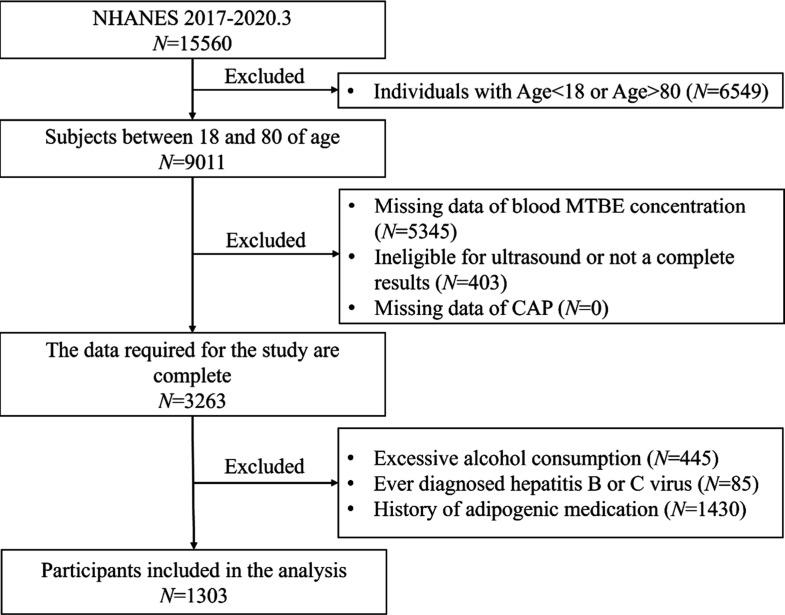
Previous studies have shown that methyl -butyl ether (MTBE) could interfere with lipid metabolism. However, there is still a lack of epidemiological reports on the association between MTBE exposure and the risk of nonalcoholic fatty liver disease (NAFLD). In this study, a cross-sectional study was performed with data from the 2017-2020 cycles of the National Health and Nutrition Examination Survey (NHANES). The target population consisted of adults with reliable vibration controlled Transient elastography (VCTE) and blood MTBE concentration results. The hepatic steatosis and fibrosis were assessed by the values of the controlled attenuation parameter (CAP) and liver stiffness measurement (LSM), respectively. Generalized linear mixed model analysis was performed to evaluate the association between MTBE exposure and both steatosis and early liver fibrosis after adjustment for potential confounders. A total of 1303 subjects were enrolled and divided into NAFLD groups (CAP ≥ 248) and non-NAFLD groups (CAP < 248) based on the values of CAP in this study. Generalized linear mixed analysis suggested that blood MTBE concentration was positively associated with NAFLD risk in whole populations (OR: 2.153, 95% confidence interval [CI], 1.176-3.940) and female populations (OR: 11.019, 95% CI: 2.069-58.676). Blood MTBE concentration still showed an obvious positive correlation with the NAFLD risk after excluding factors such as diet and exercise in whole populations. Similarly, a positive correlation between blood MTBE concentration and liver fibrosis was also observed, although the results did not show significant statistical differences. In conclusion, our results indicate that MTBE exposure might be a potential important environmental pathogenic factor for NAFLD.
以往研究表明,甲基叔丁基醚(MTBE)可能会干扰脂质代谢。然而,关于MTBE暴露与非酒精性脂肪性肝病(NAFLD)风险之间关联的流行病学报告仍然缺乏。在本研究中,利用国家健康与营养检查调查(NHANES)2017 - 2020周期的数据进行了一项横断面研究。目标人群为具有可靠的振动控制瞬时弹性成像(VCTE)和血液MTBE浓度结果的成年人。分别通过控制衰减参数(CAP)值和肝脏硬度测量(LSM)评估肝脂肪变性和肝纤维化。在对潜在混杂因素进行调整后,采用广义线性混合模型分析来评估MTBE暴露与脂肪变性和早期肝纤维化之间的关联。在本研究中,共纳入1303名受试者,并根据CAP值分为NAFLD组(CAP≥248)和非NAFLD组(CAP<248)。广义线性混合分析表明,血液MTBE浓度与全人群(比值比:2.153,95%置信区间[CI],1.176 - 3.940)和女性人群(比值比:11.019,95%CI:2.069 - 58.676)的NAFLD风险呈正相关。在全人群中排除饮食和运动等因素后,血液MTBE浓度与NAFLD风险仍呈现明显的正相关。同样,尽管结果未显示出显著的统计学差异,但也观察到血液MTBE浓度与肝纤维化之间存在正相关。总之,我们的结果表明,MTBE暴露可能是NAFLD一个潜在的重要环境致病因素。
 Zotero 插件