
表面纹理对牙髓干细胞成骨分化的影响:一项研究。
Influence of surface texture on osteogenic differentiation of dental pulp stem cells: An study.
作者信息
Rajpurohit Komal, Dodwad Vidya, Kharat Avinash, Belludi Spoorthi, Pharne Pooja, Marium Sarah
机构信息
Department of Periodontology, Bharati Vidyapeeth (Deemed to be University) Dental college and Hospital, Pimpri, Pune, Maharashtra, India.
Regenerative Medicine Laboratory, Dr. D.Y. Patil Dental College and Hospital, Dr. D.Y. Patil Vidyapeeth, Pimpri, Pune, Maharashtra, India.
出版信息
J Indian Soc Periodontol. 2024 Jul-Aug;28(4):478-483. doi: 10.4103/jisp.jisp_307_23. Epub 2025 Jan 6.
BACKGROUND
In comparison with perfectly machined surface implants, surface topographic modifications like roughness accelerate the osteogenesis of dental pulpal stem cells (DPSC). This greatly enhances bone-implant contact and osteogenic potential of the stem cells. Hence, the aim of the current study was to evaluate and compare the differentiation and proliferation potential of stem cells obtained from dental pulp on sand-blasted and acid etched implant discs surfaces.
MATERIALS AND METHODS
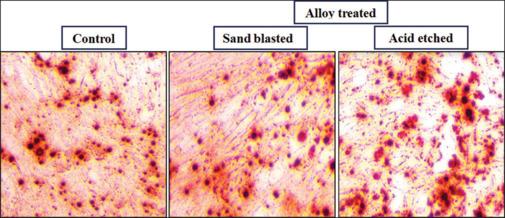
Stem cells from dental pulp were extracted from the premolar region of oral cavity. Titanium discs that measured one centimeter in diameter and three millimetres in thickness were used as investigation surfaces. Titanium surface disc were acid etched and sandblasted. Investigation had three group: acid etched (Group A), sandblasted (Group B), and standard control group, i.e., cells treated with osteogenic induction media only (Group C). In Group C, mesenchymal stem cells (MSCs) were treated with osteogenic induction medium without any titanium disc and these cells were used as standard controls. To identify which modified implant surface had greater potential for proliferation, 3-(4,5-dimethylthiazol-2-yl)-2,5-diphenyltetrazolium bromide (MTT) assay was performed using the explant culture. MTT assay assessed the viability of the cells as a function of its redox potential. This was followed by recognition of the stem cells for CD90, CD73, and CD 105 markers using flow cytometry with RUNX2 antibody on days 7 and 21 of incubation. The isolated cells were stained using 1% alizarin red stain to identify the number of stem cells per square centimeter area under the light microscope.
RESULTS
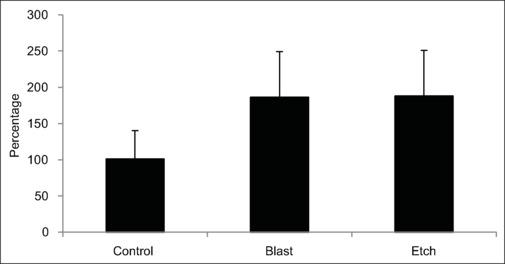
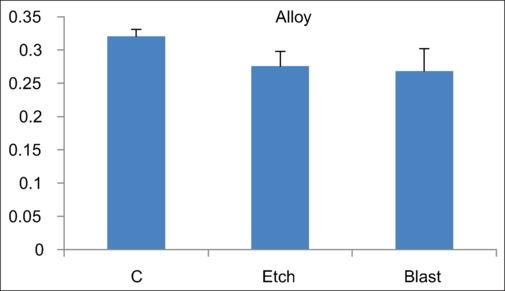
The osteogenic differentiation of both the materials was compared with standard control (MSCs treated with osteogenic differentiation media only). The osteoblastic cells on the acid-etched and sand-blasted implant surface disc had an almost identical capacity for proliferation till the MTT assay but according to the results of the alizarin red staining there was a slightly higher proliferation potential on acid etched surfaces compared to the sand blasted surfaces. Therefore, acid etched surfaces showed higher potential of osteogenic differentiation of DPSCs compared with sand-blasted surfaces.
CONCLUSION
In comparison with perfectly machined surface implants, topographic surface modifications such as roughness can accelerate the osteogenesis of DPSC .
背景
与表面加工完美的种植体相比,诸如粗糙度之类的表面形貌改变可加速牙髓干细胞(DPSC)的成骨作用。这极大地增强了干细胞的骨-种植体接触及成骨潜能。因此,本研究的目的是评估和比较从牙髓获取的干细胞在喷砂和酸蚀种植体盘表面上的分化及增殖潜能。
材料与方法
从口腔前磨牙区域提取牙髓干细胞。将直径1厘米、厚度3毫米的钛盘用作研究表面。对钛表面盘进行酸蚀和喷砂处理。研究分为三组:酸蚀组(A组)、喷砂组(B组)和标准对照组,即仅用成骨诱导培养基处理的细胞(C组)。在C组中,间充质干细胞(MSC)用成骨诱导培养基处理,不使用任何钛盘,这些细胞用作标准对照。为确定哪种改良的种植体表面具有更大的增殖潜能,使用外植体培养进行3-(4,5-二甲基噻唑-2-基)-2,5-二苯基四氮唑溴盐(MTT)试验。MTT试验根据细胞的氧化还原电位评估细胞活力。随后,在培养第7天和第21天,使用流式细胞仪和RUNX2抗体识别干细胞的CD90、CD73和CD105标志物。分离的细胞用1%茜素红染色,在光学显微镜下确定每平方厘米面积的干细胞数量。
结果
将两种材料的成骨分化与标准对照(仅用成骨分化培养基处理的MSC)进行比较。在MTT试验之前,酸蚀和喷砂种植体表面盘上的成骨细胞增殖能力几乎相同,但根据茜素红染色结果,与喷砂表面相比,酸蚀表面的增殖潜能略高。因此,与喷砂表面相比,酸蚀表面显示出DPSC更高的成骨分化潜能。
结论
与表面加工完美的种植体相比,诸如粗糙度之类的表面形貌改变可加速DPSC的成骨作用。

 Zotero 插件