
对稳态、阿尔茨海默病和胶质母细胞瘤吸引子的鸟瞰。
A bird's eye view to the homeostatic, Alzheimer and Glioblastoma attractors.
作者信息
Nieves Joan, Gil Gabriel, Gonzalez Augusto
机构信息
Institute of Cybernetics, Mathematics and Physics, Havana, Cuba.
出版信息
Heliyon. 2025 Feb 4;11(4):e42445. doi: 10.1016/j.heliyon.2025.e42445. eCollection 2025 Feb 28.
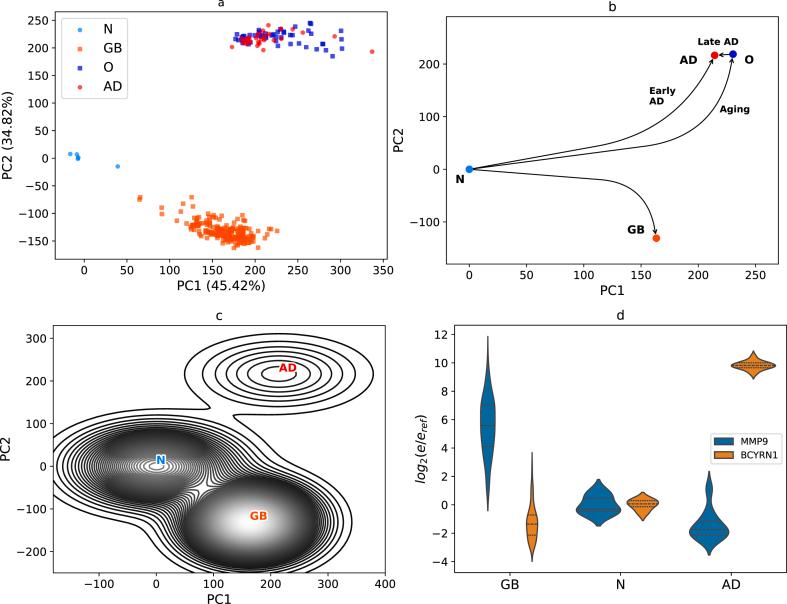
Dimensional reduction analysis of available data for white matter of the brain allows to locate the normal (homeostatic), Glioblastoma and Alzheimer's disease attractors in gene expression space and to identify paths related to transitions like carcinogenesis or Alzheimer's disease onset. A predefined path for aging is also apparent, which is consistent with the hypothesis of programmatic aging. In addition, reasonable assumptions about the relative strengths of attractors allow to draw a schematic landscape of fitness: a Wright's diagram. These simple diagrams reproduce known relations between aging, Glioblastoma and Alzheimer's disease, and rise interesting questions like the possible connection between programmatic aging and Glioblastoma in this tissue. We anticipate that similar multiple diagrams in other tissues could be useful in the understanding of the biology of apparently unrelated diseases or disorders, and in the discovery of unexpected clues for their treatment.
对大脑白质可用数据进行降维分析,能够在基因表达空间中定位正常(稳态)、胶质母细胞瘤和阿尔茨海默病的吸引子,并识别与致癌作用或阿尔茨海默病发病等转变相关的路径。一条预先定义的衰老路径也很明显,这与程序性衰老假说一致。此外,关于吸引子相对强度的合理假设能够绘制出一个适应性示意图:赖特图。这些简单的图表再现了衰老、胶质母细胞瘤和阿尔茨海默病之间的已知关系,并提出了一些有趣的问题,比如在该组织中程序性衰老与胶质母细胞瘤之间可能存在的联系。我们预计,其他组织中的类似多重图表可能有助于理解明显不相关疾病或病症的生物学机制,并为其治疗发现意想不到的线索。

 Zotero 插件