
凤眼莲对微塑料的植物修复作用。
Phytoremediation of microplastics by water hyacinth.
作者信息
Yin Jingjing, Zhu Tongshan, Li Xiaozun, Wang Fayuan, Xu Guoxin
机构信息
Institute of Wetland Agriculture and Ecology, Shandong Academy of Agricultural Sciences, Ji'nan, Shandong Province, 250100, PR China.
College of Pharmacy, Shandong University of Traditional Chinese Medicine, Ji'nan, Shandong Province, 250100, PR China.
出版信息
Environ Sci Ecotechnol. 2025 Feb 11;24:100540. doi: 10.1016/j.ese.2025.100540. eCollection 2025 Mar.
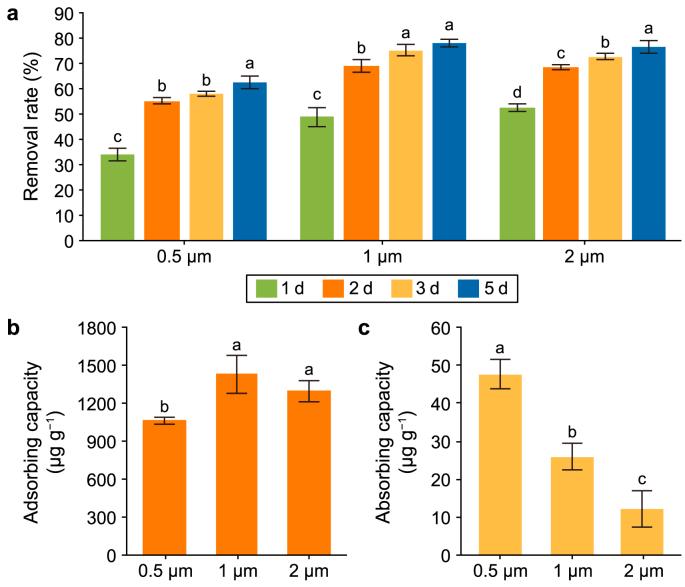
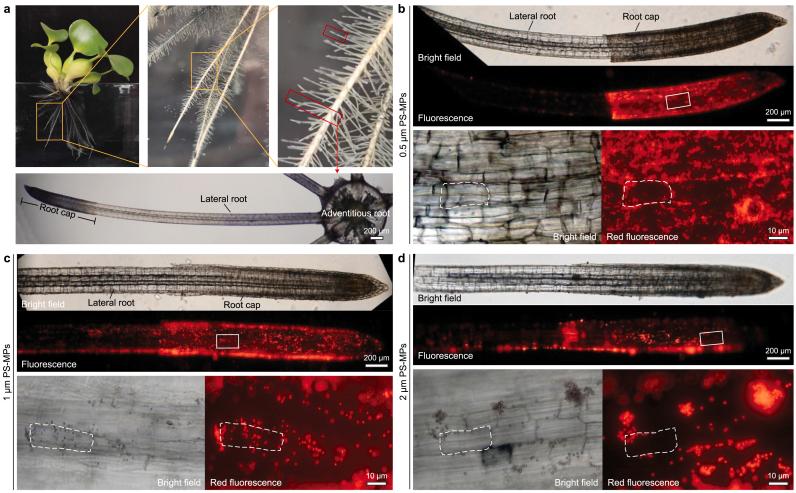
Microplastics have emerged as pervasive environmental pollutants, posing significant risks to both terrestrial and aquatic ecosystems worldwide. Current remediation strategies-including physical, chemical, and microbial methods-are inadequate for large-scale, in situ removal of microplastics, highlighting the urgent need for alternative solutions. Phytoremediation, an eco-friendly and cost-effective technology, holds promise in addressing these challenges, though its application to microplastic pollution remains underexplored. Here we show the capacity of (water hyacinth), a fast-growing, floating aquatic plant, to remove microplastics from contaminated water. Our results show that within 48 h, water hyacinth achieved removal efficiencies of 55.3 %, 69.1 %, and 68.8 % for 0.5, 1, and 2 μm polystyrene particles, respectively, with root adsorption identified as the primary mechanism. Fluorescence microscopy revealed that the extremely large and abundant root caps, featuring a total surface area exceeding 150,000 mm per plant, serve as the principal sites for the entrapment of microplastics. Furthermore, a unique "vascular ring" structure within the stem prevents the translocation of microplastics to aerial tissues, safeguarding leaves for potential downstream applications. This study offers the first microstructural insight into the mechanisms underpinning water hyacinth's exceptional microplastic adsorption capacity and resilience, providing a promising framework for developing phytoremediation strategies to mitigate microplastic pollution in aquatic ecosystems.
微塑料已成为普遍存在的环境污染物,对全球陆地和水生生态系统构成重大风险。目前的修复策略,包括物理、化学和微生物方法,都不足以大规模原位去除微塑料,这凸显了对替代解决方案的迫切需求。植物修复是一种环保且经济高效的技术,有望应对这些挑战,尽管其在微塑料污染方面的应用仍未得到充分探索。在这里,我们展示了凤眼蓝(一种生长迅速的漂浮水生植物)从受污染水中去除微塑料的能力。我们的结果表明,在48小时内,凤眼蓝对0.5、1和2微米的聚苯乙烯颗粒的去除效率分别达到了55.3%、69.1%和68.8%,其中根部吸附被确定为主要机制。荧光显微镜显示,极其庞大且丰富的根冠,每株植物的总表面积超过150,000平方毫米,是截留微塑料的主要部位。此外,茎内独特的“维管束环”结构可防止微塑料向地上组织转移,从而保护叶子以备潜在的下游应用。这项研究首次从微观结构角度深入了解了凤眼蓝卓越的微塑料吸附能力和耐受性背后的机制,为制定植物修复策略以减轻水生生态系统中的微塑料污染提供了一个有前景的框架。




 Zotero 插件