
对溶酶体核酸应激的固有免疫反应。
Innate immune responses to lysosomal nucleic acid stress.
作者信息
Miyake Kensuke, Shibata Takuma, Sato Ryota, Fukui Ryutaro
机构信息
Division of Innate Immunity, The Institute of Medical Science, The University of Tokyo, 4-6-1 Shirokanedai, Minatoku, Tokyo 108-8639, Japan.
出版信息
J Biochem. 2025 Jul 31;178(2):89-96. doi: 10.1093/jb/mvaf011.
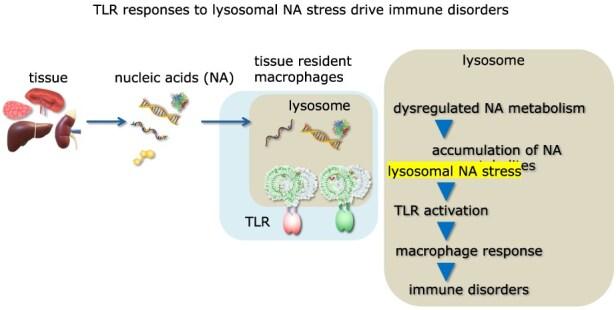
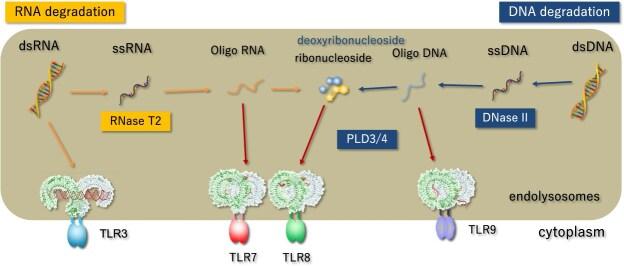
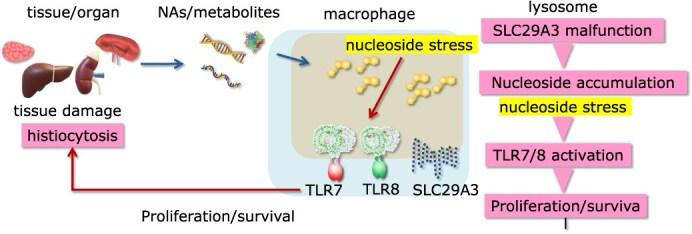
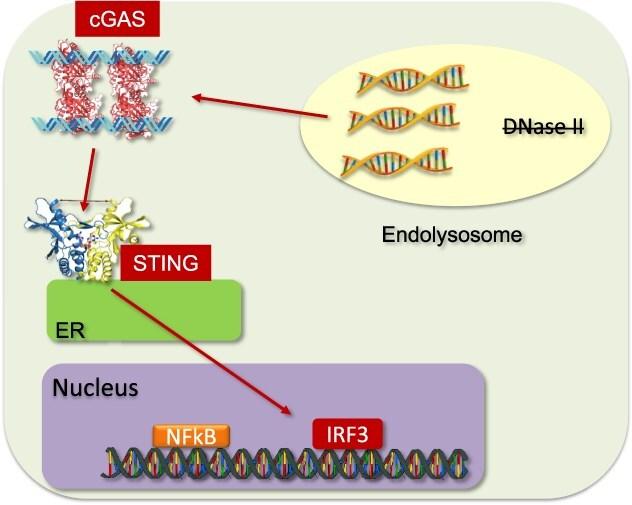
Nucleic acids (NAs) are recognized by endosomal Toll-like receptors (TLRs) and cytoplasmic sensors in innate immune cells. NAs accumulate within lysosomes due to either excessive NA influx or defective lysosomal degradation. The resultant storage of NAs and/or NA metabolites in the lysosome, referred to here as lysosomal NA stress, elicits a spectrum of responses, ranging from inflammation to tissue repair, through NA sensor activation. Although these responses contribute to host defence against infection, they may also drive diseases. For instance, loss of function of the lysosomal nucleoside transporter SLC29A3 drives lysosomal nucleoside stress, which activates TLR8 in macrophages to cause histiocytic diseases collectively called SLC29A3 disorders. Similarly, DNase II deficiency promotes lysosomal DNA stress, leading to activation of cytoplasmic double-stranded DNA sensors, such as cGAS-STING and AIM2, and thereby autoinflammatory and autoimmune diseases. Thus, lysosomal NA stress is viewed as a pivotal environmental signal that initiates innate immune responses.
核酸(NAs)被内体Toll样受体(TLRs)和天然免疫细胞中的细胞质传感器识别。由于核酸流入过多或溶酶体降解缺陷,核酸在溶酶体内积累。核酸和/或核酸代谢产物在溶酶体中的这种储存,在这里称为溶酶体核酸应激,通过核酸传感器激活引发一系列反应,从炎症到组织修复。虽然这些反应有助于宿主抵御感染,但它们也可能引发疾病。例如,溶酶体核苷转运体SLC29A3功能丧失会导致溶酶体核苷应激,激活巨噬细胞中的TLR8,从而引发统称为SLC29A3疾病的组织细胞疾病。同样,DNase II缺乏会促进溶酶体DNA应激,导致细胞质双链DNA传感器如cGAS-STING和AIM2激活,进而引发自身炎症和自身免疫性疾病。因此,溶酶体核酸应激被视为引发天然免疫反应的关键环境信号。

 Zotero 插件