
资源有限的农村地区居民心血管疾病的风险因素。基于加纳一项横断面研究的初步结果。
Risk factors of CVDs among residents of resource-limited rural settings. Preliminary findings based on a cross-sectional study, Ghana.
作者信息
Konlan Kennedy Diema, Afaya Agani, Anaman-Torgbor Judith A, Adedia David, Todzro-Agudze Mathias, Biney Abigail Cobba, Kuug Anthony, Mumuni Hadiru, Baiden Frank, HyoJung Sea, Kim Soyoon
机构信息
Department of Public Health Nursing, School of Nursing and Midwifery, University of Health and Allied Sciences, Ho, Ghana.
Department of Nursing, School of Nursing and Midwifery, University of Health and Allied Sciences, Ho, Ghana.
出版信息
BMC Cardiovasc Disord. 2025 Mar 7;25(1):164. doi: 10.1186/s12872-025-04594-y.
BACKGROUNDS
Cardiovascular disease (CVD) risk factors lead to morbidity and mortality among adults globally. In Ghana, there is a lack of coordinated efforts at all levels of healthcare service to prevent risk factors of cardiovascular disease (CVD). This study assessed cardiovascular disease risk factors among residents of resource-limited rural settings.
METHODS
This descriptive cross-sectional design is the first phase of a two-year community-level study aimed at implementing an intervention to reduce CVD risk in a rural community in Ghana. The study population included 379 people living in the Avenui community. We conducted a nurse-led door-to-door visit, screened for CVD risk, provided health education, and collected data using an adapted questionnaire. The data were analyzed using SPSS. Categorical data were expressed as frequencies and proportions, and the Chi-Square test of associations. A multivariable logistic regression analysis with a backward elimination method was used to examine the association of the risk factors with the risk of developing CVD.
RESULTS
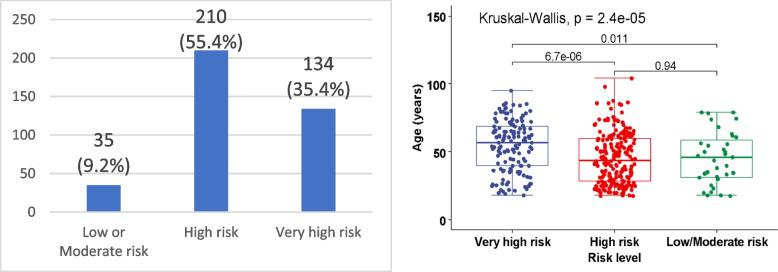
The CVD risk among participants was categorized as 'very high' (35.4%), high (55.4%), and low or moderate (9.2%). There was a positive correlation between lifestyle (r = 0.126, p-value < 0.05), stress (r = 0.114, p-value < 0.05), blood sugar level (r = 0.102, p-value < 0.05) inflammation and pain (r = 0.109, p-value < 0.05), and high blood pressure (r = 0.268, p-value < 0.01) with history of CVD. CVD high risk was significantly associated with marital status (p-value = 0.001), employment status (p-value = 0.001), perception of personal health (p-value = 0.045), lifestyle (p-value = 0.034), knowledge of peripheral arterial disease (p-value = 0.018), and knowledge on deep vein thrombosis and pulmonary embolism (p-value = 0.002). The backward multiple logistic regression model was significant (78.912, p-value < 0.001) with a non-significant Hosmer and Lemeshow Test (2.145, p-value = 0.976) and a Cox & Snell R Square and Nagelkerke R Square of 0.393 and 0.619, respectively. The significant predictors of a 'very high' CVD risk include marital status being single (p-value = 0.001), those that exercise only two (2) times a week (p-value = 0.001) employment status being part-time worker (p-value = 0.015), poor perception of overall personal health (p-value < 0.001), and those listening to the radio (p-value = 0.024).
CONCLUSION
The risk factors associated with CVD were identified to be multiple and interacted variable among rural community dwellers. These factors included marital status, exercise, employment, perception of health, and listening to the radio. We recommend implementing primary prevention strategies that involve adopting a comprehensive assessment and management of the risk factors of CVD in Ghana.
背景
心血管疾病(CVD)风险因素导致全球成年人发病和死亡。在加纳,各级医疗服务缺乏协同努力来预防心血管疾病(CVD)的风险因素。本研究评估了资源有限的农村地区居民的心血管疾病风险因素。
方法
这种描述性横断面设计是一项为期两年的社区层面研究的第一阶段,旨在实施一项干预措施以降低加纳一个农村社区的CVD风险。研究人群包括居住在阿韦努伊社区的379人。我们进行了由护士主导的挨家挨户访问,筛查CVD风险,提供健康教育,并使用一份改编的问卷收集数据。数据使用SPSS进行分析。分类数据以频率和比例表示,并进行关联的卡方检验。采用向后逐步回归法的多变量逻辑回归分析来检验风险因素与发生CVD风险之间的关联。
结果
参与者的CVD风险被分类为“非常高”(35.4%)、“高”(55.4%)和“低或中度”(9.2%)。生活方式(r = 0.126,p值 < 0.05)、压力(r = 0.114,p值 < 0.05)、血糖水平(r = 0.102,p值 < 0.05)、炎症和疼痛(r = 0.109,p值 < 0.05)以及高血压(r = 0.268,p值 < 0.01)与CVD病史之间存在正相关。CVD高风险与婚姻状况(p值 = 0.001)、就业状况(p值 = 0.001)、个人健康认知(p值 = 0.045)、生活方式(p值 = 0.034)、外周动脉疾病知识(p值 = 0.018)以及深静脉血栓形成和肺栓塞知识(p值 = 0.002)显著相关。向后多变量逻辑回归模型具有显著性(78.912,p值 < 0.001),Hosmer和Lemeshow检验不显著(2.145,p值 = 0.976),Cox & Snell R方和Nagelkerke R方分别为0.393和0.619。“非常高”的CVD风险的显著预测因素包括单身婚姻状况(p值 = 0.001)、每周仅锻炼两次(2次)的人(p值 = 0.001)、兼职工作的就业状况(p值 = 0.015)、对整体个人健康的不良认知(p值 < 0.001)以及听收音机的人(p值 = 0.024)。
结论
在农村社区居民中,与CVD相关的风险因素被确定为多种且相互作用的变量。这些因素包括婚姻状况、锻炼、就业、健康认知和听收音机。我们建议实施初级预防策略,包括对加纳CVD风险因素进行全面评估和管理。
 Zotero 插件