
基于非聚乙二醇化和聚乙二醇化纳米乳剂交叉注射的比格犬和大鼠中性粒细胞介导的加速血液清除现象。
Neutrophils-mediated accelerated blood clearance phenomenon in beagles and rats based on the cross-injection of non-PEGylated and PEGylated nanoemulsions.
作者信息
Liu Mengyang, Wang Jia, Chen Ge, Wang Lirong, Wang Xuling, Xiang Bai, Deng Yihui, He Chaoxing, Wang Lei
机构信息
Postdoctoral Research Station in Clinical Medicine of Hebei Medical University, The Fourth Hospital of Hebei Medical University, Shijiazhuang 050017, PR China.
Department of Pharmaceutics, College of Pharmacy, Shenyang Pharmaceutical University, Shenyang 110016, PR China.
出版信息
Int J Pharm X. 2025 Feb 19;9:100318. doi: 10.1016/j.ijpx.2025.100318. eCollection 2025 Jun.
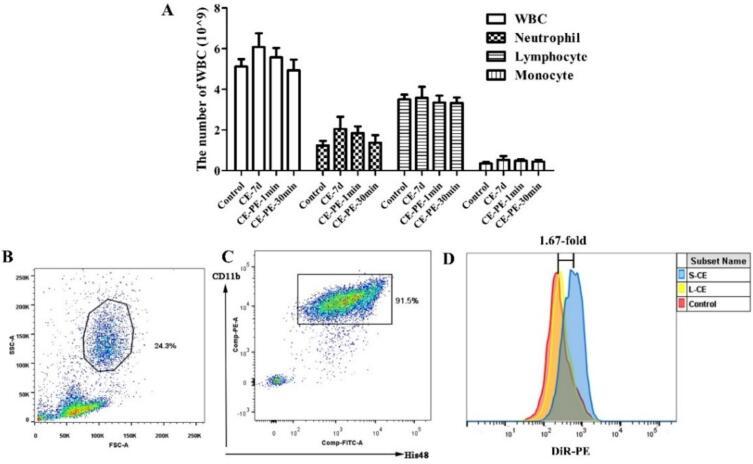
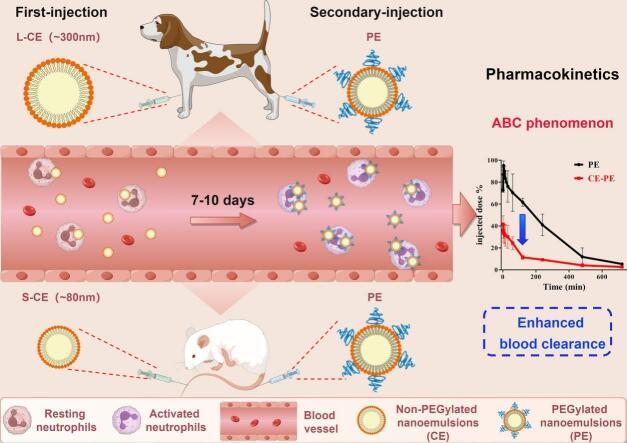
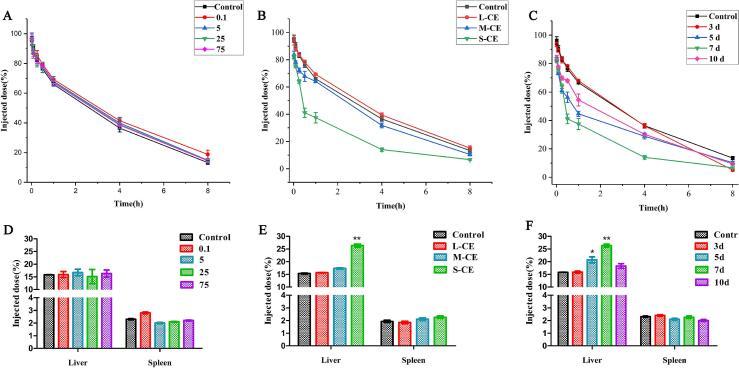
The initial injection of PEGylated nanoparticles can activate antibodies and the complement system, leading to the accelerated blood clearance (ABC) phenomenon, characterized by reduced circulation time and abnormal liver and spleen accumulation upon re-exposure. However, PEGylation is not essential for ABC induction, as non-PEGylated nanoparticles can also trigger the similar ABC phenomenon. In this study, we found non-PEGylated nanoemulsions (CE) could accelerate the blood clearance of subsequent injection of PEGylated nanoemulsions (PE) in beagles and rats, which was independent of antibodies and the complement system, but was associated with an increase in neutrophil numbers and phagocytic activity. We propose classifying this as a "general ABC phenomenon," broadening clinical relevance and highlighting potential immune risks of ABC phenomenon. The intensity of the ABC phenomenon correlated with the initial CE phospholipid dose in both species. Notably, larger CE particles (∼ 300 nm) induced the ABC phenomenon in beagles, while smaller particles (∼ 80 nm) with higher immunogenicity were required in rats. This suggested that beagles are more susceptible to CE-induced ABC phenomenon. The higher neutrophil proportion in beagles likely contributed to species differences in ABC phenomenon. This is the first study to report neutrophil involvement in ABC induction by non-PEGylated nanoparticles, more importantly, underscoring potential immune risks in the cross-injection of non-PEGylated and PEGylated nanoparticles during the developments and clinical applications of nano-drug delivery systems.
聚乙二醇化纳米颗粒的初次注射可激活抗体和补体系统,导致加速血液清除(ABC)现象,其特征为循环时间缩短以及再次注射时肝脏和脾脏出现异常蓄积。然而,聚乙二醇化对于ABC诱导并非必不可少,因为非聚乙二醇化纳米颗粒也可引发类似的ABC现象。在本研究中,我们发现非聚乙二醇化纳米乳剂(CE)可加速比格犬和大鼠随后注射的聚乙二醇化纳米乳剂(PE)的血液清除,这与抗体和补体系统无关,但与中性粒细胞数量增加和吞噬活性有关。我们建议将此归类为“一般ABC现象”,以拓宽其临床相关性并突出ABC现象的潜在免疫风险。ABC现象的强度与两种动物中初始CE磷脂剂量相关。值得注意的是,较大的CE颗粒(约300 nm)在比格犬中诱导了ABC现象,而在大鼠中则需要具有更高免疫原性的较小颗粒(约80 nm)。这表明比格犬对CE诱导的ABC现象更敏感。比格犬中较高的中性粒细胞比例可能导致了ABC现象的种属差异。这是第一项报道中性粒细胞参与非聚乙二醇化纳米颗粒诱导ABC的研究,更重要的是,强调了在纳米药物递送系统的研发和临床应用过程中非聚乙二醇化和聚乙二醇化纳米颗粒交叉注射时的潜在免疫风险。



 Zotero 插件