
CD8 T细胞在塑造骨髓增生异常综合征和急性髓系白血病患者治疗结局中的新作用
The Emerging Role of CD8 T Cells in Shaping Treatment Outcomes of Patients with MDS and AML.
作者信息
Tasis Athanasios, Spyropoulos Theodoros, Mitroulis Ioannis
机构信息
Translational Research and Laboratory Medicine Unit, First Department of Internal Medicine, University Hospital of Alexandroupolis, Democritus University of Thrace, 68100 Alexandroupolis, Greece.
Department of Hematology, University Hospital of Alexandroupolis, Democritus University of Thrace, 68100 Alexandroupolis, Greece.
出版信息
Cancers (Basel). 2025 Feb 22;17(5):749. doi: 10.3390/cancers17050749.
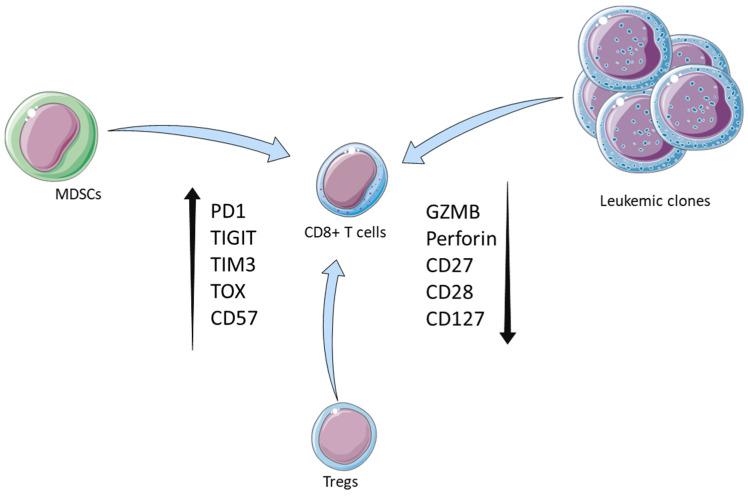
CD8 T cells are critical players in anti-tumor immunity against solid tumors, targeted by immunotherapies. Emerging evidence suggests that CD8 T cells also play a crucial role in anti-tumor responses and determining treatment outcomes in hematologic malignancies like myelodysplastic neoplasms (MDS) and acute myeloid leukemia (AML). In this review, we focus on the implication of CD8 T cells in the treatment response of patients with MDS and AML. First, we review reported studies of aberrant functionality and clonality of CD8 T cells in MDS and AML, often driven by the immunosuppressive bone marrow microenvironment, which can hinder effective antitumor immunity. Additionally, we discuss the potential use of CD8 T cell subpopulations, including memory and senescent-like subsets, as predictive biomarkers for treatment response to a variety of treatment regimens, such as hypomethylating agents, which is the standard of care for patients with higher-risk MDS, and chemotherapy which is the main treatment of patients with AML. Understanding the multifaceted role of CD8 T cells and their interaction with malignant cells in MDS and AML will provide useful insights into their potential as prognostic/predictive biomarkers, but also uncover alternative approaches to novel treatment strategies that could reshape the therapeutic landscape, thus improving treatment efficacy, aiding in overcoming treatment resistance and improving patient survival in these challenging myeloid neoplasms.
CD8 T细胞是针对实体瘤的抗肿瘤免疫中的关键参与者,也是免疫疗法的靶点。新出现的证据表明,CD8 T细胞在抗肿瘤反应以及在骨髓增生异常综合征(MDS)和急性髓系白血病(AML)等血液系统恶性肿瘤的治疗结果判定中也发挥着关键作用。在本综述中,我们重点关注CD8 T细胞在MDS和AML患者治疗反应中的意义。首先,我们回顾已报道的关于MDS和AML中CD8 T细胞功能异常和克隆性的研究,这些通常由免疫抑制性骨髓微环境驱动,而这种微环境会阻碍有效的抗肿瘤免疫。此外,我们讨论了CD8 T细胞亚群(包括记忆性和衰老样亚群)作为多种治疗方案(如去甲基化药物,这是高危MDS患者的标准治疗方法,以及化疗,这是AML患者的主要治疗方法)治疗反应预测生物标志物的潜在用途。了解CD8 T细胞在MDS和AML中的多方面作用及其与恶性细胞的相互作用,将为其作为预后/预测生物标志物的潜力提供有用的见解,同时也揭示新的治疗策略的替代方法,这些方法可能重塑治疗格局,从而提高治疗效果,有助于克服治疗耐药性并改善这些具有挑战性的髓系肿瘤患者的生存率。

 Zotero 插件