
用于水分解的先进钛基光催化系统:从基础到制造的综合综述
Advanced TiO-Based Photocatalytic Systems for Water Splitting: Comprehensive Review from Fundamentals to Manufacturing.
作者信息
Ahasan Tarek, Edirisooriya E M N Thiloka, Senanayake Punhasa S, Xu Pei, Wang Huiyao
机构信息
Department of Civil Engineering, New Mexico State University, Las Cruces, NM 88003, USA.
出版信息
Molecules. 2025 Feb 28;30(5):1127. doi: 10.3390/molecules30051127.
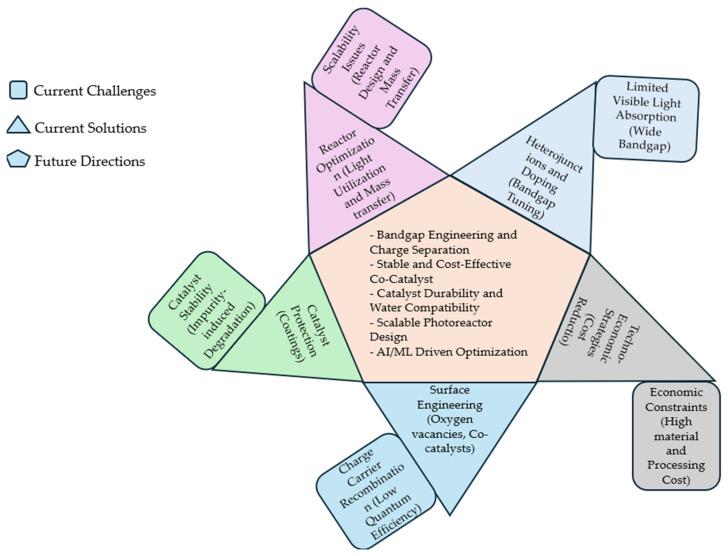
The global imperative for clean energy solutions has positioned photocatalytic water splitting as a promising pathway for sustainable hydrogen production. This review comprehensively analyzes recent advances in TiO-based photocatalytic systems, focusing on materials engineering, water source effects, and scale-up strategies. We recognize the advancements in nanoscale architectural design, the engineered heterojunction of catalysts, and cocatalyst integration, which have significantly enhanced photocatalytic efficiency. Particular emphasis is placed on the crucial role of water chemistry in photocatalytic system performance, analyzing how different water sources-from wastewater to seawater-impact hydrogen evolution rates and system stability. Additionally, the review addresses key challenges in scaling up these systems, including the optimization of reactor design, light distribution, and mass transfer. Recent developments in artificial intelligence-driven materials discovery and process optimization are discussed, along with emerging opportunities in bio-hybrid systems and CO reduction coupling. Through critical analysis, we identify the fundamental challenges and propose strategic research directions for advancing TiO-based photocatalytic technology toward practical implementation. This work will provide a comprehensive framework for exploring advanced TiO-based composite materials and developing efficient and scalable photocatalytic systems for multifunctional simultaneous hydrogen production.
全球对清洁能源解决方案的迫切需求使光催化水分解成为可持续制氢的一条有前景的途径。本综述全面分析了基于TiO的光催化系统的最新进展,重点关注材料工程、水源效应和放大策略。我们认识到纳米级结构设计、催化剂的工程异质结和助催化剂集成方面的进展,这些进展显著提高了光催化效率。特别强调了水化学在光催化系统性能中的关键作用,分析了从废水到海水等不同水源如何影响析氢速率和系统稳定性。此外,该综述还讨论了扩大这些系统规模的关键挑战,包括反应器设计、光分布和传质的优化。讨论了人工智能驱动的材料发现和工艺优化的最新进展,以及生物混合系统和CO还原耦合方面的新机遇。通过批判性分析,我们确定了基本挑战,并提出了将基于TiO的光催化技术推向实际应用的战略研究方向。这项工作将为探索先进的基于TiO的复合材料和开发用于多功能同步制氢的高效且可扩展的光催化系统提供一个全面的框架。


 Zotero 插件