
偏向性阿片受体激动剂:平衡镇痛疗效与副作用特征
Biased Opioid Receptor Agonists: Balancing Analgesic Efficacy and Side-Effect Profiles.
作者信息
Ju Jie, Li Zheng, Liu Jie, Peng Xiaoling, Gao Feng
机构信息
Department of Anesthesiology and Pain Medicine, Hubei Key Laboratory of Geriatric Anesthesia and Perioperative Brain Health, Wuhan Clinical Research Center for Geriatric Anesthesia, Tongji Hospital, Tongji Medical College, Huazhong University of Science and Technology, Wuhan 430030, China.
出版信息
Int J Mol Sci. 2025 Feb 21;26(5):1862. doi: 10.3390/ijms26051862.
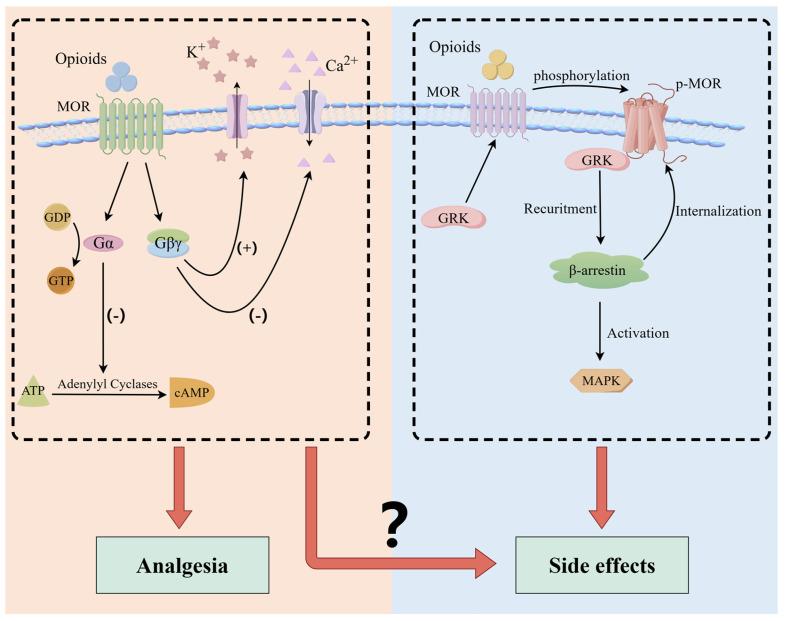
Opioids are the most effective option for severe pain. However, it is well documented that the side effects associated with prolonged opioid use significantly constrain dosage in the clinical setting. Recently, researchers have concentrated on the development of biased opioid receptor agonists that preferentially activate the G protein signaling pathway over β-arrestin signaling. This approach is based on the hypothesis that G protein signaling mediates analgesic effects, whereas β-arrestin signaling is implicated in adverse side effects. Although certain studies have demonstrated that the absence or inhibition of β-arrestin signaling can mitigate the incidence of side effects, recent research appears to challenge these earlier findings. In-depth investigations into biased signal transduction of opioid receptor agonists have been conducted, potentially offering novel insights for the development of biased opioid receptors. Consequently, this review elucidates the contradictory roles of β-arrestin signaling in the adverse reactions associated with opioid receptor activation. Furthermore, a comparative analysis was conducted to evaluate the efficacy of the classic G protein-biased agonists, TRV130 and PZM21, relative to the traditional non-biased agonist morphine. This review aims to inform the development of novel analgesic drugs that can optimize therapeutic efficacy and safety, while minimizing adverse reactions to the greatest extent possible.
阿片类药物是治疗重度疼痛最有效的选择。然而,有充分的文献记载,长期使用阿片类药物所带来的副作用在临床环境中显著限制了其剂量。最近,研究人员专注于开发偏向性阿片受体激动剂,这类激动剂优先激活G蛋白信号通路而非β-抑制蛋白信号通路。这种方法基于这样一种假设,即G蛋白信号传导介导镇痛作用,而β-抑制蛋白信号传导与副作用有关。尽管某些研究表明,β-抑制蛋白信号的缺失或抑制可以降低副作用的发生率,但最近的研究似乎对这些早期发现提出了挑战。对阿片受体激动剂的偏向性信号转导进行了深入研究,这可能为开发偏向性阿片受体提供新的见解。因此,本综述阐明了β-抑制蛋白信号在与阿片受体激活相关的不良反应中的矛盾作用。此外,还进行了一项比较分析,以评估经典的偏向G蛋白激动剂TRV130和PZM21相对于传统非偏向性激动剂吗啡的疗效。本综述旨在为新型镇痛药的开发提供参考,这类药物可以优化治疗效果和安全性,同时尽可能减少不良反应。
 Zotero 插件