
用于增强生物可降解材料性能的锌-氧化锌纳米复合材料的制备与表征
Development and Characterization of Zn-ZnO Nanocomposites for Enhanced Biodegradable Material Properties.
作者信息
Shin Johngeon, Choi Jaewon, Choi Yong Whan, Kim Seongsoo, Hwang Injoo
机构信息
Department of Batteries Science and Engineering, Silla University, Busan 46958, Republic of Korea.
Department of Mechanical Engineering, Silla University, Busan 46958, Republic of Korea.
出版信息
Materials (Basel). 2025 Feb 21;18(5):938. doi: 10.3390/ma18050938.
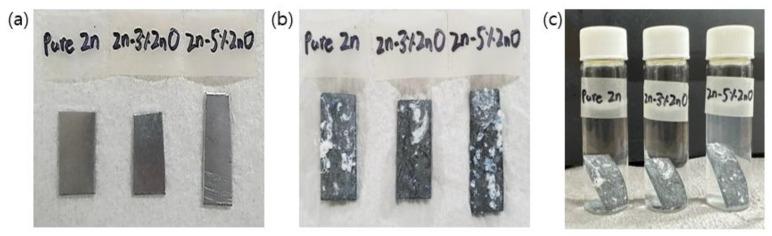
Zinc has attracted significant attention as a versatile material with potential applications in various fields, particularly in biomedical engineering. Despite its desirable characteristics, such as biodegradability and biocompatibility, the inherently low mechanical strength of zinc has been a major limitation for its broader use in clinical applications. To address this issue and enhance its mechanical performance without compromising its biocompatibility, a novel composite material was developed by mixing zinc oxide (ZnO) with zinc (Zn). ZnO is widely recognized for its high chemical stability, non-toxicity, and antimicrobial properties, making it an excellent additive for biomedical materials. In this study, Zn-ZnO nanocomposites were fabricated by uniformly dispersing ZnO nanoparticles into molten zinc using an ultrasonic processor. The uniform distribution of ZnO nanoparticles within the zinc matrix was confirmed, and the resulting nanocomposites demonstrated remarkable improvements in mechanical properties. Specifically, the hardness and tensile strength of the Zn-ZnO nanocomposites were increased by approximately 90% and 160%, respectively, compared to pure zinc. To evaluate the biodegradation behavior of the materials, both pure zinc and Zn-ZnO nanocomposite samples were immersed in phosphate-buffered saline (PBS) at 37 °C, simulating physiological conditions. The degradation rate was assessed by measuring the weight loss of the material over time. The biodegradation rate of the Zn-ZnO nanocomposites was found to be nearly identical to that of pure zinc under identical conditions, indicating that the addition of ZnO did not adversely affect the degradability of the material. These findings suggest that Zn-ZnO nanocomposites offer a promising solution for biomedical applications by combining improved mechanical properties with maintained biodegradability and biocompatibility.
锌作为一种具有多种潜在应用的多功能材料,尤其是在生物医学工程领域,已引起了广泛关注。尽管锌具有诸如生物可降解性和生物相容性等理想特性,但其固有的低机械强度一直是其在临床应用中更广泛使用的主要限制。为了解决这个问题并在不影响其生物相容性的情况下提高其机械性能,通过将氧化锌(ZnO)与锌(Zn)混合开发了一种新型复合材料。ZnO因其高化学稳定性、无毒和抗菌性能而被广泛认可,使其成为生物医学材料的优良添加剂。在本研究中,使用超声处理器将ZnO纳米颗粒均匀分散到熔融锌中制备了Zn-ZnO纳米复合材料。证实了ZnO纳米颗粒在锌基体中的均匀分布,所得纳米复合材料的机械性能有显著改善。具体而言,与纯锌相比,Zn-ZnO纳米复合材料的硬度和拉伸强度分别提高了约90%和160%。为了评估材料的生物降解行为,将纯锌和Zn-ZnO纳米复合材料样品都浸泡在37°C的磷酸盐缓冲盐水(PBS)中,模拟生理条件。通过测量材料随时间的重量损失来评估降解速率。发现在相同条件下,Zn-ZnO纳米复合材料的生物降解速率与纯锌几乎相同,这表明添加ZnO不会对材料的降解性产生不利影响。这些发现表明,Zn-ZnO纳米复合材料通过将改善的机械性能与保持的生物可降解性和生物相容性相结合,为生物医学应用提供了一个有前景的解决方案。


 Zotero 插件