
原发性减重手术术后并发症相关的人口统计学因素:快速综述
Demographic Factors Associated with Postoperative Complications in Primary Bariatric Surgery: A Rapid Review.
作者信息
Hon Jocelin, Fahey Paul, Ariya Mohammad, Piya Milan, Craven Alex, Atlantis Evan
机构信息
School of Medicine, Western Sydney University, Campbelltown, Australia.
School of Health Sciences, Western Sydney University, Campbelltown, Australia.
出版信息
Obes Surg. 2025 Apr;35(4):1456-1468. doi: 10.1007/s11695-025-07784-x. Epub 2025 Mar 13.
BACKGROUND
Bariatric surgery is highly effective for the management of severe obesity, but its safety profile is not completely understood. This review aimed to synthesise evidence linking demographic factors to postoperative complications and mortality following primary bariatric surgery.
METHODS
We searched Medline for observational studies of adult patients linking demographic factors to postoperative complications of primary bariatric surgery published from 2017 to 2022. Risk ratios (RR) with 95% confidence intervals (95% CI) were calculated and pooled using random effect meta-analysis. Heterogeneity was quantified using the I statistic and tested for statistical significance using the Q-statistic. Sensitivity analyses were used to explore potential sources of heterogeneity.
RESULTS
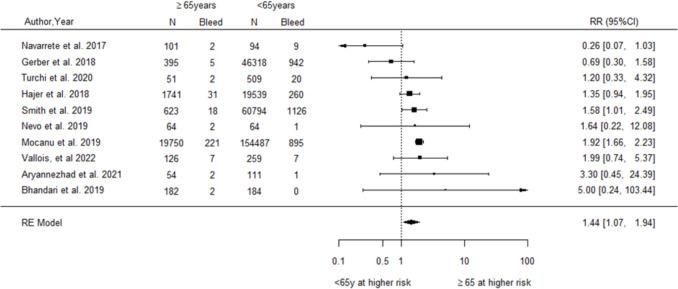
A total of 71 observational studies (69 cohort, 2 case-control) were reviewed and appraised. Older age was consistently associated with increased risks of postoperative mortality (RR = 2.62, 95% CI 1.63-4.23, I = 42.04%), serious complications (RR = 1.76, 95% CI 1.09-2.82, I = 93.24%), anastomotic leak (RR = 1.64, 95% CI 1.04-2.58, I = 61.09%), and haemorrhage (RR = 1.44, 95% CI 1.07-1.94, I = 45.25%). Male sex was associated with increased anastomotic leak (RR = 1.39, 95% CI 1.04-1.87, I = 72.36%). Sensitivity analyses did not identify sources of bias. Socioeconomic factors, including Black/African American race, low financial status, and marital status (mixed results), were linked to higher complication risks in some studies.
CONCLUSIONS
Older age and certain demographic factors (male sex, Black/African American race, low financial status, marital status) were associated with increased risks of postoperative complications following primary bariatric surgery.
背景
减肥手术对于重度肥胖的治疗非常有效,但其安全性尚未完全明确。本综述旨在综合有关人口统计学因素与初次减肥手术后并发症及死亡率之间关联的证据。
方法
我们在Medline数据库中检索了2017年至2022年发表的关于成年患者的观察性研究,这些研究将人口统计学因素与初次减肥手术的术后并发症相联系。计算风险比(RR)及其95%置信区间(95%CI),并采用随机效应荟萃分析进行汇总。使用I统计量对异质性进行量化,并用Q统计量检验其统计学意义。采用敏感性分析来探索异质性的潜在来源。
结果
共回顾并评估了71项观察性研究(69项队列研究,2项病例对照研究)。年龄较大始终与术后死亡风险增加相关(RR = 2.62,95%CI 1.63 - 4.23,I = 42.04%)、严重并发症风险增加相关(RR = 1.76,95%CI 1.09 - 2.82,I = 93.24%)、吻合口漏风险增加相关(RR = 1.64,95%CI 1.04 - 2.58,I = 61.09%)以及出血风险增加相关(RR = 1.44,95%CI 1.07 - 1.94,I = 45.25%)。男性与吻合口漏风险增加相关(RR = 1.39,95%CI 1.04 - 1.87,I = 72.36%)。敏感性分析未发现偏倚来源。在一些研究中,社会经济因素,包括黑人/非裔美国人种族、低经济状况和婚姻状况(结果不一)与较高的并发症风险相关。
结论
年龄较大以及某些人口统计学因素(男性、黑人/非裔美国人种族、低经济状况、婚姻状况)与初次减肥手术后并发症风险增加相关。



 Zotero 插件