
糖尿病肾病中细胞铁死亡与固有免疫的相互作用:机制及治疗意义
Crosstalk between ferroptosis and innate immune in diabetic kidney disease: mechanisms and therapeutic implications.
作者信息
Wang Jinyang, Shi Haonan, Yang Ye, Gong Xueli
机构信息
Department of Geriatric Integrative, Second Affiliated Hospital of Xinjiang Medical University, Urumqi, Xinjiang, China.
School of Medicine, Shanghai University, Shanghai, China.
出版信息
Front Immunol. 2025 Feb 28;16:1505794. doi: 10.3389/fimmu.2025.1505794. eCollection 2025.
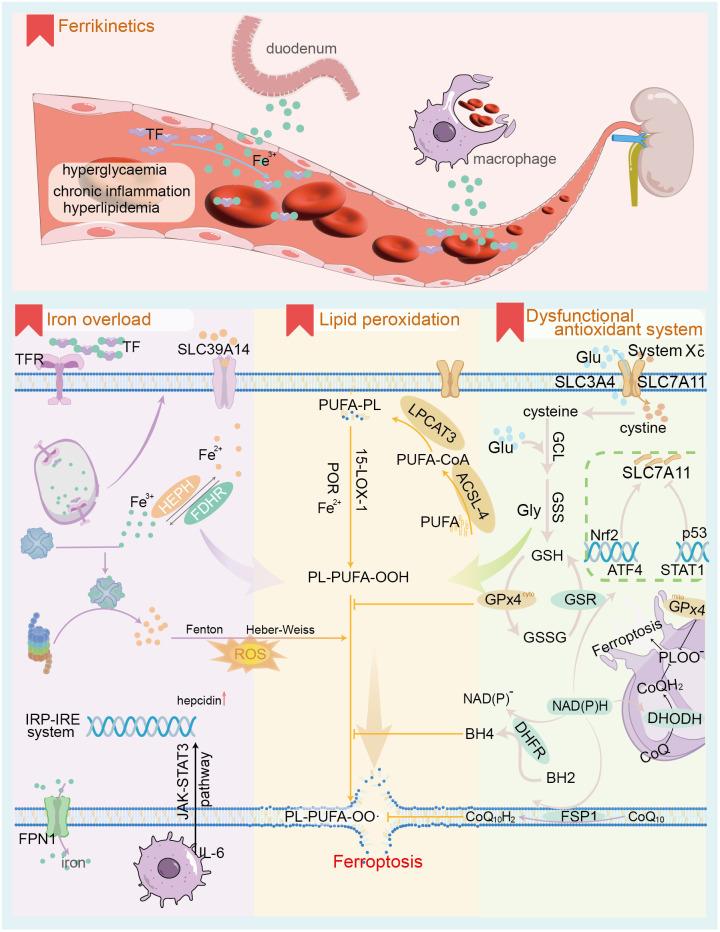
Diabetic kidney disease (DKD) is a prevalent complication of diabetes mellitus (DM), and its incidence is increasing alongside the number of diabetes cases. Effective treatment and long-term management of DKD present significant challenges; thus, a deeper understanding of its pathogenesis is essential to address this issue. Chronic inflammation and abnormal cell death in the kidney closely associate with DKD development. Recently, there has been considerable attention focused on immune cell infiltration into renal tissues and its inflammatory response's role in disease progression. Concurrently, ferroptosis-a novel form of cell death-has emerged as a critical factor in DKD pathogenesis, leading to increased glomerular filtration permeability, proteinuria, tubular injury, interstitial fibrosis, and other pathological processes. The cardiorenal benefits of SGLT2 inhibitors (SGLT2-i) in DKD patients have been demonstrated through numerous large clinical trials. Moreover, further exploratory experiments indicate these drugs may ameliorate serum and urinary markers of inflammation, such as TNF-α, and inhibit ferroptosis in DKD models. Consequently, investigating the interplay between ferroptosis and innate immune and inflammatory responses in DKD is essential for guiding future drug development. This review presents an overview of ferroptosis within the context of DKD, beginning with its core mechanisms and delving into its potential roles in DKD progression. We will also analyze how aberrant innate immune cells, molecules, and signaling pathways contribute to disease progression. Finally, we discuss the interactions between ferroptosis and immune responses, as well as targeted therapeutic agents, based on current evidence. By analyzing the interplay between ferroptosis and innate immunity alongside its inflammatory responses in DKD, we aim to provide insights for clinical management and drug development in this area.
糖尿病肾病(DKD)是糖尿病(DM)常见的并发症,其发病率随着糖尿病病例数的增加而上升。DKD的有效治疗和长期管理面临重大挑战;因此,深入了解其发病机制对于解决这一问题至关重要。肾脏中的慢性炎症和异常细胞死亡与DKD的发展密切相关。最近,免疫细胞浸润到肾组织及其炎症反应在疾病进展中的作用受到了相当多的关注。同时,铁死亡——一种新的细胞死亡形式——已成为DKD发病机制中的一个关键因素,导致肾小球滤过通透性增加、蛋白尿、肾小管损伤、间质纤维化和其他病理过程。通过大量大型临床试验已证明钠-葡萄糖协同转运蛋白2抑制剂(SGLT2-i)对DKD患者的心肾有益。此外,进一步的探索性实验表明,这些药物可能改善炎症的血清和尿液标志物,如肿瘤坏死因子-α,并抑制DKD模型中的铁死亡。因此,研究DKD中铁死亡与固有免疫和炎症反应之间的相互作用对于指导未来的药物开发至关重要。本综述概述了DKD背景下的铁死亡,从其核心机制开始,深入探讨其在DKD进展中的潜在作用。我们还将分析异常的固有免疫细胞、分子和信号通路如何促进疾病进展。最后,我们根据现有证据讨论铁死亡与免疫反应之间的相互作用以及靶向治疗药物。通过分析DKD中铁死亡与固有免疫及其炎症反应之间的相互作用,我们旨在为该领域的临床管理和药物开发提供见解。


 Zotero 插件