
乳腺癌中肿瘤相关巨噬细胞的机制及治疗策略。
Mechanisms of tumor-associated macrophages in breast cancer and treatment strategy.
作者信息
Jin Hong, Meng Xinyue, Feng Jianwei
机构信息
Department of Ultrasound, Shengjing Hospital of China Medical University, Shenyang, Liaoning, China.
出版信息
Front Immunol. 2025 Feb 28;16:1560393. doi: 10.3389/fimmu.2025.1560393. eCollection 2025.
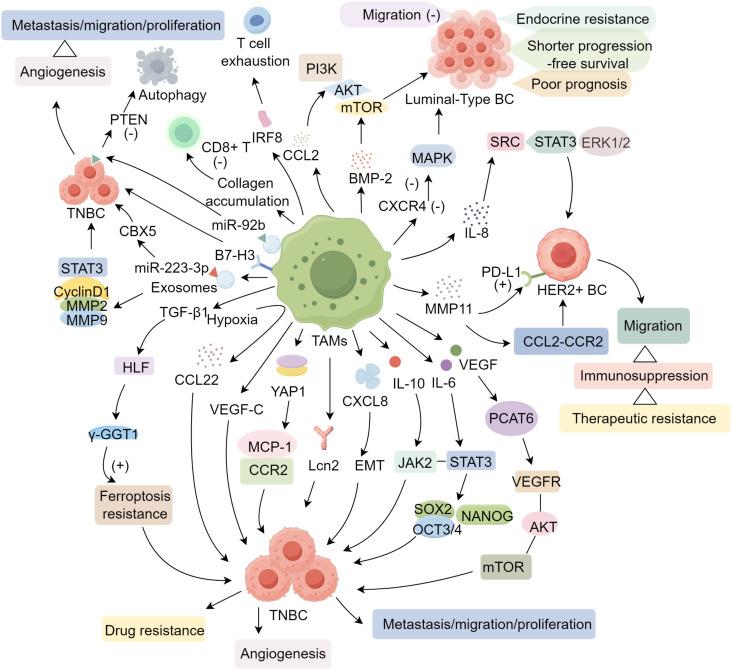
Breast cancer (BC) is the most common cancer in women and a leading cause of cancer-related mortality. Despite advances in screening and treatment, outcomes for advanced or recurrent BC remain poor, highlighting the need for new strategies. Recent research emphasizes the tumor microenvironment (TME), particularly tumor-associated macrophages (TAMs), as key drivers of tumor growth, metastasis, and resistance to therapy. The presence of M2-like TAMs in the TME promotes immune evasion and tumor progression across BC subtypes. This review summarizes TAMs classification, their role in BC, and emerging therapies targeting TAMs, including depletion, inhibition of recruitment, and reprogramming from pro-tumoral M2 to anti-tumoral M1 phenotypes. Targeting TAMs offers a promising strategy to improve BC treatment outcomes.
乳腺癌(BC)是女性中最常见的癌症,也是癌症相关死亡的主要原因。尽管在筛查和治疗方面取得了进展,但晚期或复发性BC的治疗效果仍然很差,这凸显了新策略的必要性。最近的研究强调肿瘤微环境(TME),特别是肿瘤相关巨噬细胞(TAM),是肿瘤生长、转移和治疗耐药性的关键驱动因素。TME中M2样TAM的存在促进了BC各亚型的免疫逃逸和肿瘤进展。本综述总结了TAM的分类、它们在BC中的作用以及针对TAM的新兴疗法,包括耗竭、抑制募集以及从促肿瘤的M2表型重编程为抗肿瘤的M1表型。靶向TAM为改善BC治疗效果提供了一种有前景的策略。
 Zotero 插件