
用于肺癌磁靶向化疗及磁共振成像的负载PAD4抑制剂的磁性FeO纳米颗粒
PAD4 Inhibitor-Loaded Magnetic FeO Nanoparticles for Magnetic Targeted Chemotherapy and Magnetic Resonance Imaging of Lung Cancer.
作者信息
Lu Yu, Wang Xin, Jia Yijiang, Zhang Shuai, Yang Jin-Kui, Li Qi, Li Yuanming, Wang Yuji
机构信息
Department of Medicinal Chemistry, College of Pharmaceutical Sciences of Capital Medical University, Beijing, 100069, People's Republic of China.
Beijing Area Major Laboratory of Peptide and Small Molecular Drugs, Engineering Research Center of Endogenous Prophylactic of Ministry of Education of China, Beijing Laboratory of Biomedical Materials, Laboratory for Clinical Medicine, Capital Medical University, Beijing, 100069, People's Republic of China.
出版信息
Int J Nanomedicine. 2025 Mar 12;20:3031-3044. doi: 10.2147/IJN.S502814. eCollection 2025.
INTRODUCTION
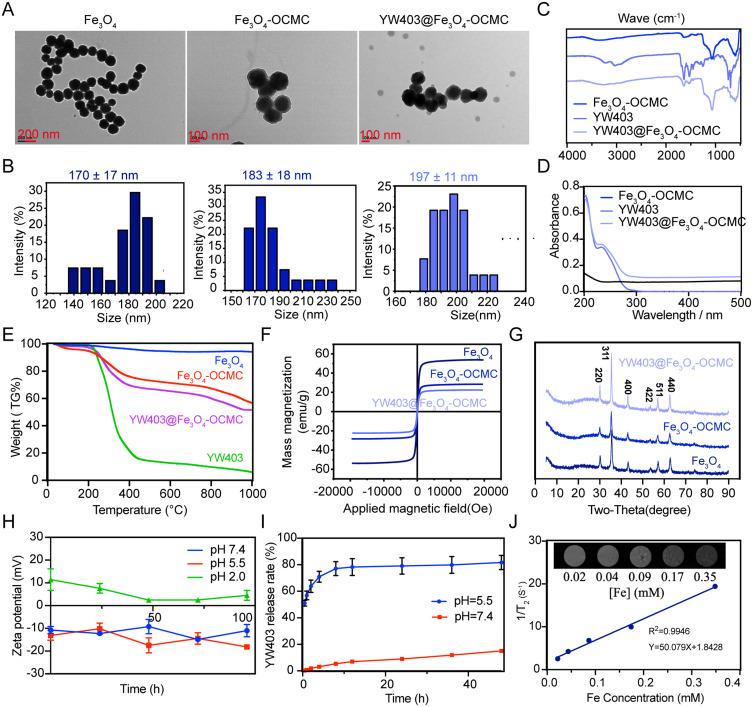
Lung cancer is a major health concern worldwide owing to its high incidence and mortality rates. Therefore, identification of new therapeutic targets and strategies for lung cancer is critical for improving patient outcomes. Peptidyl arginine deiminase 4 (PAD4) promotes tumor growth and metastasis by catalyzing the citrullination of histones, making it a potential therapeutic target. Although PAD4 inhibitors have shown potential in the treatment of a variety of tumors, existing PAD4 inhibitors lack sufficient specificity and cause substantial systemic adverse reactions. To overcome these challenges, we developed novel YW403@FeO-oxidized carboxymethyl chitosan (OCMC) magnetic nanoparticles (MNPs) that enabled magnetically targeted drug delivery by binding the PAD4 inhibitor YW403 to a ferric oxide magnetic carrier.
METHODS
In vitro experiments were conducted using 3-(4,5-dimethylthiazol-2-yl)-2,5-diphenyltetrazolium bromide (MTT) assays, Transwell assays, and flow cytometry to evaluate the activity of the MNPs. In vivo experiments involved magnetic resonance imaging (MRI) assessments and inductively coupled plasma mass spectrometry (ICP-MS) analyses to confirm the tumor targeting and iron metabolism of MNPs. Additionally, immunofluorescence staining was employed to further validate the expression of citrullinated histone H3 (H3cit).
RESULTS
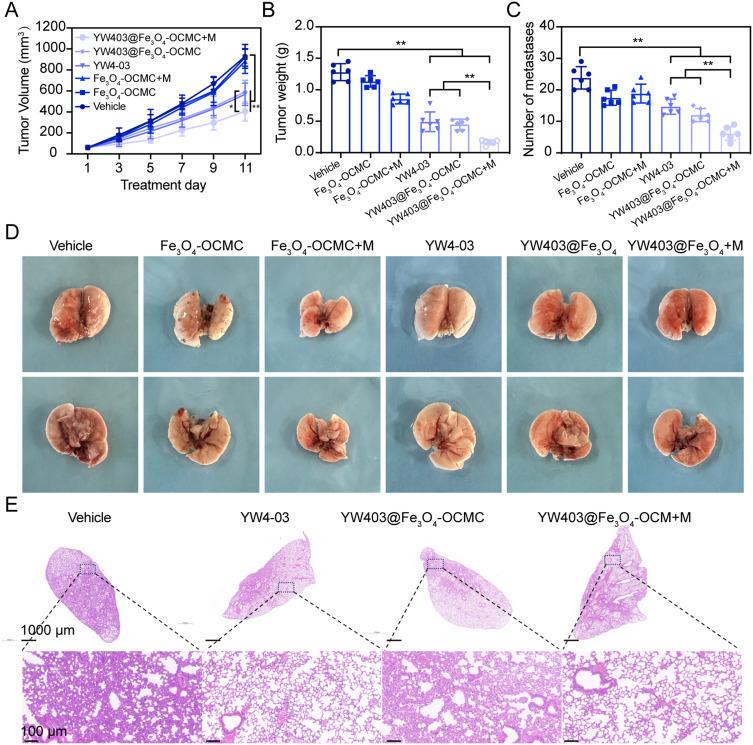
The implementation of this approach enhanced the targeting efficiency of PAD4 inhibitors, consequently reducing the required dosage of chemotherapy and potentially facilitating MRI monitoring. In vitro experiments demonstrated that MNPs exhibited superior activity compared to free drugs when subjected to an applied magnetic field, due to increased uptake of MNPs by tumor cells. In vivo experiments revealed that the application of magnetic fields significantly improved the tumor targeting of MNPs without impacting iron metabolism. By suppressing the expression of citrullinated histone (H3cit), MNPs effectively inhibited tumor growth and metastasis.
DISCUSSION
These findings provide new research ideas for the development of novel anti-tumor nanomaterials and are expected to yield breakthroughs in the treatment of lung cancer.
引言
肺癌因其高发病率和死亡率而成为全球主要的健康问题。因此,确定肺癌新的治疗靶点和策略对于改善患者预后至关重要。肽基精氨酸脱氨酶4(PAD4)通过催化组蛋白的瓜氨酸化促进肿瘤生长和转移,使其成为一个潜在的治疗靶点。尽管PAD4抑制剂在多种肿瘤的治疗中已显示出潜力,但现有的PAD4抑制剂缺乏足够的特异性,并会引起大量的全身不良反应。为了克服这些挑战,我们开发了新型的YW403@FeO-氧化羧甲基壳聚糖(OCMC)磁性纳米颗粒(MNPs),通过将PAD4抑制剂YW403与三氧化二铁磁性载体结合实现磁靶向药物递送。
方法
使用3-(4,5-二甲基噻唑-2-基)-2,5-二苯基四氮唑溴盐(MTT)试验、Transwell试验和流式细胞术进行体外实验,以评估MNPs的活性。体内实验包括磁共振成像(MRI)评估和电感耦合等离子体质谱(ICP-MS)分析,以确认MNPs的肿瘤靶向性和铁代谢情况。此外,采用免疫荧光染色进一步验证瓜氨酸化组蛋白H3(H3cit)的表达。
结果
这种方法的实施提高了PAD4抑制剂的靶向效率,从而降低了化疗所需剂量,并有可能便于MRI监测。体外实验表明,在施加磁场的情况下,与游离药物相比,MNPs表现出更强的活性,这是由于肿瘤细胞对MNPs的摄取增加。体内实验显示,施加磁场显著提高了MNPs的肿瘤靶向性,而不影响铁代谢。通过抑制瓜氨酸化组蛋白(H3cit)的表达,MNPs有效抑制了肿瘤生长和转移。
讨论
这些发现为新型抗肿瘤纳米材料的开发提供了新的研究思路,有望在肺癌治疗中取得突破。




 Zotero 插件