
靶向环鸟苷酸-腺苷酸合成酶-干扰素基因刺激蛋白:调节肝脏疾病的免疫格局
Targeting cGAS-STING: modulating the immune landscape of hepatic diseases.
作者信息
Xue Feng, Liu Yong-Kang, Chen Xiao-Ying, Chen Shan-Shan, Yu Xiang-Rong, Li Hua-Wen, Lu Li-Gong, Chen Mu-He
机构信息
Department of Radiology, Zhuhai Clinical Medical College of Jinan University (Zhuhai People's Hospital, The Affiliated Hospital of Beijing Institute of Technology), Zhuhai, Guangdong, China.
Guangdong Provincial Key Laboratory of Tumor Interventional Diagnosis and Treatment, Zhuhai Institute of Translational Medicine, Zhuhai, Guangdong, China.
出版信息
Front Immunol. 2025 Mar 3;16:1498323. doi: 10.3389/fimmu.2025.1498323. eCollection 2025.
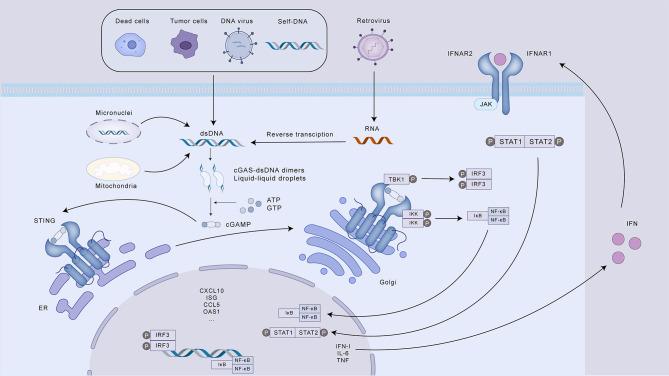
Liver diseases, including viral hepatitis, alcoholic liver disease (ALD), metabolic dysfunction-associated steatotic liver disease (MASLD), and hepatocellular carcinoma (HCC), represent a significant threat to global health due to their high mortality rates. The cGAS-STING pathway, a critical part of the innate immune system, plays a crucial role in detecting cytoplasmic DNA and initiating immune responses, including autoimmune inflammation and antitumor immunity. Genomic instability during cancer progression can trigger this pathway by releasing DNA into the cytoplasm. Emerging research indicates that cGAS-STING signaling is intricately involved in maintaining liver homeostasis and contributes to the pathogenesis of various liver diseases. This review outlines the cGAS-STING pathway, with a particular focus on its activation mechanism and its roles in several notable liver conditions. Specifically, we explore the complex interplay of cGAS-STING signaling in viral hepatitis, ALD, MASLD, and HCC, and discuss its potential as a therapeutic target. For example, in HCC, strategies targeting cGAS-STING include using nanomaterials to deliver STING agonists, combining radiofrequency ablation (RFA) with cGAS-STING activation, and leveraging radiotherapy to enhance pathway activation. Furthermore, modulating cGAS-STING activity may offer therapeutic avenues for viral hepatitis and chronic liver diseases like MASLD and ALD, either by boosting antiviral responses or mitigating inflammation. This review highlights the complex role of cGAS-STING signaling in these specific liver diseases and underscores the need for further research to fully realize its therapeutic potential.
肝脏疾病,包括病毒性肝炎、酒精性肝病(ALD)、代谢功能障碍相关脂肪性肝病(MASLD)和肝细胞癌(HCC),因其高死亡率对全球健康构成重大威胁。cGAS-STING通路是先天免疫系统的关键部分,在检测细胞质DNA和启动免疫反应(包括自身免疫性炎症和抗肿瘤免疫)中起关键作用。癌症进展过程中的基因组不稳定性可通过将DNA释放到细胞质中触发该通路。新兴研究表明,cGAS-STING信号通路与维持肝脏内环境稳定密切相关,并在各种肝脏疾病的发病机制中起作用。本综述概述了cGAS-STING通路,特别关注其激活机制及其在几种常见肝脏疾病中的作用。具体而言,我们探讨了cGAS-STING信号通路在病毒性肝炎、ALD、MASLD和HCC中的复杂相互作用,并讨论了其作为治疗靶点的潜力。例如,在HCC中,靶向cGAS-STING的策略包括使用纳米材料递送STING激动剂、将射频消融(RFA)与cGAS-STING激活相结合,以及利用放射疗法增强通路激活。此外,调节cGAS-STING活性可能为病毒性肝炎和MASLD及ALD等慢性肝病提供治疗途径,要么通过增强抗病毒反应,要么减轻炎症。本综述强调了cGAS-STING信号通路在这些特定肝脏疾病中的复杂作用,并强调需要进一步研究以充分实现其治疗潜力。



 Zotero 插件