
用于原位识别小动物和非人类灵长类动物血管狭窄和血栓形成的电子血管导管。
Electronic vascular conduit for in situ identification of hemadostenosis and thrombosis in small animals and nonhuman primates.
作者信息
Liu Zhirong, Tang Chuyu, Han Nannan, Jiang Zhuoheng, Liang Xi, Wang Shaobo, Hu Quanhong, Xiong Cheng, Yao Shuncheng, Wang Zhuo, Wang Zhong Lin, Zou Duohong, Li Linlin
机构信息
Beijing Institute of Nanoenergy and Nanosystems, Chinese Academy of Sciences, Beijing, China.
School of Nanoscience and Engineering, University of Chinese Academy of Sciences, Beijing, China.
出版信息
Nat Commun. 2025 Mar 18;16(1):2671. doi: 10.1038/s41467-025-58056-2.
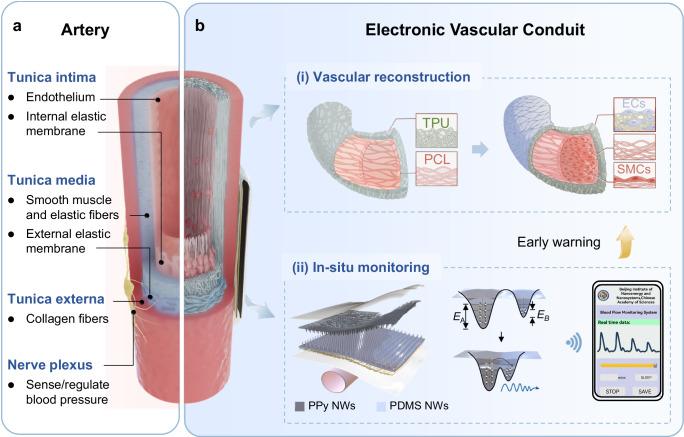
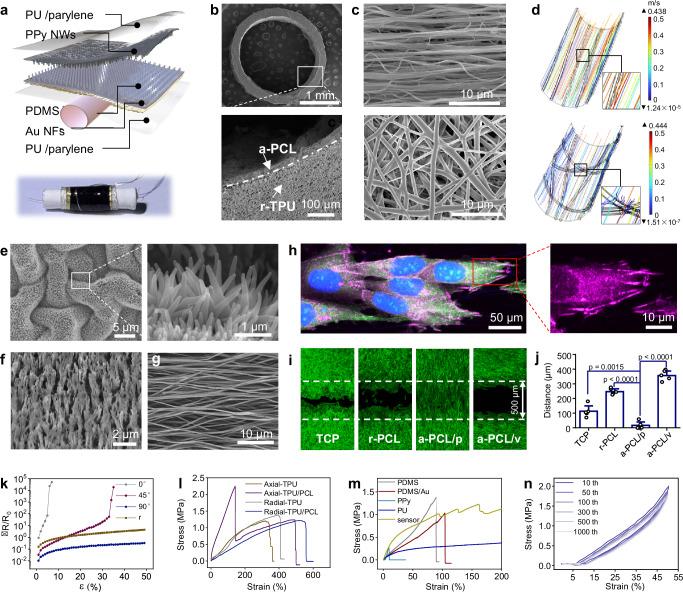
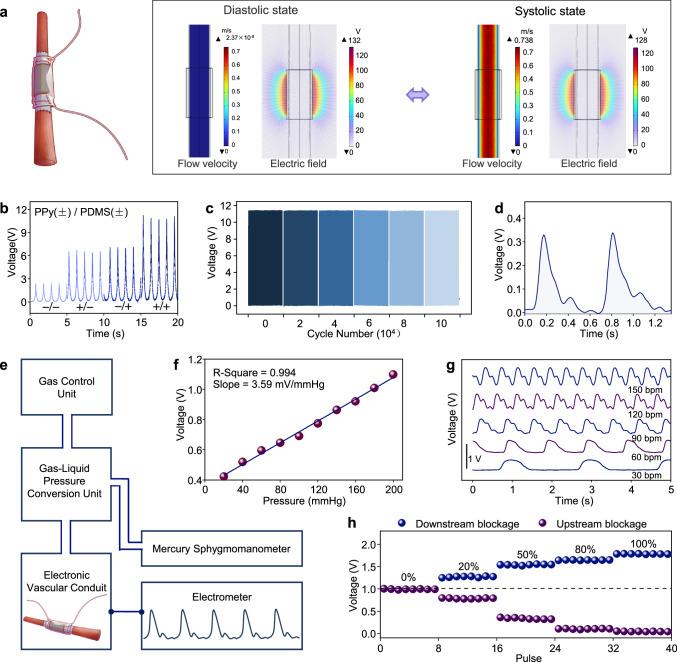
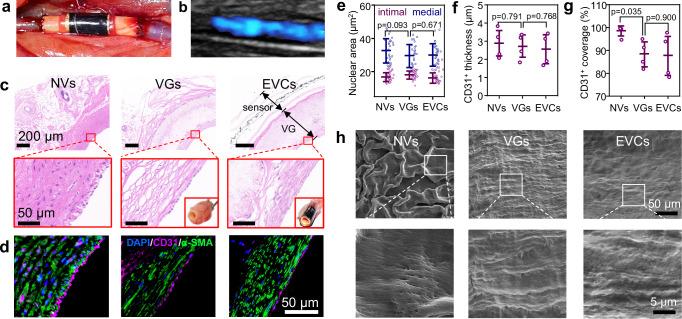
Patients suffering from coronary artery disease (CAD) or peripheral arterial disease (PAD) can benefit from bypass graft surgery. For this surgery, arterial vascular grafts have become promising alternatives when autologous grafts are inaccessible but suffer from numerous postimplantation challenges, particularly delayed endothelialization, intimal hyperplasia, high risk of thrombogenicity and restenosis, and difficulty in timely detection of these subtle pathological changes. We present an electronic vascular conduit that integrates flexible electronics into bionic vascular grafts for in situ, real-time and long-term monitoring for hemadostenosis and thrombosis concurrent with postoperative vascular repair. Following bypass surgery, the integrated bioelectronic sensor based on the triboelectric effect enables monitoring of the blood flow in the vascular graft and identification of lesions in real time for up to three months. In male nonhuman primate cynomolgus monkeys, the electronic vascular conduit, with an integrated wireless signal transmission module, enables wireless and real-time hemodynamic monitoring and timely identification of thrombi. This electronic vascular conduit demonstrates potential as a treatment-monitoring platform, providing a sensitive and intuitive monitoring technique during the critical period after bypass surgery in patients with CAD and PAD.
患有冠状动脉疾病(CAD)或外周动脉疾病(PAD)的患者可从旁路移植手术中获益。对于该手术,当自体移植物不可用时,动脉血管移植物已成为有前景的替代方案,但面临众多植入后挑战,特别是内皮化延迟、内膜增生、血栓形成和再狭窄风险高,以及难以及时检测这些细微的病理变化。我们展示了一种电子血管导管,其将柔性电子器件集成到仿生血管移植物中,用于对血管狭窄和血栓形成进行原位、实时和长期监测,同时进行术后血管修复。旁路手术后,基于摩擦电效应的集成生物电子传感器能够监测血管移植物中的血流,并实时识别病变长达三个月。在雄性食蟹猴这一非人灵长类动物中,带有集成无线信号传输模块的电子血管导管能够进行无线和实时血流动力学监测,并及时识别血栓。这种电子血管导管显示出作为治疗监测平台的潜力,在CAD和PAD患者旁路手术后的关键时期提供一种灵敏且直观的监测技术。


 Zotero 插件