
人们对睡眠日记有何看法?影响有无每日光照情况下睡眠日记完成情况的因素。
How do people feel about sleep diaries? Factors influencing sleep diaries completion with and without daily exposure to light.
作者信息
Gass Boris, Pierné Grégory, Ruppert Elisabeth, Kilic-Huck Ulker, Hugueny Laurence, Bourgin Patrice, Chambe Juliette
机构信息
Sleep Disorders Center & CIRCSom (International Research Center for ChronoSomnology), Strasbourg University Hospital, 1 place de l'hôpital, Strasbourg, France.
General Medicine Department, Faculty of Medicine, University of Strasbourg, Strasbourg, France.
出版信息
PLoS One. 2025 Mar 19;20(3):e0317788. doi: 10.1371/journal.pone.0317788. eCollection 2025.
STUDY OBJECTIVES
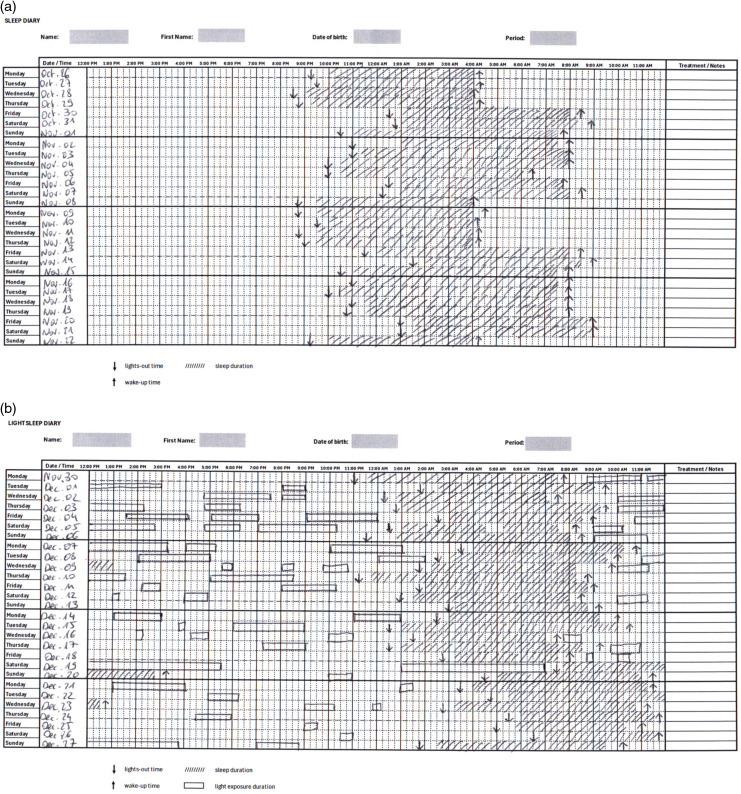
Sleep diary is a common tool in sleep medicine, but was barely validated in practice so far. Lack of light exposure is associated with sleep disorders, especially insomnia. For that purpose, our team developed a sleep diary with information about light exposure. Our objectives were to compare the proportion of informative usual sleep diaries (USD) and light/sleep diaries (LSD) and to evaluate factors influencing the quality of filling them.
METHODS
A monocentric, prospective, controlled interventional study was conducted. Patients included were randomized into two parallel groups: distribution of an USD (used in common practice), versus distribution of a LSD (similar to the USD but with light exposure data). The main outcome was the proportion of diaries returned and correctly filled out. A multivariate logistic regression model was then used to identify factors associated with the correct filling.
RESULTS
A total of 325 USD and 324 LSD were distributed. 295 (45.5%) diaries were returned by patients: 158 (48.6%) USD, 137 (42.3%) LSD. The proportion of correctly completed diaries was 25.2% for USD versus 20.4% for LSD, which corresponds to a difference in the proportion of -4.86% [-10.25%; +∞[. The hypothesis of non-inferiority of LSD compared to USD cannot therefore be retained for a non-inferiority threshold of -10%. Multivariate analysis identified the level of difficulty experienced by the patient as an important factor influencing the quality of completion (OR = 0.99 [0.979-0.998]). The proportion of returned sleep diaries was greater in the USD and LSD insomniac subgroup (p < 0.0001).
CONCLUSIONS
The non-inferiority of this new diary was not reached but this study highlighted the importance of clear explanations, patient motivation and restricted amount of collected data. Interestingly, insomniac patients represent a major target population for this tool.
研究目的
睡眠日记是睡眠医学中的常用工具,但迄今为止在实际应用中几乎未得到验证。光照不足与睡眠障碍尤其是失眠有关。为此,我们团队开发了一种包含光照信息的睡眠日记。我们的目的是比较内容丰富的常规睡眠日记(USD)和光照/睡眠日记(LSD)的比例,并评估影响其填写质量的因素。
方法
进行了一项单中心、前瞻性、对照干预研究。纳入的患者被随机分为两个平行组:发放常规睡眠日记(用于常规实践),与发放光照/睡眠日记(类似于常规睡眠日记但包含光照数据)。主要结果是回收并正确填写的日记比例。然后使用多因素逻辑回归模型来确定与正确填写相关的因素。
结果
共发放了325份常规睡眠日记和324份光照/睡眠日记。患者共回收了295份(45.5%)日记:158份(48.6%)常规睡眠日记,137份(42.3%)光照/睡眠日记。常规睡眠日记正确填写的比例为25.2%,光照/睡眠日记为20.4%,比例差异为-4.86%[-10.25%;+∞[。因此,对于-10%的非劣效性阈值,光照/睡眠日记不劣于常规睡眠日记这一假设不能成立。多因素分析确定患者所经历的困难程度是影响填写质量的一个重要因素(OR = 0.99[0.979 - 0.998])。常规睡眠日记和光照/睡眠日记失眠亚组中回收的睡眠日记比例更高(p < 0.0001)。
结论
这种新日记未达到非劣效性,但本研究强调了清晰解释、患者积极性和限制收集数据量的重要性。有趣的是,失眠患者是该工具的主要目标人群。
 Zotero 插件