
热休克蛋白90在特发性肺纤维化中的作用:最新进展
The role of heat shock protein 90 in idiopathic pulmonary fibrosis: state of the art.
作者信息
Monteleone Giorgio, Cameli Paolo, Bonella Francesco
机构信息
Department of Cardiovascular and Pulmonary Sciences, Catholic University of Sacred Heart, Rome, Italy.
Respiratory Diseases Unit, Department of Medicine, Surgery and Neurosciences, University of Siena, Siena, Italy.
出版信息
Eur Respir Rev. 2025 Mar 19;34(175). doi: 10.1183/16000617.0147-2024. Print 2025 Jan.
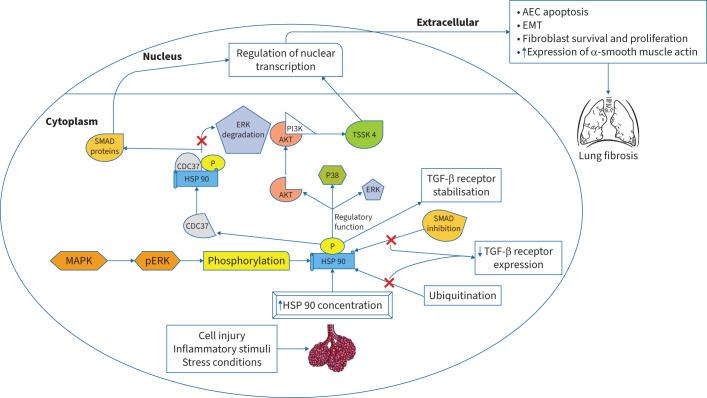
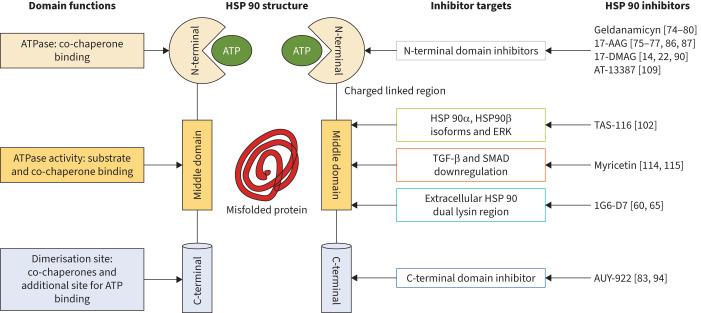
Heat shock protein 90 (HSP 90) and its isoforms are a group of homodimeric proteins that regulate several cellular processes, such as the elimination of misfolded proteins, cell development and post-translational modifications of kinase proteins and receptors. Due to its involvement in extracellular matrix (ECM) remodelling, myofibroblast differentiation and apoptosis, HSP 90 has been investigated as a key player in the pathogenesis of lung fibrosis. Idiopathic pulmonary fibrosis (IPF) is the most common and deadly interstitial lung disease, due to the progressive distortion of lung parenchyma related to the overproduction and deposition of altered ECM, driven by transforming growth factor-β (TGF-β) dependent and independent pathways. The inhibition or induction of HSP 90 is associated with a reduced or increased expression of TGF-β receptors, respectively, suggesting a role for HSP 90 as a biomarker and therapeutic target in IPF. Experimental drugs such as geldanamycin and its derivatives 17-AAG (17--allylamino-17-demethoxygeldanamicin) and 17-DMAG (17-dimethylaminoethylamino-17-demethoxigeldanamycin), along with AUY-922, 1G6-D7, AT-13387, TAS-116 and myricetin, have been found to reduce lung fibrosis in both and models, supporting the role of this emerging target. This review aims to illustrate the structure and biological function of HSP 90 in the context of IPF pathobiology, as well as perspective application of this molecule as a biomarker and therapeutic target for IPF.
热休克蛋白90(HSP 90)及其亚型是一组同源二聚体蛋白,可调节多种细胞过程,如错误折叠蛋白的清除、细胞发育以及激酶蛋白和受体的翻译后修饰。由于其参与细胞外基质(ECM)重塑、肌成纤维细胞分化和凋亡,HSP 90已被作为肺纤维化发病机制中的关键因素进行研究。特发性肺纤维化(IPF)是最常见且致命的间质性肺病,其原因是肺实质的渐进性扭曲与转化生长因子-β(TGF-β)依赖性和非依赖性途径驱动的异常ECM过度产生和沉积有关。HSP 90的抑制或诱导分别与TGF-β受体表达的降低或增加相关,这表明HSP 90在IPF中作为生物标志物和治疗靶点发挥作用。已发现诸如格尔德霉素及其衍生物17-AAG(17-烯丙基氨基-17-去甲氧基格尔德霉素)和17-DMAG(17-二甲基氨基乙氨基-17-去甲氧基格尔德霉素)等实验性药物,以及AUY-922、1G6-D7、AT-13387、TAS-116和杨梅素,在体内和体外模型中均能减轻肺纤维化,支持了这一新兴靶点的作用。本综述旨在阐述在IPF病理生物学背景下HSP 90的结构和生物学功能,以及该分子作为IPF生物标志物和治疗靶点的潜在应用。
 Zotero 插件