
特应性皮炎中的瘙痒机制
Mechanisms of Itch in Atopic Dermatitis.
作者信息
Kamata Yayoi, Tominaga Mitsutoshi, Takamori Kenji
出版信息
Juntendo Med J. 2025 Jan 30;71(1):43-50. doi: 10.14789/ejmj.JMJ24-0036-R. eCollection 2025.
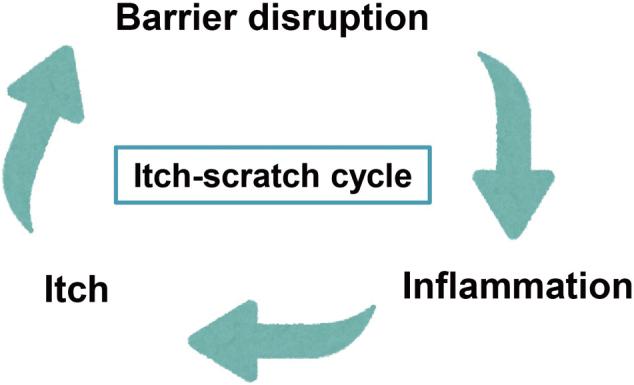
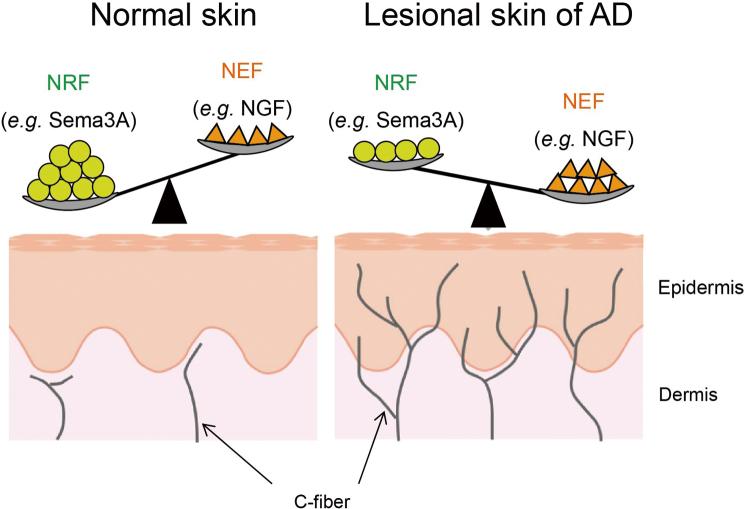
Atopic dermatitis (AD) is a common inflammatory skin disease characterized by recurrent eczematous lesions and intense itch. The pathological mechanism of AD involves a complex interaction between skin barrier dysfunction and a predominantly T helper (Th) 2-skewed immune dysregulation. The dysfunctional skin barrier in AD enhances antigen penetration, exacerbating allergic reactions. Scratching further damages the skin barrier, worsens dryness and increases the release of pro-inflammatory mediators, perpetuating the itch-scratch cycle. Breaking this cycle with appropriate treatments is vital. Th2 cells secrete interleukin (IL)-4, IL-13 and IL-31 which play keys roles in AD pathogenesis. IL-31 directly induces pruritus, while IL-4 and IL-13 enhance itching. An increased density of intraepidermal nerve fibers has been observed in AD lesions in a disease-state-dependent manner. In normal skin, both semaphorin 3A (Sema3A; a nerve repulsion factor) and nerve growth factor (NGF; a nerve elongation factor) are expressed. However, in AD lesions, Sema3A expression decreases while NGF expression increases. These findings suggest that epidermal nerve density is regulated by a fine balance between Sema3A and NGF, with Sema3A playing a key role in itch sensitivity in AD. In healthy skin, Sema3A is produced during the early-stage of differentiation of keratinocytes and moves into the upper epidermis. The levels of Sema3A and the density of epidermal nerve fibers may vary depending on the disease state of AD. Our future research will focus on the regulatory mechanisms of Sema3A in skin, and potential clinical applications.
特应性皮炎(AD)是一种常见的炎症性皮肤病,其特征为反复出现湿疹样皮损和剧烈瘙痒。AD的病理机制涉及皮肤屏障功能障碍与主要以辅助性T细胞(Th)2为主导的免疫失调之间的复杂相互作用。AD中功能失调的皮肤屏障会增强抗原渗透,加剧过敏反应。搔抓会进一步损害皮肤屏障,加重皮肤干燥并增加促炎介质的释放,使瘙痒-搔抓循环持续存在。通过适当治疗打破这一循环至关重要。Th2细胞分泌白细胞介素(IL)-4、IL-13和IL-31,它们在AD发病机制中起关键作用。IL-31直接诱导瘙痒,而IL-4和IL-13则加剧瘙痒。在AD皮损中已观察到表皮内神经纤维密度以疾病状态依赖的方式增加。在正常皮肤中,信号素3A(Sema3A;一种神经排斥因子)和神经生长因子(NGF;一种神经伸长因子)均有表达。然而,在AD皮损中,Sema3A表达减少而NGF表达增加。这些发现表明,表皮神经密度由Sema3A和NGF之间的精细平衡调节,其中Sema3A在AD瘙痒敏感性中起关键作用。在健康皮肤中,Sema
 Zotero 插件