
连续代谢探针照亮核DNA以区分癌细胞和正常细胞。
Sequential metabolic probes illuminate nuclear DNA for discrimination of cancerous and normal cells.
作者信息
Liu Caiqi, Lu Sirui, Yan Chenxu, Zhao Xingyuan, Yang Jing, Zhang Weixu, Zhao Xiuyan, Ge Yao, You Xiaofan, Guo Zhiqian
机构信息
Key Laboratory for Advanced Materials, Institute of Fine Chemicals, Feringa Nobel Prize Scientist Joint Research Center, Frontiers Science Center for Materiobiology and Dynamic Chemistry, School of Chemistry and Molecular Engineering, East China University of Science and Technology Shanghai 200237 China
State Key Laboratory of Bioreactor Engineering, East China University of Science and Technology Shanghai 200237 China.
出版信息
Chem Sci. 2025 Mar 11;16(16):6837-6844. doi: 10.1039/d5sc00360a. eCollection 2025 Apr 16.
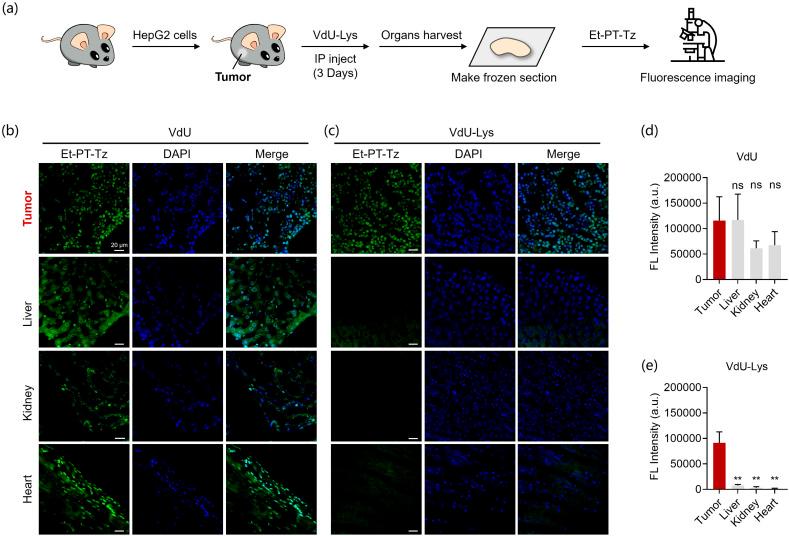
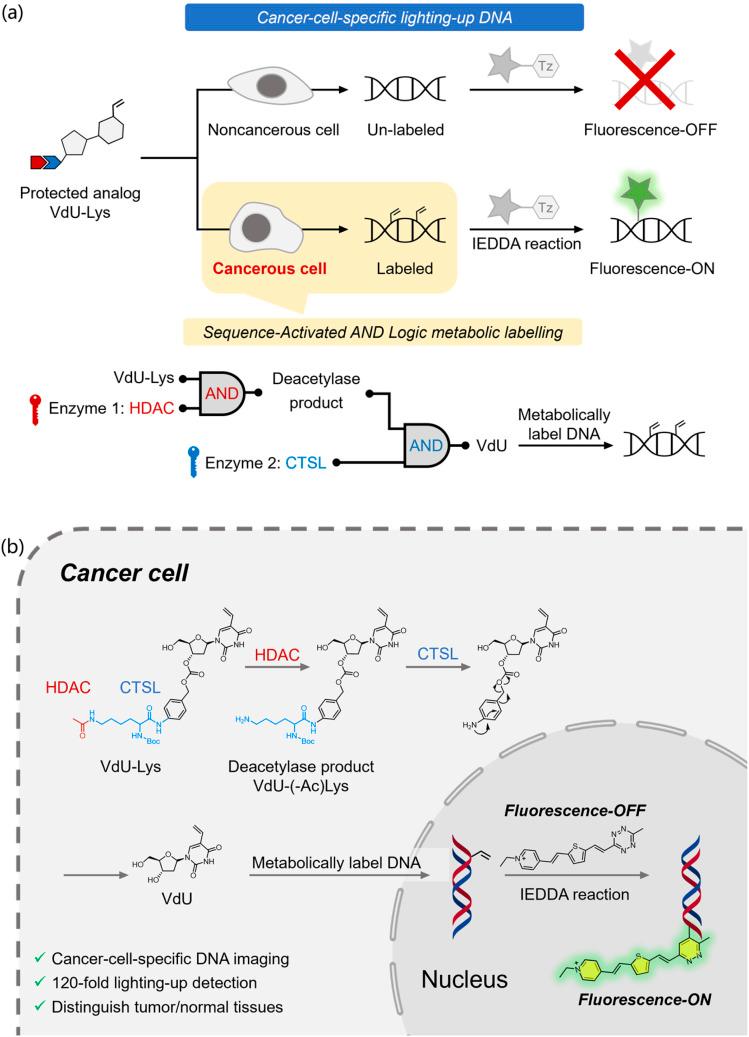
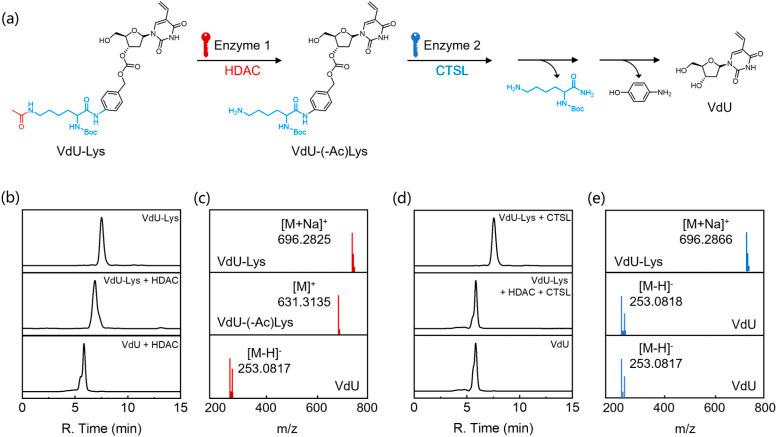
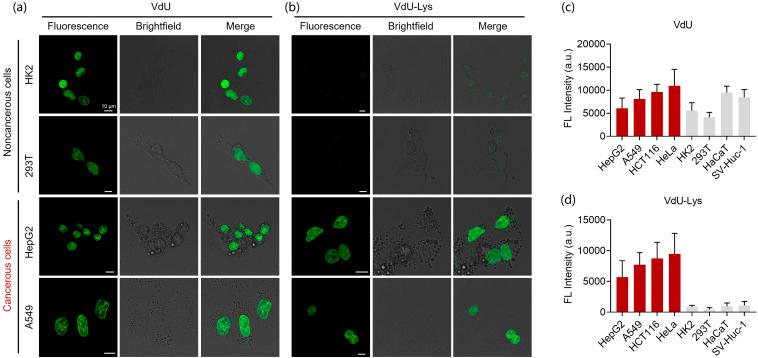
Elucidating the timing and spatial distribution of DNA synthesis within cancer cells is vital for cancer diagnosis and targeted therapy. However, current probes for staining nucleic acids rely on electrostatic interactions and hydrogen bonds with the nucleic acid, resulting in "static" DNA staining and the inability to distinguish cell types. Here, we present a proof-of-concept study of sequential metabolic probes, for the first time allowing for cancer-cell-specific illumination of DNA. This breakthrough is achieved by the combination of a "dual-locked" nucleoside analog VdU-Lys, and a new tetrazine-based bioorthogonal probe. Specifically, 5-vinyl-2'-deoxyuridine (VdU) release is only conducted in programmatically triggered histone deacetylases (HDACs) and cathepsin L (CTSL) as "sequential keys", enabling the modification of vinyl groups into the nuclear DNA of cancerous cells rather than normal cells. Subsequently, tetrazine-based Et-PT-Tz could light-up DNA containing VdUs with significant fluorescence illumination (120-fold enhancement) through rapid bioorthogonal reaction. We demonstrated the compatibility of our probe in cancer-specific sensing of DNA with a high signal-to-noise ratio ranging from multiple cell lines to whole-organism scale. This approach would serve as a benchmark for the development of cell-specific metabolic reporters for DNA labelling, to characterize DNA metabolism in various types of cell lines.
阐明癌细胞内DNA合成的时间和空间分布对于癌症诊断和靶向治疗至关重要。然而,目前用于核酸染色的探针依赖于与核酸的静电相互作用和氢键,导致“静态”DNA染色且无法区分细胞类型。在此,我们首次展示了一种连续代谢探针的概念验证研究,可实现癌细胞特异性的DNA发光。这一突破是通过“双锁”核苷类似物VdU-Lys与一种新型基于四嗪的生物正交探针相结合实现的。具体而言,5-乙烯基-2'-脱氧尿苷(VdU)的释放仅在作为“连续钥匙”的程序性触发的组蛋白脱乙酰酶(HDACs)和组织蛋白酶L(CTSL)作用下进行,从而使乙烯基修饰到癌细胞而非正常细胞的核DNA中。随后,基于四嗪的Et-PT-Tz可通过快速生物正交反应,以显著的荧光发光(增强120倍)照亮含有VdU的DNA。我们证明了我们的探针在从多种细胞系到全生物体尺度范围内对DNA进行癌症特异性传感时具有高信噪比的兼容性。这种方法将作为开发用于DNA标记的细胞特异性代谢报告分子的基准,以表征各种类型细胞系中的DNA代谢。

 Zotero 插件