
早期酒精使用障碍中的白质差异:结构完整性的扩散张量及神经突方向离散度与密度测量
White Matter Differences in Early-Stage Alcohol Use Disorder: Diffusion Tensor and Neurite Orientation Dispersion and Density Measures of Structural Integrity.
作者信息
Baker Sunderland K, Claus Eric D
机构信息
Department of Biobehavioral Health, The Pennsylvania State University, University Park, Pennsylvania, USA.
出版信息
Addict Biol. 2025 Mar;30(3):e70019. doi: 10.1111/adb.70019.
BACKGROUND
Alcohol use disorder (AUD) is prevalent during young adulthood, and this risk may be linked to aberrations in neurodevelopmental processes. Prior studies examining white matter (WM) integrity in young adult individuals with AUD have shown considerable variability. This is due in part because traditional tensor related metrics such as fractional anisotropy are subject to limitations in estimation precision at sites of crossing or curving fibres. In response, to better understand differences in WM integrity of young adults with AUD, this study sought to uniquely employ two WM integrity measurement domains.
METHODS
Twenty-five participants (n = 14 female) diagnosed with AUD and 33 social drinkers (n = 19 female) underwent structural and diffusion-weighted imaging. Diffusion-weighted images were processed to extract diffusion tensor (DTI) and neurite orientation dispersion and density (NODDI) metrics in major WM tracts for comparison between the two groups.
RESULTS
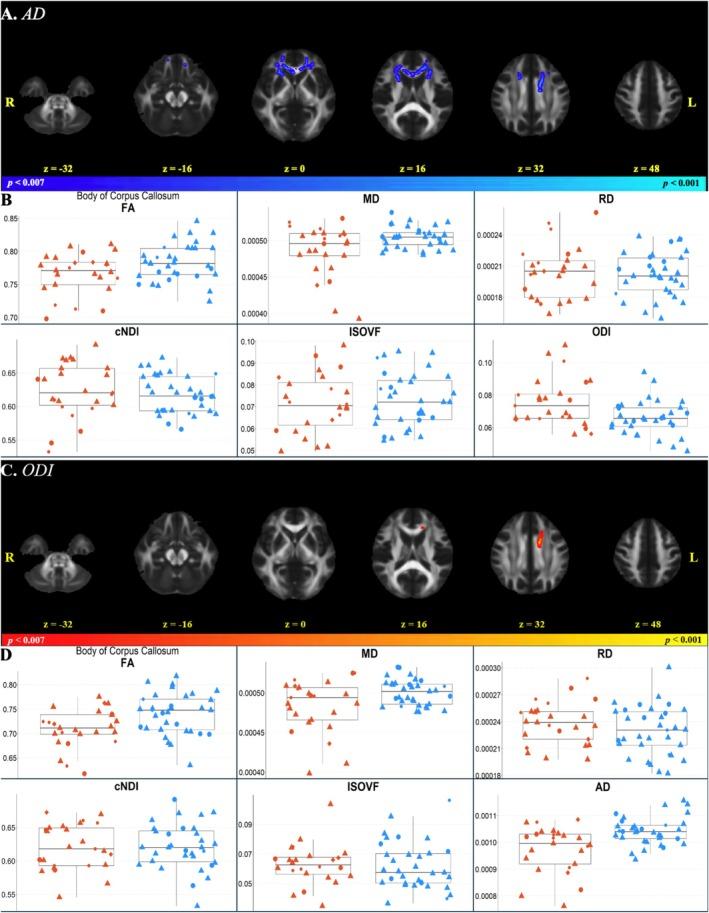
We identified decreased axial diffusivity in portions of frontolimbic and corticostriatal WM tracts, and increased orientation dispersion at overlapping tracts in participants with AUD relative to social drinkers.
CONCLUSIONS
These results may represent early-stage neural immune system activation and axonal reorganization targeting frontolimbic and corticostriatal WM tracts, therein associated with behaviours linked to AUD. This is the first study combining DTI and NODDI metrics to identify early-stage indicators of alcohol-related neurobiological pathology in young adults with AUD compared to social drinkers.
背景
酒精使用障碍(AUD)在青年期较为普遍,这种风险可能与神经发育过程的异常有关。先前对患有AUD的青年个体进行的白质(WM)完整性研究显示出相当大的变异性。部分原因是传统的张量相关指标,如分数各向异性,在交叉或弯曲纤维部位的估计精度存在局限性。因此,为了更好地理解患有AUD的青年成人白质完整性的差异,本研究试图独特地采用两个白质完整性测量领域。
方法
25名被诊断为AUD的参与者(n = 14名女性)和33名社交饮酒者(n = 19名女性)接受了结构和扩散加权成像。对扩散加权图像进行处理,以提取主要白质束中的扩散张量(DTI)和神经突方向分散度和密度(NODDI)指标,用于两组之间的比较。
结果
我们发现,与社交饮酒者相比,患有AUD的参与者额边缘和皮质纹状体白质束部分的轴向扩散率降低,重叠束的方向分散度增加。
结论
这些结果可能代表针对额边缘和皮质纹状体白质束的早期神经免疫系统激活和轴突重组,这与AUD相关的行为有关。这是第一项将DTI和NODDI指标结合起来,以识别患有AUD的青年成人与社交饮酒者相比酒精相关神经生物学病理学早期指标的研究。
 Zotero 插件