
通过在中国云南省一个热点地区开展分子监测来揭示HIV-1传播模式。
Unraveling HIV-1 transmission patterns through molecular surveillance in a hotspot in Yunnan Province, China.
作者信息
Yang Hui, Chen Huichao, Yao Enlong, Dai Jie, Han Yu, Jin Xiaomei, Yang Min, Zeng Zhijun, Sun Pengyan, Shi Yuhua, Ma Yanling, Jia Manhong, Chen Min
机构信息
Yunnan Provincial Key Laboratory of Public Health and Biosafety & School of Public Health, Kunming Medical University, Kunming, Yunnan Province, China.
Yunnan Provincial Key Laboratory of Public Health and Biosafety & Institute for AIDS/STD Control and Prevention, Yunnan Center for Disease Control and Prevention, No 1177, Xianghe Street, Chenggong District, Kunming, 650500, Yunnan Province, China.
出版信息
Sci Rep. 2025 Mar 22;15(1):9964. doi: 10.1038/s41598-025-94290-w.
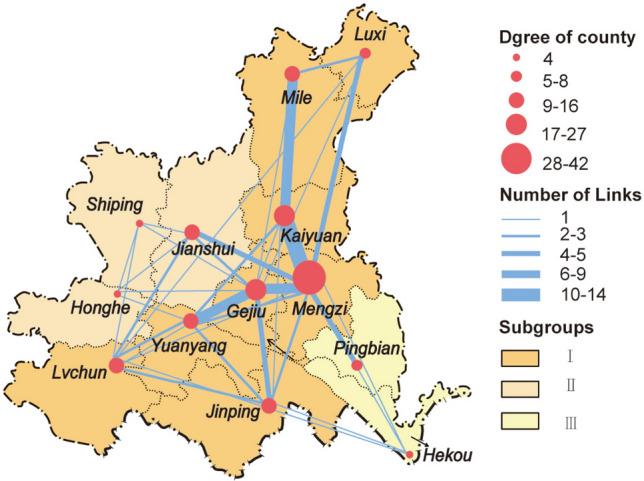
Honghe Prefecture, Yunnan Province, China, is a key area affected by HIV/AIDS. Given the high number of infected individuals, understanding HIV transmission in this region is crucial to controlling the epidemic in Yunnan Province. A molecular epidemiology study with 1004 newly diagnosed HIV-1 cases in 2022 was conducted to characterize transmission and guide targeted interventions. Of the 833 samples genotyped, nine HIV-1 genotypes were identified, with CRF08_BC (56.7%), URFs (17.8%), CRF07_BC (13.9%) and CRF01_AE (7.1%) being the most prevalent. These genotypes were widely distributed but concentrated in the center and east of the prefecture. Molecular network analysis showed varying clustering rates among counties, with Luxi County having the highest and Honghe County the lowest. Low education levels were associated with higher clustering. Cross-county transmission patterns were revealed, with strong links between specific counties. Of the three spatial subdivisions identified by the cohesive subgroup analysis, subgroup I included eight counties running from northeast to southwest. Persons aged 50-59 years and ethnic minorities were more likely to be identified in cross-county transmission. Notably, the overall prevalent level of HIV-1 pre-treatment drug resistance was 6.2% (50/809), with higher levels in Luxi (18.2%, 8/44), Hekou (14.3%, 3/21) and Yuanyang (10.9%, 13/119). This study investigated HIV-1 transmission patterns using molecular network analysis in a hotspot of HIV transmission, and informed the application of HIV molecular surveillance in practice.
中国云南省红河州是受艾滋病病毒/艾滋病影响的重点地区。鉴于感染人数众多,了解该地区的艾滋病病毒传播情况对于控制云南省的疫情至关重要。2022年对1004例新诊断的HIV-1病例进行了分子流行病学研究,以描述传播特征并指导针对性干预措施。在833份基因分型样本中,鉴定出9种HIV-1基因型,其中CRF08_BC(56.7%)、未重组形式(URFs,17.8%)、CRF07_BC(13.9%)和CRF01_AE(7.1%)最为常见。这些基因型分布广泛,但集中在该州的中部和东部。分子网络分析显示各县之间的聚类率有所不同,泸西县最高,红河县最低。低教育水平与较高的聚类相关。揭示了跨县传播模式,特定县之间存在紧密联系。在凝聚性子群分析确定的三个空间分区中,子群I包括从东北向西南延伸的八个县。50至59岁的人群和少数民族更有可能出现在跨县传播中。值得注意的是,HIV-1治疗前耐药的总体流行水平为6.2%(50/809),泸西(18.2%,8/44)、河口(14.3%,3/21)和元阳(10.9%,13/119)的水平较高。本研究在艾滋病病毒传播热点地区使用分子网络分析调查了HIV-1传播模式,并为艾滋病病毒分子监测在实践中的应用提供了信息。


 Zotero 插件