
2019至2023年中国西南地区尿路感染患者病原菌耐药性分布特征及变化分析
Analysis of the Distribution Characteristics and Changes of Drug Resistance of Pathogens in Patients with Urinary Tract Infection Across Southwest China From 2019 to 2023.
作者信息
Zhong Min, Huang Xiangning, Liu Xin, Yu Hua, Long Shanshan
机构信息
Department of Laboratory Medicine, Sichuan Provincial People's Hospital, University of Electronic Science and Technology of China, Chengdu, 610072, People's Republic of China.
出版信息
Infect Drug Resist. 2025 Mar 17;18:1491-1502. doi: 10.2147/IDR.S512409. eCollection 2025.
OBJECTIVE
To analyze the changes in the distribution and drug resistance of pathogenic bacteria causing urinary tract infections in Southwest China from 2019 to 2023, and to provide an accurate scientific basis for empirical clinical use.
METHODS
The identification results and drug susceptibility tests of non-duplicate pathogens isolated from urine samples of patients in Sichuan region from 2019 to 2023 were retrospectively analyzed. The results obtained were interpreted with reference to CLSI M100-33th and analyzed with WHONET 5.6 software.
RESULTS
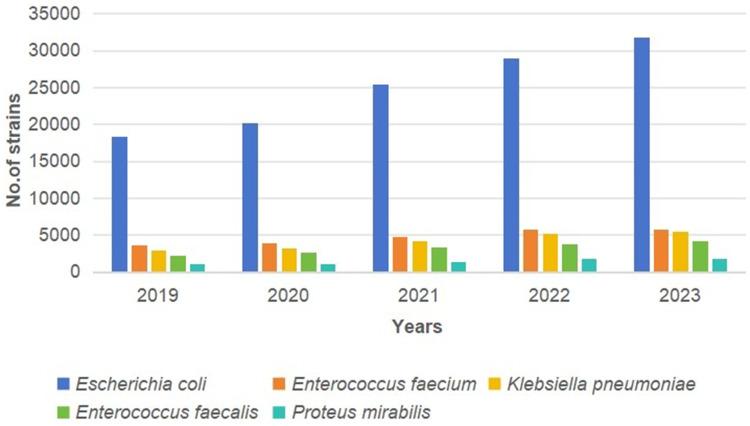
A total of 247295 strains of pathogens were detected, including 188551 gram-negative strains (76.2%). The positive rate of female patients (56.8%) was significantly higher than that of male patients (43.2%). The top five most common urinary pathogens were (50.5%), (11.5%), (8.5%), (6.5%), and (2.9%). The resistance rate of to levofloxacin, cefotaxime and ceftriaxone was higher (>50%) and had a certain upward trend. The resistance rates of to imipenem and meropenem increased from 7.8% and 9.6% in 2019 to 11.6% and 13.2% in 2023, respectively, much higher than the resistance rates of to carbapenem antibiotics (<2%). and still maintained high activity against tigecycline and polymyxin B. The drug resistance rate of to imipenem and meropenem was more than 27.4%. The resistance rates of and to vancomycin, teicoplanin and linezolid were lower than 3.4%. There was an increasing trend in the detection of CRE-KPN among multidrug-resistant bacteria, and a slight decreasing trend in CRPA and CRAB.
CONCLUSION
The main pathogens of urinary tract infections were and . The drug resistance rates of main clinically isolated bacteria in urine samples showed a diverse trend. Antibiotics should be rationally selected based on the resistance patterns of the pathogens. At the same time, with the continuous detection of multi-drug resistant bacteria VRE and CRE, we have a long way to go in future drug resistance monitoring.
目的
分析2019年至2023年中国西南地区引起尿路感染的病原菌分布及耐药性变化,为临床经验用药提供准确的科学依据。
方法
回顾性分析2019年至2023年四川地区患者尿液样本中分离出的非重复病原菌的鉴定结果和药敏试验。所得结果参照CLSI M100-33th进行解释,并使用WHONET 5.6软件进行分析。
结果
共检测到247295株病原菌,其中革兰阴性菌188551株(76.2%)。女性患者阳性率(56.8%)显著高于男性患者(43.2%)。最常见的前五种尿路病原菌分别为大肠埃希菌(50.5%)、白色念珠菌(11.5%)、肺炎克雷伯菌(8.5%)、奇异变形杆菌(6.5%)和粪肠球菌(2.9%)。大肠埃希菌对左氧氟沙星、头孢噻肟和头孢曲松的耐药率较高(>50%)且呈一定上升趋势。肺炎克雷伯菌对亚胺培南和美罗培南的耐药率分别从2019年的7.8%和9.6%上升至2023年的11.6%和13.2%,远高于其对碳青霉烯类抗生素的耐药率(<2%)。屎肠球菌和粪肠球菌对替加环素和多粘菌素B仍保持高活性。肺炎克雷伯菌对亚胺培南和美罗培南的耐药率超过27.4%。屎肠球菌和粪肠球菌对万古霉素、替考拉宁和利奈唑胺的耐药率低于3.4%。耐碳青霉烯类肺炎克雷伯菌在多重耐药菌中的检出呈上升趋势,耐碳青霉烯类鲍曼不动杆菌和耐碳青霉烯类铜绿假单胞菌呈轻微下降趋势。
结论
尿路感染的主要病原菌为大肠埃希菌和肺炎克雷伯菌。尿液样本中主要临床分离菌的耐药率呈多样化趋势。应根据病原菌的耐药模式合理选用抗生素。同时,随着多重耐药菌VRE和CRE的不断检出,未来耐药监测工作任重道远。

 Zotero 插件