
慢性乙型肝炎患者的心脏代谢合并症及其对肝脏并发症发生率的影响。一项丹麦全国性队列研究。
Cardiometabolic Comorbidities in Patients With Chronic Hepatitis B and Impact on Incidence of Liver Complications. A Danish Nationwide Cohort Study.
作者信息
Jespersen Sofie, Bollerup Signe, Madsbad Sten, Krogh-Madsen Rikke, Byberg Stine, Weis Nina
机构信息
Department of Infectious Diseases, Copenhagen University Hospital - Hvidovre, Hvidovre, Denmark.
Centre for Physical Activity Research, Copenhagen University Hospital - Rigshospitalet, Copenhagen, Denmark.
出版信息
Int J Gen Med. 2025 Mar 19;18:1591-1604. doi: 10.2147/IJGM.S471083. eCollection 2025.
PURPOSE
To evaluate liver complications in patients with chronic hepatitis B, both with and without cardiometabolic comorbidities, and to compare the incidence of cardiometabolic comorbidities in these patients with that of the general population.
STUDY POPULATION AND METHODS
This nationwide registry-based cohort study included data from 2002-2020. In the primary analysis, we used multivariate Poisson regression to estimate the incidence rate and incidence rate ratio of liver complications in patients with chronic hepatitis B, stratified by the presence of cardiometabolic comorbidities. In the secondary analysis, we compared the incidence rate of developing cardiometabolic comorbidities in patients with chronic hepatitis B to those of the general population. Both analyses were adjusted for sex, age, and country of origin, while the primary analysis was additionally adjusted for time since cardiometabolic comorbidity diagnosis and calendar year.
RESULTS
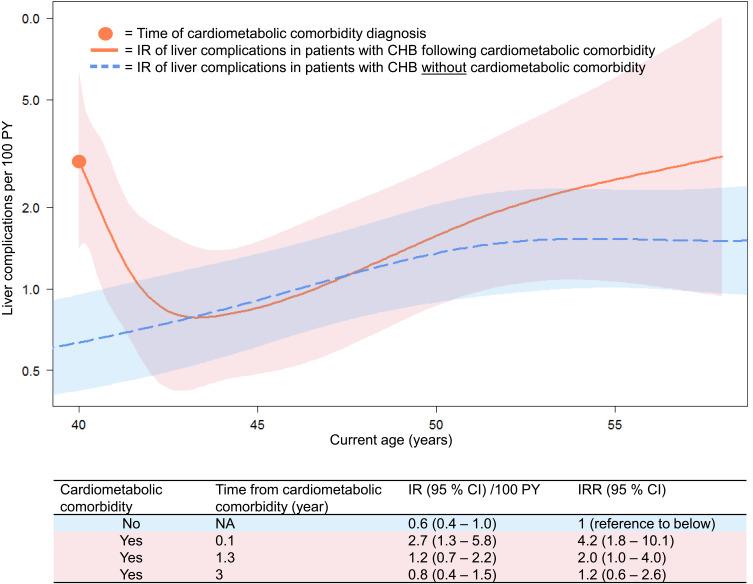
The primary analysis included 4731 patients with chronic hepatitis B, of whom 532 (11%) had at least one cardiometabolic comorbidity. The unadjusted overall incidence rate of liver complications in patients with cardiometabolic comorbidities was 1.0 per 100 person-years (95% confidence intervals: 0.84-1.30) compared to 0.4 per 100 person-years (95% confidence intervals: 0.30-0.42) in those without. The incidence rate ratio for liver complications was highest in the first year following the diagnosis of cardiometabolic comorbidity. The incidence rate ratio for developing cardiometabolic comorbidities in the chronic hepatitis B cohort compared to the general population, was 1.10 (95% confidence intervals: 1.02-1.19). Sensitivity analyses revealed a higher incidence rate ratio for type 2 diabetes and hypertension but a lower incidence rate ratio for hypercholesterolemia.
CONCLUSION
Patients with chronic hepatitis B and cardiometabolic comorbidities exhibit a higher incidence of liver complications, particularly in the first year following comorbidity diagnosis compared to those without comorbidities. Furthermore, patients with chronic hepatitis B have a higher incidence of cardiometabolic comorbidities than the general population.
目的
评估合并和未合并心脏代谢共病的慢性乙型肝炎患者的肝脏并发症,并比较这些患者与普通人群心脏代谢共病的发生率。
研究人群与方法
这项基于全国登记处的队列研究纳入了2002年至2020年的数据。在初步分析中,我们使用多变量泊松回归来估计慢性乙型肝炎患者肝脏并发症的发病率和发病率比,并根据是否存在心脏代谢共病进行分层。在二次分析中,我们比较了慢性乙型肝炎患者发生心脏代谢共病的发病率与普通人群的发病率。两项分析均对性别、年龄和原籍国进行了调整,而初步分析还对心脏代谢共病诊断后的时间和日历年进行了调整。
结果
初步分析纳入了4731例慢性乙型肝炎患者,其中532例(11%)至少有一种心脏代谢共病。合并心脏代谢共病患者肝脏并发症的未调整总发病率为每100人年1.0例(95%置信区间:0.84 - 1.30),而未合并者为每100人年0.4例(95%置信区间:0.30 - 0.42)。心脏代谢共病诊断后的第一年,肝脏并发症的发病率比最高。与普通人群相比,慢性乙型肝炎队列中发生心脏代谢共病的发病率比为1.10(95%置信区间:1.02 - 1.19)。敏感性分析显示2型糖尿病和高血压的发病率比更高,但高胆固醇血症的发病率比更低。
结论
合并心脏代谢共病的慢性乙型肝炎患者肝脏并发症的发生率更高,尤其是在共病诊断后的第一年,与未合并共病的患者相比。此外,慢性乙型肝炎患者心脏代谢共病的发生率高于普通人群。
 Zotero 插件