
丙型肝炎阴性受者中丙型肝炎阳性实体器官移植后直接抗病毒治疗失败及再治疗策略:一项多中心病例系列研究
Direct-Acting Antiviral Treatment Failure and Retreatment Strategies Following Hepatitis C-Positive Solid Organ Transplantation in Hepatitis C-Negative Recipients: A Multicenter Case Series.
作者信息
Carver Alicia B, Özoral Claire, Lange Morgan, Mattise Alysa, Whelchel Kristen, Perri Roman
机构信息
Specialty Pharmacy Services, Vanderbilt University Medical Center, Nashville, Tennessee, USA.
Specialty Pharmacy Services, Ochsner Health, New Orleans, Louisiana, USA.
出版信息
Transpl Infect Dis. 2025 Mar 24;27(3):e70024. doi: 10.1111/tid.70024.
BACKGROUND
Transplanting solid organs from hepatitis C virus (HCV) nucleic acid testing (NAT+) donors (D+) into HCV-negative recipients (R-) has become more common with the development of curative direct-acting antiviral (DAA) treatment. Limited information exists to guide retreatment strategies for patients not achieving sustained virologic response (SVR) with DAAs. This multisite case series examines retreatment strategies and subsequent SVR rates in HCV-negative solid-organ transplant (SOT) recipients who did not achieve SVR following reactive initial DAA therapy following NAT+ SOT.
METHODS
A retrospective multisite case series was conducted on patients not achieving SVR with initial DAA treatment post-NAT+ HCV SOT between September 2016 and September 2022 across four tertiary medical centers in the United States.
RESULTS
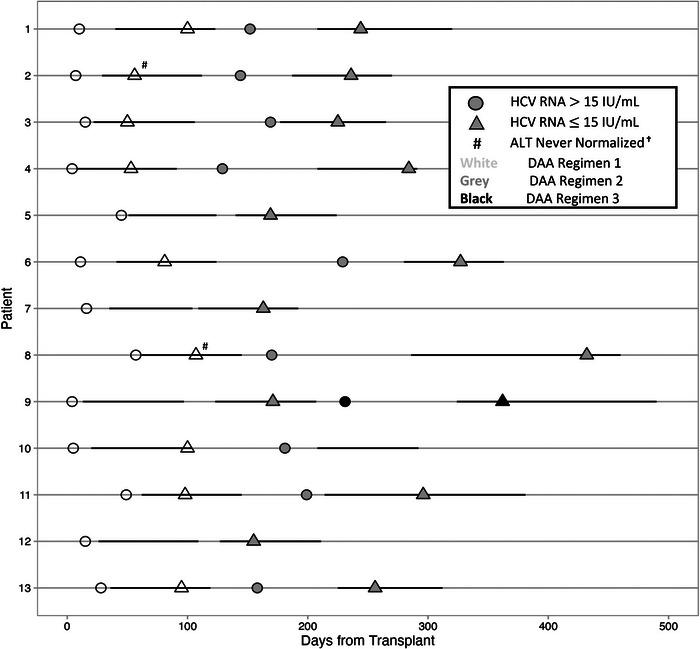
Thirteen patients were identified, predominantly receiving HCV NAT+ kidneys (77%) and SOF/VEL for 12 weeks as initial DAA therapy (43%). Baseline resistance testing was not performed. Median time to treatment initiation post-SOT was 35 [IQR 22-41] days, and to retreatment postpositive viral load was 35 days [IQR 17-76]. Most patients (62%) were retreated with sofosbuvir/velpatasvir/voxilaprevir (SOF/VEL/VOX) for 12 weeks. Two patients required retreatment extension with SOF/VEL/VOX and SOF/VEL/VOX + ribavirin (RBV) from 12 to 24 weeks due to persistent viremia. Only one patient did not achieve SVR following retreatment with SOF/VEL/VOX for 12 weeks but did achieve SVR after a third course of treatment with SOF + GLE/PIB + RBV for 24 weeks.
CONCLUSION
Despite initial DAA failures, all HCV-negative SOT recipients achieved SVR following one or more courses of retreatment with DAAs.
背景
随着治愈性直接抗病毒药物(DAA)治疗的发展,将丙型肝炎病毒(HCV)核酸检测呈阳性(NAT+)的供体(D+)的实体器官移植到HCV阴性受者(R-)体内的情况变得越来越普遍。关于未通过DAA实现持续病毒学应答(SVR)的患者的再治疗策略的信息有限。本多中心病例系列研究了HCV阴性实体器官移植(SOT)受者在NAT+ SOT后初始DAA治疗反应不佳后的再治疗策略及后续SVR率。
方法
对2016年9月至2022年9月期间在美国四个三级医疗中心接受NAT+ HCV SOT后初始DAA治疗未实现SVR的患者进行了一项回顾性多中心病例系列研究。
结果
共确定了13例患者,主要接受HCV NAT+肾脏移植(77%),初始DAA治疗为12周的索磷布韦/维帕他韦(SOF/VEL)(43%)。未进行基线耐药性检测。SOT后开始治疗的中位时间为35[四分位间距22 - 41]天,病毒载量呈阳性后再治疗的中位时间为35天[四分位间距17 - 76]。大多数患者(62%)接受了12周的索磷布韦/维帕他韦/伏西瑞韦(SOF/VEL/VOX)再治疗。两名患者因持续病毒血症需要将SOF/VEL/VOX和SOF/VEL/VOX + 利巴韦林(RBV)的再治疗时间从12周延长至24周。只有一名患者在接受12周的SOF/VEL/VOX再治疗后未实现SVR,但在接受24周的SOF + glecaprevir/pibrentasvir + RBV第三疗程治疗后实现了SVR。
结论
尽管初始DAA治疗失败,但所有HCV阴性SOT受者在接受一个或多个疗程的DAA再治疗后均实现了SVR。
 Zotero 插件