
生活方式运动对中国江苏省抑郁高中生睡眠质量的影响:基于横断面研究
The impact of lifestyle sports on the sleep quality of depressed high school students in Jiangsu Province, China: based on cross-sectional study.
作者信息
Chen Xianghe, Yang Yuxin, Hu Jianbo, Jin Shengjie, Lu Pengcheng, Zeng Xinyu, Yi Xiaoyan, Yin Rongbin, Zhong Chenghao
机构信息
College of Physical Education, Yangzhou University, Yangzhou, 225127, China.
Physical Education and Sports School of Soochow University, Soochow, 215021, China.
出版信息
BMC Public Health. 2025 Mar 24;25(1):1114. doi: 10.1186/s12889-024-21238-6.
OBJECTIVE
Lifestyle sports refer to the stable forms and behavioral characteristics formed by individuals or groups of individuals who regularly and consciously participate in sports activities, which are divided into six dimensions: joviality type, challenge type, health type, beauty type, study type, and society type. High school students have a high prevalence of depression, and lifestyle sports are important factors affecting depression and depression-induced sleep quality problems. This paper intends to investigate the relationship between the six dimensions of lifestyle sports and the sleep quality of depressed high school students.
METHODS
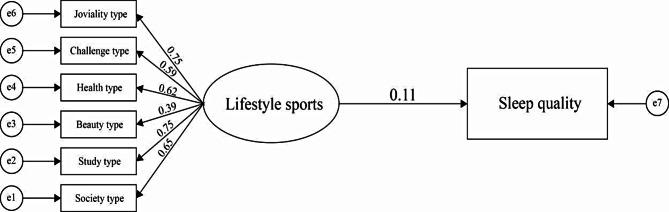
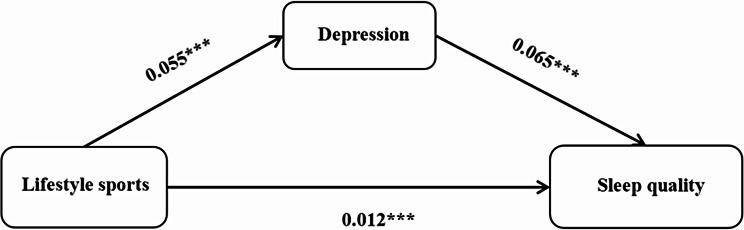
In 129 high schools in 13 cities of Jiangsu Province, approximately 300 male and female students were selected for a questionnaire survey in each high school via the Lifestyle Sports Scale, the Self-rating Depression Scale (SDS), and the Pittsburgh Sleep Quality Index Scale (PSQI), and a stratified random sampling method was used. A total of 40,000 questionnaires were distributed, and 32,974 questionnaires were valid. The mediation model of depression between lifestyle sports and sleep quality was constructed via the Model4 model and other models in the SPSS macro program Process4.0. From the 32,974 valid questionnaires, 14,943 depressed high school students (SDS ≥ 53) were screened out, and structural equation modeling of the relationships between the six dimensions of lifestyle sports and the sleep quality of depressed high school students has been established via AMOS 28.0.
RESULTS
(1) Lifestyle sports significantly and positively predicted depression (P < 0.001), positively predicted sleep quality (P < 0.001), and depression significantly and positively predicted sleep quality (P < 0.001), and depression significantly mediated the relationship between high school students' lifestyle sports and sleep quality (β = 0.004, accounting for 29.91% of the total effect value). (2) The joviality type, challenge type, health type, beauty type, study type and society type of lifestyle sports significantly and positively predicted sleep quality in depressed high school students (P < 0.01), with the correlation coefficients between joviality type (β = 0.75, P < 0.01) and study type (β = 0.75, P < 0.01) of lifestyle sports and the sleep quality of depressed high school students being the largest.
CONCLUSION
Depression significantly mediated the relationship between lifestyle sports and sleep quality in high school students. All six dimensions of lifestyle sports are significantly positively correlated with sleep quality in depressed high school students, with the strongest correlations for the joviality type and study type.
目的
生活方式运动是指个体或个体群体有规律、有意识地参与体育活动所形成的稳定形式和行为特征,分为六个维度:愉悦型、挑战型、健康型、美体型、学习型和社交型。高中生抑郁症患病率较高,生活方式运动是影响抑郁症及抑郁症所致睡眠质量问题的重要因素。本文旨在探讨生活方式运动的六个维度与抑郁高中生睡眠质量之间的关系。
方法
在江苏省13个市的129所高中,采用分层随机抽样方法,每所高中选取约300名男女学生通过生活方式运动量表、自评抑郁量表(SDS)和匹兹堡睡眠质量指数量表(PSQI)进行问卷调查。共发放问卷40000份,有效问卷32974份。通过SPSS宏程序Process4.0中的Model4模型等模型构建生活方式运动与睡眠质量之间抑郁的中介模型。从32974份有效问卷中筛选出14943名抑郁高中生(SDS≥53),通过AMOS 28.0建立生活方式运动六个维度与抑郁高中生睡眠质量之间关系的结构方程模型。
结果
(1)生活方式运动显著正向预测抑郁(P<0.001),正向预测睡眠质量(P<0.001),抑郁显著正向预测睡眠质量(P<0.001),抑郁显著中介了高中生生活方式运动与睡眠质量之间的关系(β=0.004,占总效应值的29.91%)。(2)生活方式运动的愉悦型、挑战型、健康型、美体型、学习型和社交型显著正向预测抑郁高中生的睡眠质量(P<0.01),其中生活方式运动的愉悦型(β=0.75,P<0.01)和学习型(β=0.75,P<0.01)与抑郁高中生睡眠质量的相关系数最大。
结论
抑郁显著中介了高中生生活方式运动与睡眠质量之间的关系。生活方式运动的所有六个维度与抑郁高中生的睡眠质量均显著正相关,其中愉悦型和学习型的相关性最强。
 Zotero 插件