
1990 - 2021年中国与全球水痘带状疱疹疾病负担趋势分析及2030年疾病负担预测比较
Comparison of trend analysis of varicella zoster disease burden between China and the world 1990-2021 and disease burden forecast 2030.
作者信息
Chang Zhichun, Li Huale, Li Yanfang, Qin Ting, Hu Mingren, Yang Xinjing, Li Jun, Xie Yufeng
机构信息
Shenzhen Hospital (Futian) of Guangzhou University of Chinese Medicine, Shenzhen, China.
The Sixth Clinical Medical College, Guangzhou University of Chinese Medicine, Shenzhen, China.
出版信息
Front Public Health. 2025 Mar 10;13:1535977. doi: 10.3389/fpubh.2025.1535977. eCollection 2025.
OBJECTIVES
This study aims to analyze temporal trends in the age- and sex-specific burdens of varicella zoster virus (VZV), including incidence, prevalence, mortality, and disability-adjusted life years (DALYs) in China from 1990 to 2021, and to predict the burden of varicella zoster in China for 2030 by comparing the trends with the global burden of the disease.
METHODS
Data from the Global Burden of Disease database (1990-2021) were used to analyze the characteristics of varicella zoster virus (VZV) burden in China and globally, including trends in incidence, prevalence, mortality, and disability-adjusted life years (DALYs). The average annual percentage change (AAPC) and its corresponding 95% confidence interval (95% CI) were calculated using Joinpoint to assess the VZV burden trends. A comprehensive comparative analysis of the differences in VZV burden between China and the global population was conducted across multiple dimensions, including age, gender, and time period. Additionally, an autoregressive integrated moving average (ARIMA) model was used to predict the VZV trend from 2021 to 2030.
RESULTS
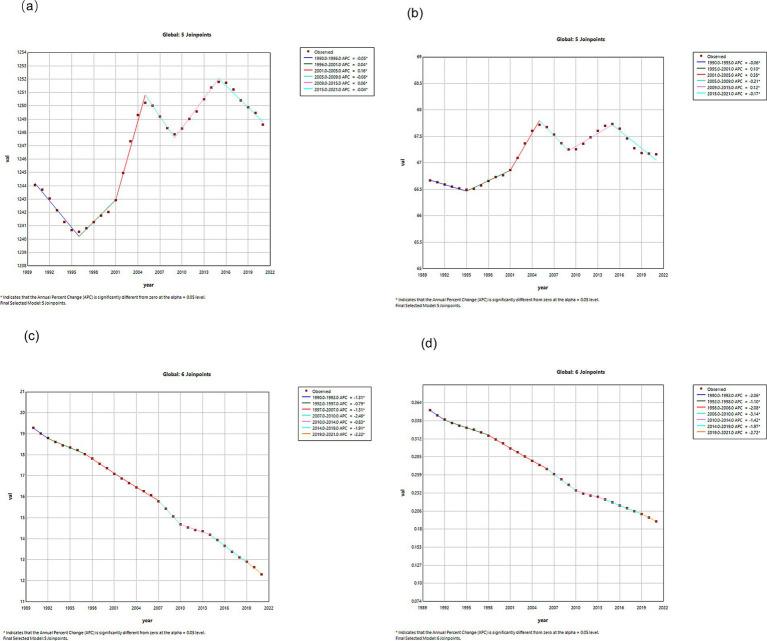
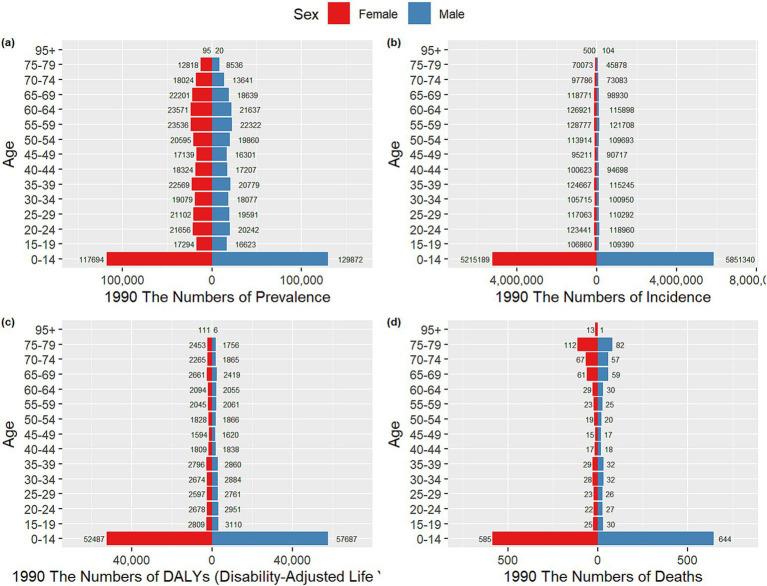
Between 1990 and 2021, the age-standardized incidence rate (ASIR) of varicella zoster in China decreased from 1,274.93/100,000 to 1,270.58/100,000, while the global ASIR increased from 1,244.05/100,000 to 1,248.59/100,000. In China, the age-standardized prevalence rate (ASPR) decreased slightly from 72.27/100,000 to 72.03/100,000, whereas the global ASPR rose from 66.67/100,000 to 67.16/100,000. The age-standardized disability-adjusted life year rate (ASDR) in China decreased significantly, from 17.68/100,000 to 4.66/100,000, while the global ASDR decreased from 19.28/100,000 to 12.31/100,000. Similarly, China's age-standardized mortality rate (ASMR) declined significantly, from 0.40/100,000 to 0.05/100,000, while the global ASMR decreased from 0.35/100,000 to 0.19/100,000. Over the same period, the average annual percentage change (AAPC) of ASIR, ASPR, ASMR, and ASDR in China was -0.0056, -0.0131%, -6.84%, and -4.24%, respectively, while the global AAPC for these metrics was 0.0119, 0.0183, -1.97%, and -1.42%, respectively. Additionally, age and gender had a significant impact on the burden of varicella zoster. The trends in ASIR and ASPR were notably influenced by age, while ASMR and ASDR exhibited a significant increasing trend with age. Projections indicate that the ASDR of varicella zoster in China will continue to decrease by 2030, while the ASIR, ASPR, and ASMR are expected to remain stable.
CONCLUSION
Between 1990 and 2021, the incidence, prevalence, mortality, and DALYs of VZV in China demonstrated a declining trend, reflecting a relative reduction in the VZV burden. Women are more susceptible to VZV infection and face a higher risk of mortality than men. In contrast, the global disease burden remains higher than that in China. Projections suggest a slight decrease in the VZV burden in China by 2030. However, due to the country's large and aging population, VZV will continue to pose a significant public health challenge.
目的
本研究旨在分析1990年至2021年中国水痘带状疱疹病毒(VZV)按年龄和性别划分的疾病负担的时间趋势,包括发病率、患病率、死亡率和伤残调整生命年(DALYs),并通过将这些趋势与全球疾病负担进行比较,预测2030年中国水痘带状疱疹的疾病负担。
方法
利用全球疾病负担数据库(1990 - 2021年)的数据,分析中国和全球水痘带状疱疹病毒(VZV)疾病负担的特征,包括发病率、患病率、死亡率和伤残调整生命年(DALYs)的趋势。使用Joinpoint计算平均年度百分比变化(AAPC)及其相应的95%置信区间(95%CI),以评估VZV疾病负担趋势。对中国和全球人群在年龄、性别和时间段等多个维度上的VZV疾病负担差异进行了全面的比较分析。此外,使用自回归积分移动平均(ARIMA)模型预测2021年至2030年的VZV趋势。
结果
1990年至2021年期间,中国水痘带状疱疹的年龄标准化发病率(ASIR)从1274.93/10万降至1270.58/10万,而全球ASIR从1244.05/10万升至1248.59/10万。在中国,年龄标准化患病率(ASPR)从72.27/10万略有下降至72.03/10万,而全球ASPR从66.67/10万升至67.16/10万。中国的年龄标准化伤残调整生命年率(ASDR)显著下降,从17.68/10万降至4.66/10万,而全球ASDR从19.28/10万降至12.31/10万。同样,中国的年龄标准化死亡率(ASMR)显著下降,从0.40/10万降至0.05/1十万,而全球ASMR从0.35/10万降至0.19/10万。在同一时期,中国ASIR、ASPR、ASMR和ASDR 的平均年度百分比变化(AAPC)分别为 -0.0056、 -0.0131%、 -6.84%和 -4.24%,而全球这些指标的AAPC分别为0.0119、0.0183、 -1.97%和 -1.42%。此外,年龄和性别对水痘带状疱疹的疾病负担有显著影响。ASIR和ASPR的趋势受年龄影响显著,而ASMR和ASDR随年龄呈显著上升趋势。预测表明,到2030年中国水痘带状疱疹的ASDR将继续下降,而ASIR、ASPR和ASMR预计将保持稳定。
结论
1990年至2021年期间,中国VZV的发病率、患病率、死亡率和伤残调整生命年呈下降趋势,反映出VZV疾病负担相对减轻。女性比男性更容易感染VZV,且面临更高的死亡风险。相比之下,全球疾病负担仍高于中国。预测表明,到2030年中国VZV疾病负担将略有下降。然而,由于中国人口众多且老龄化,VZV将继续构成重大的公共卫生挑战。






 Zotero 插件