
代谢工程的进展:释放关键有机酸在可持续工业应用中的潜力。
Advancements in metabolic engineering: unlocking the potential of key organic acids for sustainable industrial applications.
作者信息
Wang Tengfei, Xue Han, Liu Hongling, Yuan Haibo, Huang Di, Jiang Yi
机构信息
State Key Laboratory of Green Papermaking and Resource Recycling, Qilu University of Technology (Shandong Academy of Sciences), Jinan, Shandong, China.
Key Laboratory of Shandong Microbial Engineering, School of Bioengineering, Qilu University of Technology (Shandong Academy of Sciences), Jinan, Shandong, China.
出版信息
Front Bioeng Biotechnol. 2025 Mar 11;13:1556516. doi: 10.3389/fbioe.2025.1556516. eCollection 2025.
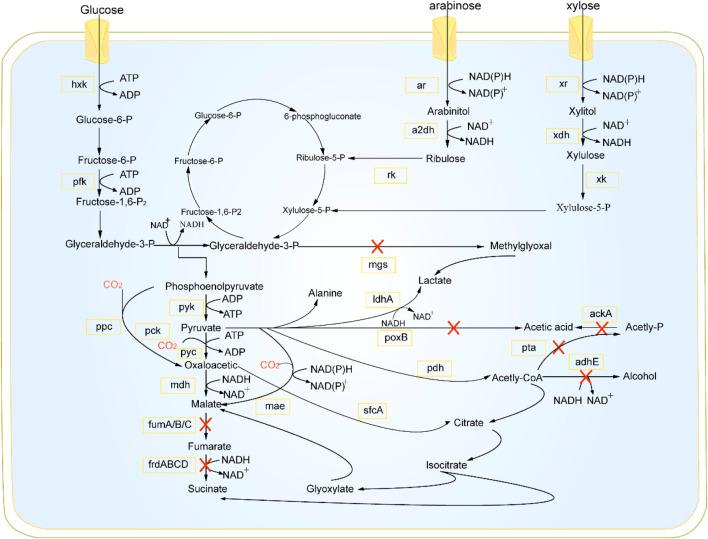
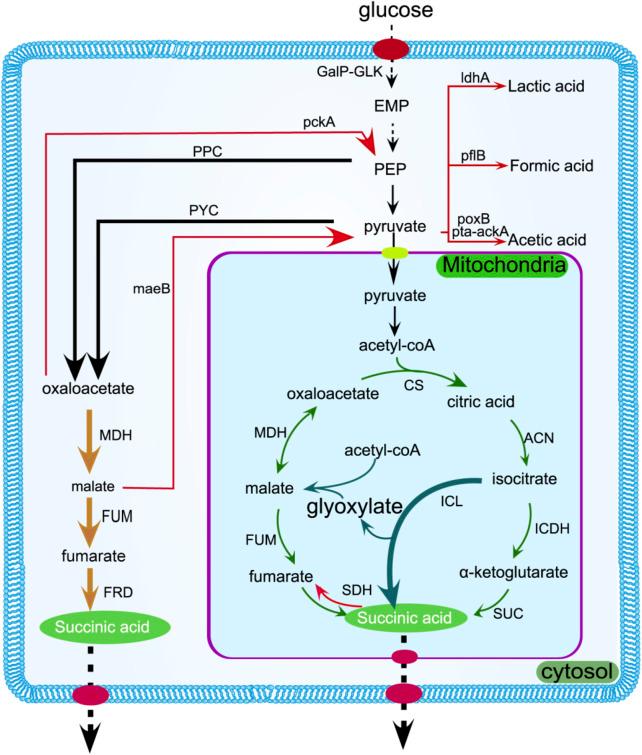
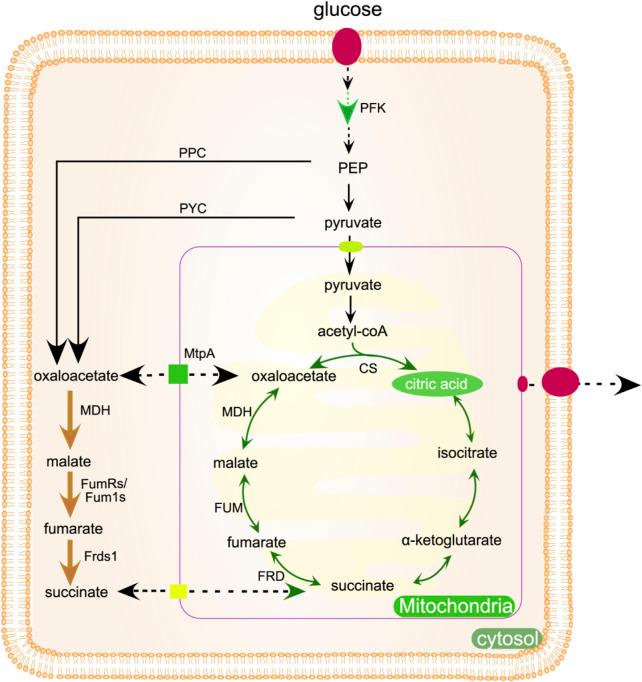
This review explores the advancements, application potential, and challenges of microbial metabolic engineering strategies for sustainable organic acid production. By integrating gene editing, pathway reconstruction, and dynamic regulation, microbial platforms have achieved enhanced biosynthesis of key organic acids such as pyruvate, lactic acid, and succinic acid. Strategies including by-product pathway knockout, key enzyme overexpression, and improved CO fixation have contributed to higher production efficiency. Additionally, utilizing non-food biomass sources, such as lignocellulose, algal feedstocks, and industrial waste, has reduced reliance on conventional carbon sources, supporting sustainability goals. However, challenges remain in substrate inhibition, purification complexity, and metabolic flux imbalances. Addressing these requires omics-driven metabolic optimization, stress-resistant strain development, and biorefinery integration. Future research should focus on system-level design to enhance cost-effectiveness and sustainability, advancing industrial bio-manufacturing of organic acids.
本综述探讨了用于可持续生产有机酸的微生物代谢工程策略的进展、应用潜力和挑战。通过整合基因编辑、途径重建和动态调控,微生物平台已实现关键有机酸(如丙酮酸、乳酸和琥珀酸)生物合成的增强。包括副产物途径敲除、关键酶过表达和改进的CO固定等策略提高了生产效率。此外,利用木质纤维素、藻类原料和工业废料等非粮食生物质来源减少了对传统碳源的依赖,支持了可持续发展目标。然而,在底物抑制、纯化复杂性和代谢通量不平衡方面仍然存在挑战。解决这些问题需要组学驱动的代谢优化、抗逆菌株开发和生物炼制整合。未来的研究应专注于系统水平设计,以提高成本效益和可持续性,推动有机酸的工业生物制造。


 Zotero 插件