
α-芋螺毒素TxIB可逆转尼古丁诱导的小鼠运动敏化及尼古丁增强的多巴胺能活性。
α-Conotoxin TxIB Reversed Nicotine-Induced Locomotor Sensitization and Nicotine-Enhanced Dopaminergic Activity in Mice.
作者信息
Xu Weifeng, Wang Meiting, Li Xiaodan, He Rongyan, Ding Ren-Bo, Bao Jiaolin, Zhangsun Dongting, Luo Sulan
机构信息
Key Laboratory of Tropical Biological Resources of Ministry of Education, Hainan University, Haikou 570228, China.
Guangxi Key Laboratory of Special Biomedicine, School of Medicine, Guangxi University, Nanning 530004, China.
出版信息
Mar Drugs. 2025 Mar 4;23(3):109. doi: 10.3390/md23030109.
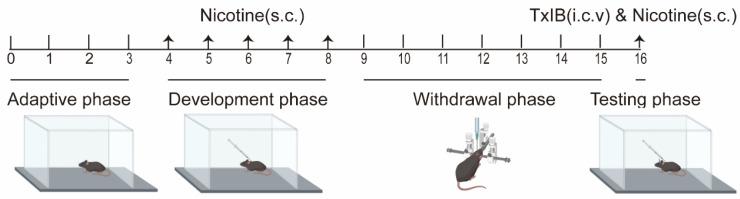
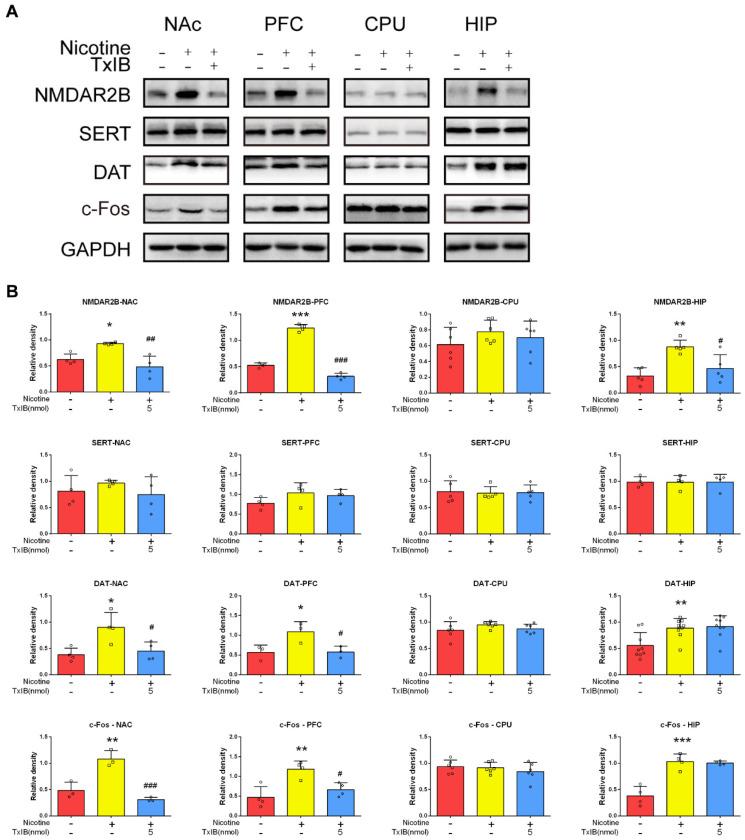
Nicotine addiction is a serious global public health problem, so there is an urgent necessity to develop novel effective smoking cessation treatments with fewer adverse effects. Spontaneous behavioral sensitization induced by repeated intermittent exposure to the addictive substance represents a classical animal model of addiction research. A significant contributor to nicotine addiction is its interaction with α6β2* nAChRs located on midbrain dopaminergic neurons, which leads to an increase in dopamine (DA) release. α-Conotoxin (α-CTx) TxIB is a novel potent antagonist of the α6/α3β2β3* nAChRs, with an IC50 value of 28.4 nM developed by our group. In this study, we aimed to investigate the effectiveness of α-CTx TxIB in countering nicotine-induced behavioral sensitization and moderating the impact of nicotine on dopamine accumulation in the midbrain. Our results demonstrated that repeated nicotine administration remarkably elevated the locomotor activity of mice, including the number of entries, average speed, and total distance traveled, which could be effectively attenuated by α-CTx TxIB intervention in a dose-dependent manner (1 nmol and 5 nmol TxIB per mouse). Furthermore, 5 nmol α-CTx TxIB significantly reduced the nicotine-elevated DA and norepinephrine (NE) levels in the ventral tegmental area (VTA) and nucleus accumbens (NAc) of mice. 5 nmol α-CTx TxIB also markedly decreased the expression of critical proteins such as the dopamine transporter (DAT), N-methyl-D-aspartic acid receptor (NMDAR), and c-Fos in the NAc and prefrontal cortex (PFC) of the nicotine-exposed mice. This research provided the first compelling evidence that α-CTx TxIB attenuated nicotine-induced locomotor sensitization and inhibited the nicotine-induced dopamine elevation in mice. These results open up new avenues for exploring the therapeutic potential of α-CTx TxIB in the treatment of nicotine addiction.
尼古丁成瘾是一个严重的全球公共卫生问题,因此迫切需要开发出不良反应较少的新型有效戒烟治疗方法。反复间歇性接触成瘾物质所诱导的自发行为敏化是成瘾研究的经典动物模型。尼古丁成瘾的一个重要因素是它与位于中脑多巴胺能神经元上的α6β2烟碱型乙酰胆碱受体相互作用,从而导致多巴胺(DA)释放增加。α-芋螺毒素(α-CTx)TxIB是α6/α3β2β3烟碱型乙酰胆碱受体的新型强效拮抗剂,由我们团队研发,其半数抑制浓度(IC50)值为28.4 nM。在本研究中,我们旨在探究α-CTx TxIB对抗尼古丁诱导的行为敏化以及调节尼古丁对中脑多巴胺积累影响的有效性。我们的结果表明,反复给予尼古丁显著提高了小鼠的运动活性,包括进入次数、平均速度和总行进距离,而α-CTx TxIB干预(每只小鼠1 nmol和5 nmol TxIB)能够以剂量依赖的方式有效减弱这种提高。此外,5 nmol α-CTx TxIB显著降低了小鼠腹侧被盖区(VTA)和伏隔核(NAc)中尼古丁升高的多巴胺和去甲肾上腺素(NE)水平。5 nmol α-CTx TxIB还显著降低了尼古丁暴露小鼠NAc和前额叶皮质(PFC)中多巴胺转运体(DAT)、N-甲基-D-天冬氨酸受体(NMDAR)和c-Fos等关键蛋白的表达。这项研究提供了首个令人信服的证据,即α-CTx TxIB减弱了尼古丁诱导的运动敏化,并抑制了尼古丁诱导的小鼠多巴胺升高。这些结果为探索α-CTx TxIB在治疗尼古丁成瘾方面的治疗潜力开辟了新途径。




 Zotero 插件