
心源性休克最初24小时内平均血流动力学变量与预后的关联:确定临床相关阈值。
Association between mean hemodynamic variables during the first 24 h and outcomes in cardiogenic shock: identification of clinically relevant thresholds.
作者信息
Levy Bruno, Curtiaud Anais, Duarte Kevin, Delmas Clément, Demiselle Julien, Girerd Nicolas, Gebhard Caroline Eva, Helms Julie, Meziani Ferhat, Kimmoun Antoine, Merdji Hamid
机构信息
Medical Intensive Care Unit Brabois, INSERM U1116, Institut Lorrain du Cœur et des Vaisseaux, CHRU de Nancy, Université de Lorraine, Nancy, France.
Service de Médecine Intensive-Réanimation, Nouvel Hôpital Civil, Hôpitaux Universitaires de Strasbourg, Faculté de Médecine, Université de Strasbourg (UNISTRA), 1, Place de L'Hôpital, 67091, Strasbourg Cedex, France.
出版信息
Crit Care. 2025 Mar 26;29(1):137. doi: 10.1186/s13054-025-05356-0.
PURPOSE
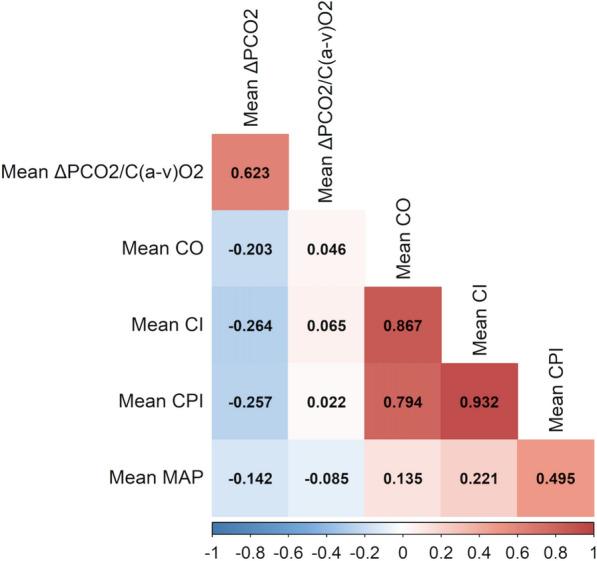
Cardiogenic shock (CS) remains a critical condition with high mortality rates despite advances in treatment. This study aims to comprehensively evaluate both macrocirculatory and tissue perfusion variables over the initial 24 h post-admission to determine their impact on patient prognosis and identify potential hemodynamic thresholds for optimal outcomes. Secondary aims were to explore the correlation between macrocirculatory and tissue perfusion variables.
DESIGN
This is a post hoc analysis of data from two prospective studies, OptimaCC (NCT01367743) and MicroShock (NCT03436641), involving only patients with CS. Both studies applied regular assessment of hemodynamic variables at specific time points (admission, 6, 12, and 24 h) to ensure consistency in data collection, enrolling 118 patients between September 2011 and July 2021, with similar inclusion criteria and care processes.
RESULTS
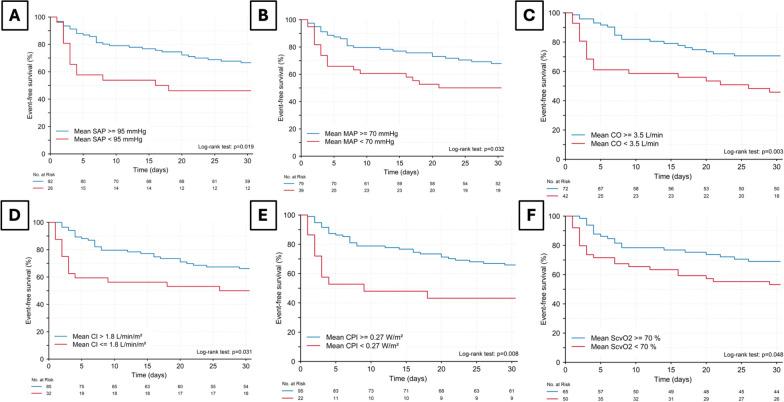
The median age of the cohort was 69 years, 59% being male. The primary outcome, 30-day mortality, occurred in 37% of patients. Average macrocirculation variables over the first 24 h of CS such as mean arterial pressure (MAP), cardiac output (CO), cardiac index (CI), and cardiac power index (CPI) were significantly lower in patients meeting the primary outcome. Accordingly, average tissue perfusion variables (ΔPCO and ΔPCO/C(a-v)O) over the first 24 h of CS were also consistently impaired in patients meeting the primary outcome. The optimal clinically relevant thresholds of the first 24 h time course for poor outcomes, closely approximating the optimal values identified in the analysis, were: mean SAP < 95 mmHg, MAP < 70 mmHg, CO < 3.5 L/min, CI ≤ 1.8 L/min/m, CPI < 0.27 W/m, ScvO < 70%, ΔPCO ≥ 9 mmHg, and ΔPCO/C(a-v)O ≥ 1.5 mmHg/mL.
CONCLUSIONS
This study is the first to identify critical hemodynamic thresholds, encompassing both macrocirculatory and tissue perfusion variables, within the initial 24 h of CS that are associated with adverse outcomes. The identified thresholds suggest specific hemodynamic targets that may guide resuscitation strategies.
目的
尽管治疗取得了进展,但心源性休克(CS)仍然是一种死亡率很高的危急病症。本研究旨在全面评估入院后最初24小时内的大循环和组织灌注变量,以确定它们对患者预后的影响,并确定实现最佳结果的潜在血流动力学阈值。次要目的是探讨大循环和组织灌注变量之间的相关性。
设计
这是一项对两项前瞻性研究OptimaCC(NCT01367743)和MicroShock(NCT03436641)的数据进行的事后分析,仅纳入CS患者。两项研究均在特定时间点(入院时、6小时、12小时和24小时)定期评估血流动力学变量,以确保数据收集的一致性,在2011年9月至2021年7月期间共纳入118例患者,纳入标准和护理流程相似。
结果
该队列的中位年龄为69岁,男性占59%。主要结局30天死亡率发生在37%的患者中。在达到主要结局的患者中,CS最初24小时内的平均动脉压(MAP)、心输出量(CO)、心脏指数(CI)和心脏功率指数(CPI)等平均大循环变量显著较低。因此,在达到主要结局的患者中,CS最初24小时内的平均组织灌注变量(ΔPCO和ΔPCO/C(a-v)O)也持续受损。不良结局的最初24小时病程的最佳临床相关阈值与分析中确定的最佳值非常接近,分别为:平均收缩压<95 mmHg、MAP<70 mmHg、CO<3.5 L/min、CI≤1.8 L/min/m²、CPI<0.27 W/m²、ScvO<70%、ΔPCO≥9 mmHg和ΔPCO/C(a-v)O≥1.5 mmHg/mL。
结论
本研究首次确定了CS最初24小时内与不良结局相关的关键血流动力学阈值,包括大循环和组织灌注变量。确定的阈值提示了可能指导复苏策略的特定血流动力学目标。

 Zotero 插件