
如何限制维持性血液透析患者的透析间期体重增加:现状与展望
How to Limit Interdialytic Weight Gain in Patients on Maintenance Hemodialysis: State of the Art and Perspectives.
作者信息
Bossola Maurizio, Mariani Ilaria, Strizzi Camillo Tancredi, Piccinni Carlo Pasquale, Di Stasio Enrico
机构信息
Nephrology, Dialysis and Transplantation Unit, Fondazione Policlinico Universitario A. Gemelli IRCCS, 00168 Rome, Italy.
Department of Translational Medicine and Surgery, Università Cattolica del Sacro Cuore, 00168 Rome, Italy.
出版信息
J Clin Med. 2025 Mar 9;14(6):1846. doi: 10.3390/jcm14061846.
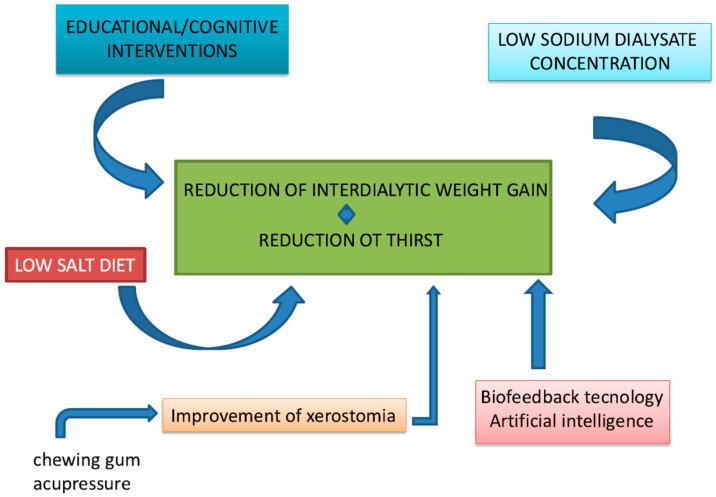
Interdialytic weight gain (IDWG), defined as the accumulation of salt and water intake between dialysis sessions, is a critical parameter of fluid management and a marker of adherence to dietary and fluid restrictions in hemodialysis patients. Excessive IDWG has been strongly associated with increased cardiovascular risk, including left ventricular hypertrophy, cardiac dysfunction, and cerebrovascular complications. Additionally, it necessitates more aggressive ultrafiltration, potentially compromising hemodynamic stability, impairing quality of life, and escalating healthcare costs. Despite international guidelines recommending an IDWG target of <4-4.5% of body weight, many patients struggle to achieve this due to barriers in adhering to dietary and fluid restrictions. This review explores the current state-of-the-art strategies to mitigate IDWG and evaluates emerging diagnostic and therapeutic perspectives to improve fluid management in dialysis patients. A literature search was conducted in PubMed/MEDLINE, Scopus, and Web of Science to identify studies on IDWG in hemodialysis. Keywords and MeSH terms were used to retrieve peer-reviewed articles, observational studies, RCTs, meta-analyses, and systematic reviews. Non-English articles, case reports, and conference abstracts were excluded. Study selection followed PRISMA guidelines, with independent screening of titles, abstracts, and full texts. Data extraction focused on IDWG definitions, risk factors, clinical outcomes, and management strategies. Due to study heterogeneity, a narrative synthesis was performed. Relevant data were synthesized thematically to evaluate both established strategies and emerging perspectives. The current literature identifies three principal strategies for IDWG control: cognitive-behavioral interventions, dietary sodium restriction, and dialysis prescription adjustments. While educational programs and behavioral counseling improve adherence, their long-term effectiveness remains constrained by patient compliance and logistical challenges. Similarly, low-sodium diets, despite reducing thirst, face barriers to adherence and potential nutritional concerns. Adjustments in dialysate sodium concentration have yielded conflicting results, with concerns regarding hemodynamic instability and intradialytic hypotension. Given these limitations, alternative approaches are emerging. Thirst modulation strategies, including chewing gum to stimulate salivation and acupuncture for autonomic regulation, offer potential benefits in reducing excessive fluid intake. Additionally, technological innovations, such as mobile applications and telemonitoring, enhance self-management by providing real-time feedback on fluid intake. Biofeedback-driven dialysis systems enable dynamic ultrafiltration adjustments, improving fluid removal efficiency while minimizing hemodynamic instability. Artificial intelligence (AI) is advancing predictive analytics by integrating wearable bioimpedance sensors and dialysis data to anticipate fluid overload and refine individualized dialysis prescriptions, driving precision-based volume management. Finally, optimizing dialysis frequency and duration has shown promise in achieving better fluid balance and cardiovascular stability, suggesting that a personalized, multimodal approach is essential for effective IDWG management. Despite decades of research, IDWG remains a persistent challenge in hemodialysis, requiring a multifaceted, patient-centered approach. While traditional interventions provide partial solutions, integrating thirst modulation strategies, real-time monitoring, biofeedback dialysis adjustments, and AI-driven predictive tools represent the next frontier in fluid management. Future research should focus on long-term feasibility, patient adherence, and clinical efficacy, ensuring these innovations translate into tangible improvements in quality of life and cardiovascular health for dialysis patients.
透析间期体重增加(IDWG)定义为透析疗程之间盐和水摄入量的累积,是血液透析患者液体管理的关键参数,也是其对饮食和液体限制依从性的一个指标。过量的IDWG与心血管风险增加密切相关,包括左心室肥厚、心脏功能障碍和脑血管并发症。此外,这需要更积极的超滤,可能会影响血流动力学稳定性,损害生活质量,并使医疗成本上升。尽管国际指南建议将IDWG目标设定为低于体重的4%-4.5%,但由于在遵守饮食和液体限制方面存在障碍,许多患者难以实现这一目标。本综述探讨了减轻IDWG的当前先进策略,并评估了改善透析患者液体管理的新的诊断和治疗观点。在PubMed/MEDLINE、Scopus和Web of Science中进行了文献检索,以识别关于血液透析中IDWG的研究。使用关键词和医学主题词来检索同行评审文章、观察性研究、随机对照试验、荟萃分析和系统评价。排除非英文文章、病例报告和会议摘要。研究选择遵循PRISMA指南,对标题、摘要和全文进行独立筛选。数据提取侧重于IDWG的定义、危险因素、临床结果和管理策略。由于研究的异质性,进行了叙述性综合。对相关数据进行主题综合,以评估既定策略和新观点。当前文献确定了控制IDWG的三种主要策略:认知行为干预、饮食钠限制和透析处方调整。虽然教育项目和行为咨询可提高依从性,但其长期有效性仍受到患者依从性和后勤挑战的限制。同样,低钠饮食尽管可减少口渴,但在依从性方面存在障碍,且存在潜在的营养问题。透析液钠浓度的调整产生了相互矛盾的结果,存在对血流动力学不稳定和透析中低血压的担忧。鉴于这些局限性,正在出现替代方法。口渴调节策略,包括咀嚼口香糖以刺激唾液分泌和针灸以进行自主调节,在减少过多液体摄入方面具有潜在益处。此外,移动应用程序和远程监测等技术创新通过提供关于液体摄入的实时反馈来增强自我管理。生物反馈驱动的透析系统可实现动态超滤调整,提高液体清除效率,同时将血流动力学不稳定降至最低。人工智能(AI)通过整合可穿戴生物阻抗传感器和透析数据来推进预测分析,以预测液体过载并优化个性化透析处方,推动基于精准的容量管理。最后,优化透析频率和时长在实现更好的液体平衡和心血管稳定性方面已显示出前景,这表明个性化的多模式方法对于有效的IDWG管理至关重要。尽管经过了数十年的研究,但IDWG在血液透析中仍然是一个持续存在的挑战,需要采取多方面的、以患者为中心的方法。虽然传统干预措施提供了部分解决方案,但整合口渴调节策略、实时监测、生物反馈透析调整和AI驱动的预测工具代表了液体管理的新前沿。未来的研究应关注长期可行性、患者依从性和临床疗效,确保这些创新转化为透析患者生活质量和心血管健康的切实改善。
 Zotero 插件