
一项全基因组跨性状分析描绘了肺部疾病和胃肠道疾病之间共享的遗传结构。
A genome-wide cross-trait analysis characterizes the shared genetic architecture between lung and gastrointestinal diseases.
作者信息
You Dongfang, Wu Yaqian, Lu Mengyi, Shao Fang, Tang Yingdan, Liu Sisi, Liu Liya, Zhou Zewei, Zhang Ruyang, Shen Sipeng, Lange Theis, Xu Hongyang, Ma Hongxia, Yin Yongmei, Shen Hongbing, Chen Feng, Christiani David C, Jin Guangfu, Zhao Yang
机构信息
Department of Biostatistics, School of Public Health, Nanjing Medical University, Nanjing, Jiangsu, China.
Department of Oncology, The First Affiliated Hospital of Nanjing Medical University, Nanjing, Jiangsu, China.
出版信息
Nat Commun. 2025 Mar 28;16(1):3032. doi: 10.1038/s41467-025-58248-w.
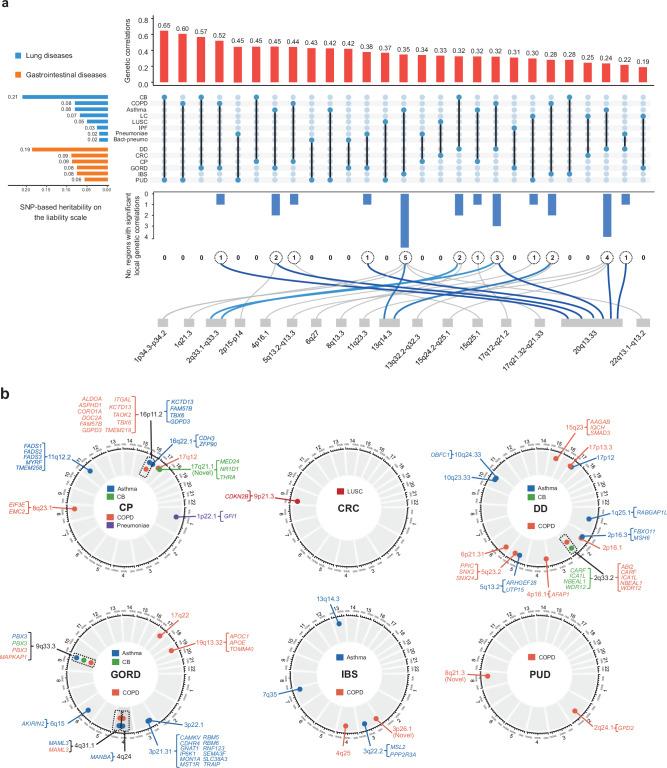
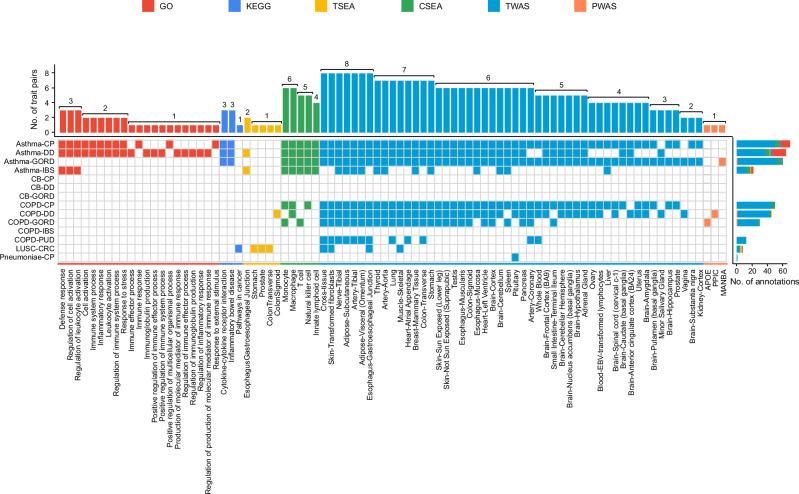
Lung and gastrointestinal diseases often occur together, leading to more adverse health outcomes than when a disease of one of these systems occurs alone. However, the potential genetic mechanisms underlying lung-gastrointestinal comorbidities remain unclear. Here, we leverage lung and gastrointestinal trait data from individuals of European, East Asian and African ancestries, to perform a large-scale genetic cross trait analysis, followed by functional annotation and Mendelian randomization analysis to explore the genetic mechanisms involved in the development of lung-gastrointestinal comorbidities. Notably, we find significant genetic correlations between 27 trait pairs among the European population. The highest correlation is between chronic bronchitis and peptic ulcer disease. At the variant level, we identify 42 candidate pleiotropic genetic variants (3 of them previously uncharacterized) in 14 trait pairs by integrating cross-trait meta-analysis, fine-mapping and colocalization analyses. We also find 66 candidate pleiotropic genes, most of which were enriched in immune or inflammatory response-related activities. Causal inference approaches result in 4 potential lung-gastrointestinal associations. Introducing the gut microbiota as a variable establishes a relationship between the genus Parasutterella, gastro-oesophageal reflux disease and asthma. In summary, our findings highlight the genetic relationship between lung and gastrointestinal diseases, providing insights into the genetic mechanisms underlying the development of lung gastrointestinal comorbidities.
肺部疾病和胃肠道疾病常常共同出现,相较于这些系统中的某一种疾病单独发生时,会导致更多不良健康后果。然而,肺部 - 胃肠道共病潜在的遗传机制仍不清楚。在此,我们利用来自欧洲、东亚和非洲血统个体的肺部和胃肠道性状数据,进行大规模的遗传跨性状分析,随后进行功能注释和孟德尔随机化分析,以探索参与肺部 - 胃肠道共病发生发展的遗传机制。值得注意的是,我们在欧洲人群中发现了27对性状之间存在显著的遗传相关性。相关性最高的是慢性支气管炎和消化性溃疡疾病。在变异水平上,通过整合跨性状荟萃分析、精细定位和共定位分析,我们在14对性状中鉴定出42个候选多效性遗传变异(其中3个此前未被表征)。我们还发现了66个候选多效性基因,其中大多数在免疫或炎症反应相关活动中富集。因果推断方法得出了4种潜在的肺部 - 胃肠道关联。将肠道微生物群作为一个变量引入后,确定了萨特氏菌属、胃食管反流病和哮喘之间的关系。总之,我们的研究结果突出了肺部疾病和胃肠道疾病之间的遗传关系,为肺部 - 胃肠道共病发生发展的遗传机制提供了见解。


 Zotero 插件