
吸烟类型对从事外科和非外科专业的医生体内活性氧水平的影响。
The impact of smoked cigarettes' type on the level of reactive oxygen species in physicians with surgical and non-surgical specialization.
作者信息
Nowak Artur, Kopa-Stojak Paulina Natalia, Pawliczak Rafał
机构信息
Department of Immunopathology, Faculty of Medicine, Medical University of Lodz, 7/9 Żeligowskiego, Building 2, Room 177, Lodz, PL-90-752, Poland.
出版信息
BMC Pulm Med. 2025 Mar 28;25(1):141. doi: 10.1186/s12890-025-03606-z.
BACKGROUND
Cigarette smoking remains a pervasive global health concern, contributing to a myriad of debilitating conditions. One critical aspect of its detrimental impact is the induction of oxidative stress (OS). The aim of the study was to identify differences in the level of reactive oxygen species between surgical and non-surgical physicians who smoke different types of cigarettes and their level of nicotine addiction.
METHODS
The prospective study conducted on surgical and non-surgical physicians who smoke various types of cigarettes worked at the Provincial Multidisciplinary Oncology and Traumatology Centre in Lodz (Poland) and at the Polish Mother's Health Centre Institute in Lodz (Poland). The Fagerström's test for nicotine dependence was used to determine degree of nicotine addiction. The differences in reactive oxygen species level among physicians with surgical and non-surgical specialization who smoke different types of cigarettes was analysed by the Cellular Reactive Oxygen Species Assay Kit.
RESULTS
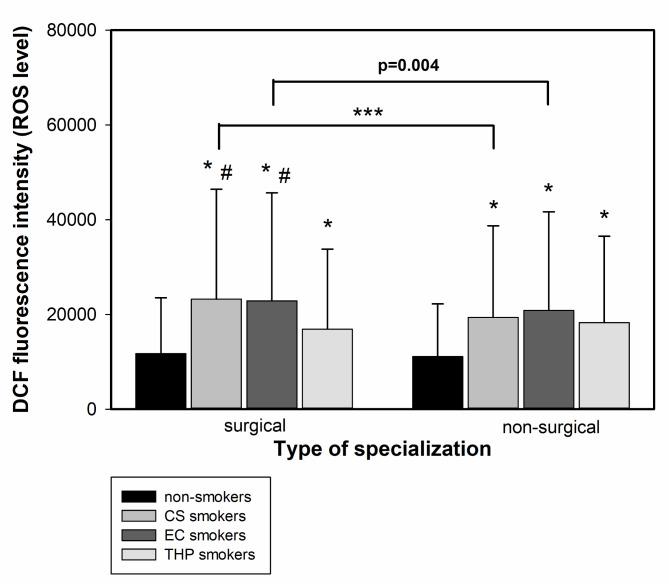
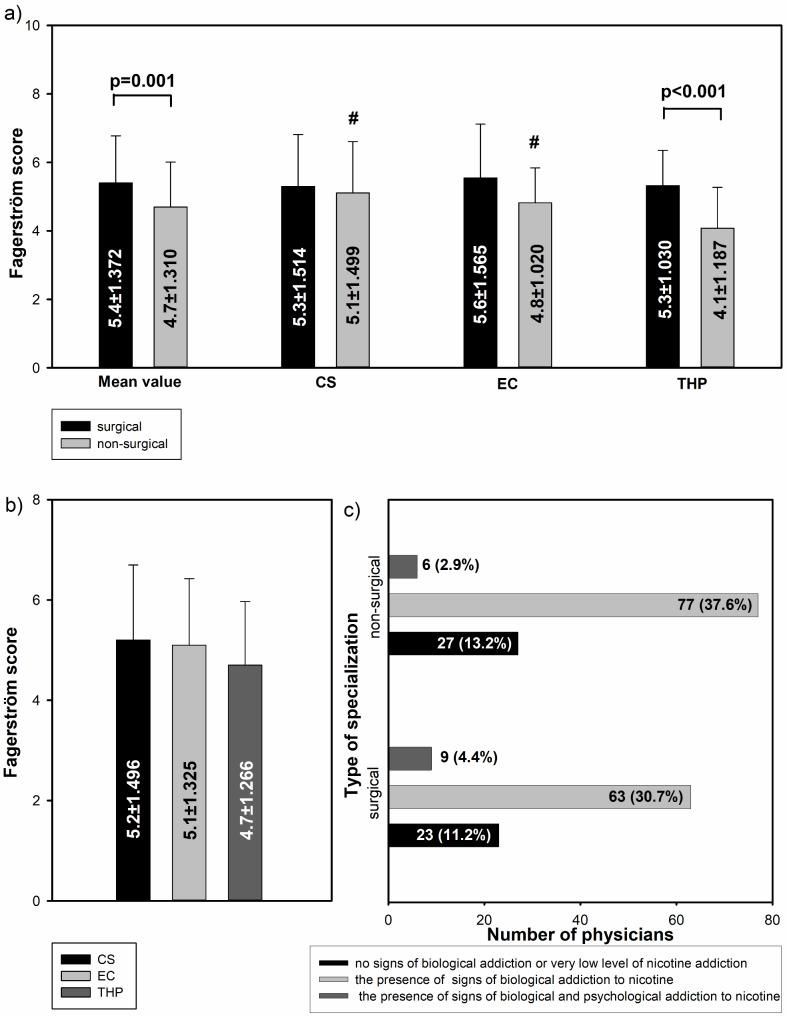
In this study 35.1% of surgical and 40.5% of non-surgical physicians indicated signs of nicotine addiction. The Fagerström score was significantly higher in surgical than non-surgical physician specialties (5.4 ± 1.372 vs. 4.7 ± 1.310; p = 0.001). Significantly higher ROS level was observed in conventional cigarette (CS) smokers, e-cigarette (EC) smokers and tobacco heating products (THP) smokers compared to non-smokers (p < 0.05). In addition, there was a significantly lower ROS level in THP smokers compared to CS smokers (p < 0.05) and EC smokers (p < 0.05). There was a significantly higher ROS level in physicians with surgical specialization who smoke CS (p < 0.001) and EC (p = 0.004) compared to non-surgical physicians.
CONCLUSIONS
Understanding the influence of the type of smoked cigarettes on oxidative stress in surgical and non-surgical physicians is imperative for targeted interventions and health promotion strategies. The broader goal is mitigating the health risks associated with cigarette smoking, especially within professional domains where stressors may already be heightened. Further investigations are essential for developing tailored approaches to address the nuanced relationships between cigarette types, occupational stress, and oxidative stress in specialized medical fields.
CLINICAL TRIAL NUMBER
not applicable.
背景
吸烟仍然是一个普遍存在的全球健康问题,会导致多种使人衰弱的疾病。其有害影响的一个关键方面是诱导氧化应激(OS)。本研究的目的是确定吸不同类型香烟的外科医生和非外科医生之间活性氧水平的差异以及他们的尼古丁成瘾程度。
方法
对在罗兹(波兰)的省级多学科肿瘤与创伤中心以及罗兹(波兰)的波兰母亲健康中心研究所工作的吸各种类型香烟的外科医生和非外科医生进行了前瞻性研究。使用法格斯特罗姆尼古丁依赖测试来确定尼古丁成瘾程度。通过细胞活性氧检测试剂盒分析吸不同类型香烟的外科和非外科专科医生之间活性氧水平的差异。
结果
在本研究中,35.1%的外科医生和40.5%的非外科医生显示出尼古丁成瘾的迹象。外科医生的法格斯特罗姆评分显著高于非外科医生专科(5.4±1.372对4.7±1.310;p = 0.001)。与不吸烟者相比,吸传统香烟(CS)、电子烟(EC)和烟草加热产品(THP)的吸烟者的活性氧水平显著更高(p < 0.05)。此外,与吸CS者(p < 0.05)和吸EC者(p < 0.05)相比,吸THP者的活性氧水平显著更低。与非外科医生相比,吸CS(p < 0.001)和吸EC(p = 0.004)的外科专科医生的活性氧水平显著更高。
结论
了解吸烟类型对外科和非外科医生氧化应激的影响对于有针对性的干预措施和健康促进策略至关重要。更广泛的目标是减轻与吸烟相关的健康风险,尤其是在压力源可能已经增加的专业领域内。进一步的研究对于制定量身定制的方法来解决专业医学领域中香烟类型、职业压力和氧化应激之间的细微关系至关重要。
临床试验编号
不适用。

 Zotero 插件