
探索新冠疫情期间(病毒的)进化及耐药性。 (注:原文中“and”前缺少具体内容,根据语境补充了“病毒的”,以使译文更通顺)
Exploring the evolution of and resistance during the COVID-19 era.
作者信息
Sehmen Emine, Yılmaz Esmeray Mutlu, Pusa Sevim Yetkin, Özdemir Metin, Yiğit Yavuz
机构信息
Department of Clinical Microbiolgy and İnfectious Disease, Gazi State Hospital, Samsun, Turkiye.
Department of Clinical Microbiolgy and İnfectious Disease, Samsun Training and Research Hospital, Samsun, Turkiye.
出版信息
Antimicrob Steward Healthc Epidemiol. 2025 Mar 26;5(1):e88. doi: 10.1017/ash.2025.46. eCollection 2025.
AIM
In our study, we aim to compare the resistance profiles of and isolates from intensive care unit (ICU) patients before and during the COVID-19 pandemic.
MATERIALS
The study involved adult patients monitored in the ICUs of a secondary-level hospital from January 2019 to December 2022. Isolates of and were obtained from blood, urine, and respiratory samples. Identification and antibiotic susceptibility tests were conducted using the disk diffusion method and the VITEK 2 system.
RESULTS
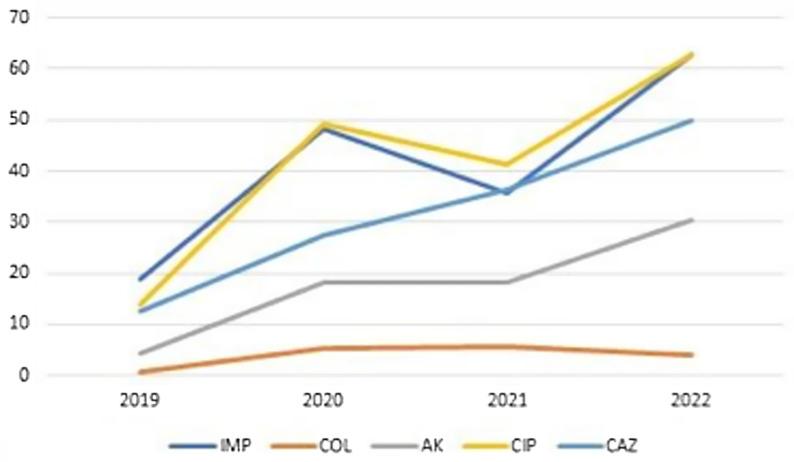
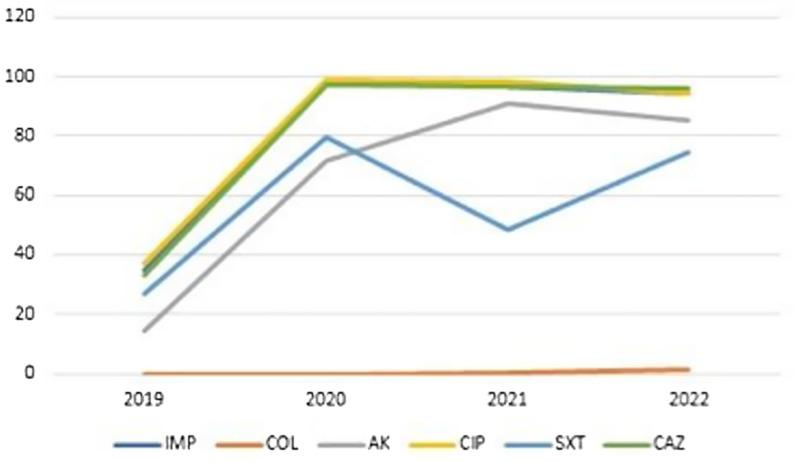
The average age of the patients was 61.3 ± 21.9 years (range: 18-95), with a majority of 1306 (51.6%) being male. During the pandemic, isolates showed a significant increase in resistance rates for several antibiotics compared to the pre-pandemic period: imipenem (96% vs 35.1%), amikacin (84.1% vs 14.4%), ciprofloxacin (96.9% vs 36.9%), trimethoprim-sulfamethoxazole (66.4% vs 27%), and ceftazidime (96.5% vs 33.3%) (all with < .001). However, there was no significant change in colistin resistance rates in these isolates (0.9% vs 0%; = .307). Similarly, isolates exhibited significant increases in resistance rates during the pandemic compared to the pre-pandemic period: imipenem (51.5% vs 18.8%; < .001), colistin (4.9% vs 0.6%; = .009), amikacin (23.5% vs 4.4%; < .001), ciprofloxacin (53.3% vs 13.8%; < .001), and ceftazidime (39.2% vs 12.7%; < .001).
CONCLUSION
Our results demonstrate a significant increase in antibiotic resistance levels in and strains associated with hospital-acquired infections or colonization during the COVID-19 pandemic.
目的
在我们的研究中,我们旨在比较重症监护病房(ICU)患者在新冠疫情之前和期间的[具体细菌名称1]和[具体细菌名称2]分离株的耐药谱。
材料
该研究纳入了2019年1月至2022年12月在一家二级医院的ICU接受监测的成年患者。[具体细菌名称1]和[具体细菌名称2]分离株取自血液、尿液和呼吸道样本。使用纸片扩散法和VITEK 2系统进行鉴定和抗生素敏感性试验。
结果
患者的平均年龄为61.3±21.9岁(范围:18 - 95岁),其中大多数为1306名男性(占51.6%)。在疫情期间,与疫情前相比,[具体细菌名称1]分离株对几种抗生素的耐药率显著增加:亚胺培南(96%对35.1%)、阿米卡星(84.1%对14.4%)、环丙沙星(96.9%对36.9%)、复方新诺明(66.4%对27%)和头孢他啶(96.5%对33.3%)(所有P均<0.001)。然而,这些分离株对黏菌素的耐药率没有显著变化(0.9%对0%;P = 0.307)。同样,与疫情前相比,[具体细菌名称2]分离株在疫情期间的耐药率也显著增加:亚胺培南(51.5%对18.8%;P<0.001)、黏菌素(4.9%对0.6%;P = 0.009)、阿米卡星(23.5%对4.4%;P<0.001)、环丙沙星(53.3%对13.8%;P<0.001)和头孢他啶(39.2%对12.7%;P<0.001)。
结论
我们的结果表明,在新冠疫情期间,与医院获得性感染或定植相关的[具体细菌名称1]和[具体细菌名称2]菌株的抗生素耐药水平显著增加。
 Zotero 插件