
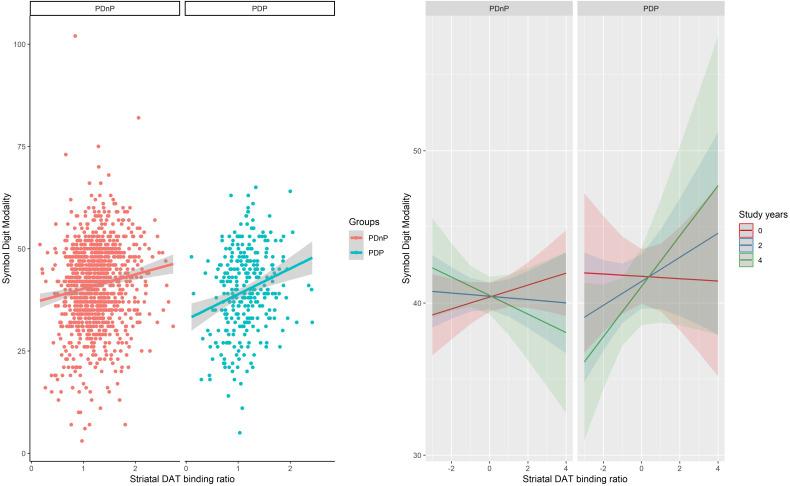
纹状体结合率下降与帕金森病精神病患者符号数字模式测试成绩加速下降相关,但与蒙特利尔认知评估量表(MoCA)成绩无关。
Decline in striatal binding ratio associated with accelerated decline in performance on symbol digit modality but not MoCA in Parkinson's Disease Psychosis.
作者信息
Pisani Sara, Velayudhan Latha, Aarsland Dag, Ray Chaudhuri Kallol, Ballard Clive, Ffytche Dominic, Bhattacharyya Sagnik
机构信息
Psychosis Studies, King's College London Institute of Psychiatry Psychology & Neuroscience, London, UK.
Psychological Medicine, Centre for Healthy Brain Ageing, King's College London Institute of Psychiatry Psychology and Neuroscience, London, UK.
出版信息
BMJ Ment Health. 2025 Mar 31;28(1):e301430. doi: 10.1136/bmjment-2024-301430.
BACKGROUND
Cognitive deficits and reduced dopamine transporter (DAT) binding ratio have been reported in Parkinson's disease psychosis (PDP). However, it remains unclear whether DAT striatal binding ratio (SBR) may contribute to worsening cognitive performance in PDP.
OBJECTIVES
We examined this using data from the Parkinson's Progression Markers Initiative.
METHODS
We analysed data from 392 PD patients, from baseline to year 4 follow-up, and classified patients into PD with psychosis (PDP) and without psychosis (PDnP). DAT SBR was available from I-FP-CIT-SPECT [(123) I-2β-carbomethoxy-3β-(4-iodophenyl)-N-(3-fluoropropyl) nortropane single photon emission computed tomography] imaging. We examined all cognitive measures assessed at each time point; sociodemographic characteristics, neuropsychiatric and PD-specific symptoms were entered as covariates of interest.
FINDINGS
PDP patients had lower DAT SBR compared with PDnP patients (b=-0.092, p=0.035) over all time points, which remained significant after controlling for age, sex and ethnicity. PDP patients also reported worse trajectory of task performance on the Montreal Cognitive Assessment (MoCA) (b=-0.238, p=0.001) and symbol digit modality (b=-0.534, p=0.016) compared with PDnP patients. Declining performance in symbol digit modality (Group×Time×DAT SBR interaction, b=0.683, p=0.028) but not MoCA was differentially associated with the decline in DAT SBR over time. MoCA scores declined more in PDP compared with PDnP patients over all timepoints (Group×Time interaction, b=-0.284, p=0.016).
CONCLUSIONS
Decline in striatal presynaptic dopamine function may specifically underlie longitudinal decline in performance in the symbol digit modality task that engages processing speed, associative learning and working memory in PD psychosis. Whether striatal presynaptic dopamine changes explain accelerated longitudinal decline in other cognitive domains in people with PDP remains to be tested.
背景
帕金森病精神病(PDP)患者存在认知缺陷且多巴胺转运体(DAT)结合率降低。然而,DAT纹状体结合率(SBR)是否会导致PDP患者认知功能恶化仍不清楚。
目的
我们利用帕金森病进展标志物计划的数据对此进行了研究。
方法
我们分析了392例帕金森病患者从基线到随访4年的数据,并将患者分为患有精神病的帕金森病(PDP)患者和未患精神病的帕金森病(PDnP)患者。DAT SBR可通过I-FP-CIT-SPECT[(123)I-2β-甲氧基羰基-3β-(4-碘苯基)-N-(3-氟丙基)去甲托烷单光子发射计算机断层扫描]成像获得。我们检查了每个时间点评估的所有认知指标;社会人口统计学特征、神经精神症状和帕金森病特异性症状作为感兴趣的协变量纳入分析。
结果
在所有时间点上,PDP患者的DAT SBR均低于PDnP患者(b=-0.092,p=0.035),在控制年龄、性别和种族后,该差异仍具有统计学意义。与PDnP患者相比,PDP患者在蒙特利尔认知评估(MoCA)(b=-0.238,p=0.001)和符号数字模式测试(b=-0.534,p=0.016)中的任务表现轨迹也更差。符号数字模式测试中的表现下降(组×时间×DAT SBR交互作用,b=0.683,p=0.028),但MoCA测试中的表现下降与DAT SBR随时间的下降无差异相关。在所有时间点上,PDP患者的MoCA评分下降幅度均大于PDnP患者(组×时间交互作用,b=-0.284,p=0.016)。
结论
纹状体突触前多巴胺功能下降可能是帕金森病精神病中涉及处理速度、联想学习和工作记忆的符号数字模式任务表现纵向下降的特异性原因。纹状体突触前多巴胺变化是否能解释PDP患者其他认知领域的加速纵向下降仍有待验证。

 Zotero 插件